 |
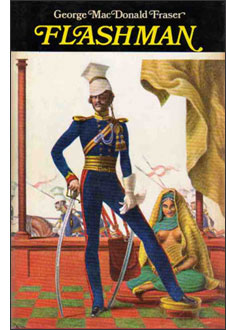 Edited and Arranged by
George MacDonald Fraser
Flashman: From the Flashman Papers 1839-42
Reviewed by: Dustin Kenall © 2009
Penguin / PlumePlume
US Trade Paperback Reprint
ISBN-10: 0452259614
Publication Date: August 1, 1984
256 pp. ; $12 (used)
Review Date: February 7, 2009
Index:
General-Fiction
When British author George MacDonald Fraser died a year ago last month, he bequeathed the world a literary legacy as richly mixed and disturbing as that of the Victorian Empire of which he wrote in over a dozen books in the voice of its most charming, charismatic, cunning, devious, womanizing, racist emissary, Harry Paget Flashman. Behold the 19th-century's template for Tony Soprano and Vic Mackey — the unscrupulous but lovable rogue who, almost impossibly, invites our contempt while demanding our affection. "Good" only in the most relative of terms in comparison to his contemporaries, organizational and political men conspicuously bereft of the virtues of good judgment or independence of will, Flashman, though a self-avowed scoundrel, outshines the nabobs whose incompetence destroys lives on a massive, institutional scale. By contrast, Flashman limits his depredations to the personal level — drunkenness, battery of natives, rape — which, for all their contemporary horror, are dwarfed by the killing fields on which the British Army and its colonial foes play. Gazing into the past century through the eyes of this English dastard, Fraser found the seeds of folly for the next.
The reader first encounters Flashman as he, literally, staggers drunkenly onto the page in the first novel of his name covering the period 1839-42. At this time, Flashman is finishing boarding school. He is peremptorily ejected when the headmasters discover him sneaking into campus inebriated from a bender. What is a headstrong, lower gentry scion to do while he waits to come into his father's income but purchase a commission in the Royal Regiments. And so he does, but not before dallying with his father's new mistress. Flashman is either born a century too soon, never to see to the 1960s' sexual frivolity or craze for antiheroes, or a decade too late, missing the decadence of the Regency and having to settle for the drudgery of Victoriana.
Perhaps that's why, after various episodes involving a duel over a French courtesan and the shotgun marriage to a Scottish industrialist's daughter, Flash departs the sceptred isle for the Empire over the seas, arriving in India demoted to the service of the India Company. He finds himself embroiled in the Afghanistan campaign, wherein he discovers unique talents but confirms his susceptibility to vice — as when, offered the bed of a belly-dancer by a local Afghan warlord, he eagerly accepts without regard to her consent. "I managed to rape her — the only time in my life I have found it necessary, by the way. It has its point, but I shouldn't care to do it regularly. I prefer willing women." Yet with perfect equanimity (and remarkable self-awareness) Flashman can later read a letter from his wife:
'To my most beloved Hector,' and I thought by God she's cheating on me, and has sent me the wrong letter by mistake. But in the second line was a reference to Achilles, and another to Ajax, so I understood that she was just addressing me in terms which she accounted fitting for a martial paladin; she knew no better. It was a common custom at that time, in the more romantic females, to see their soldier husbands and sweethearts as Greek heroes, instead of the whoremongering, drunken clowns most of them were. However, the Greek heroes were probably no better, so it was not so far off the mark.
To be clear, both Fraser and Flashman underplay the rape scene and later scenes where the victim reappears, appearing as a crazy harpy rather than a genuinely wronged person. Fraser's casual treatment of the suffering of women by such predatory, entitled 19th-century males earned him a deserved reputation as a misogynist. Rape, in Flashman's and until late in even Fraser's time, was considered a venial sin and the expected lot of women, as it remains in many parts of the world today. What's interesting, however, is how frankly Fraser couldn't be bothered by modern liberalism, so enchanted is he by nostalgia for the patriarchal mores of the British Empire. What's even more interesting is how enchanted thoroughly modern readers are of Flashman (12 books and a movie!), whether in oblivious escapism or in meta-fictional engagement with the work's contemporary cultural dissonance.
Some of this should be credited to Fraser's skill as a raconteur. The writing is crisp, alert, à point. Flashman's memoirs may constitute picaresque tales of pulp-adventure plotting but they also provide a tour through the historical back alleys of imperialism and colonialism. The disastrous retreat of the British Army from Kabul resonates with special force today, a warning on the folly of grand enterprises and wishful thinking.
Possibly there has been a greater shambles in the history of warfare than our withdrawal from Kabul; probably there has not. Even now, after a lifetime of consideration, I am at a loss for words to describe the superhuman stupidity, the truly monumental incompetence, and the bland blindness to reason of Elphy Bey and his advisers. If you had taken the greatest military geniuses of the ages, placed them in command or our army, and asked them to ruin it utterly as speedily as possible, they could not — I mean it seriously — have done it as surely and swiftly as he did.
Perhaps the trait that redeems Flashman to our modern sensibilities is his complete immunity to this humbug and tripe, as when he observes of the army's general:
The last words I heard Elphy say were: it is really too bad. They should be his epitaph; I raged inwardly at the time when I thought of how he had brought me to this; now, in my maturer years, I have modified my view. Whereas I would have cheerfully shot him then, now I would hang, draw and quarter him for a bungling, useless, selfish old swine. No fate could be bad enough for him.
For all the swashbuckling and derring do of Flashman's story, Fraser cannot be reprimanded for omitting the most damning failures of his age: the ubiquity of poverty, the duplicity of public and private interests, the endurance of ignorance, and the triumph of greed, hate, and cruelty. Fraser peppers his writing with racist language for historical authenticity, but in view of his sympathetic depiction of the suffering of the Afghani natives due to the incompetence and indifference of the British Army, it might be fair to extend him the license extended Huck Finn. And, in light of his choice of how Flashman gets his comeuppance in the last page of the novel, Fraser might even be due a little redemption. Fraser might have died a conservative reactionary, but he wrote fiction with a liberal's secret guilt.
|
|


















