Alfred A. Knopf / Random House
US Hardcover First Edition
ISBN 978-0-307-26918-8
Publication Date: 09-22-2009
412 Pages; $27.95
Date Reviewed: 10-03-2009
We live in two worlds; the world of our emotions and the world of facts. They're so intimately intermingled that it's hard and not especially helpful to try to tease the two apart. It's also in our nature to try to do just that. The world of facts compels us to reduce everything to a fact, to slice and dice our lives into neat compartments, some of which might just happen to contain feelings. As it happens, emotions and feelings, and even the facts themselves, are not necessarily amenable to logical arguments. There is senseless pain in this world, and tragic loss, there are facts of death and disease and divorce that no other facts can quite counterbalance. We need something more than the facts to sustain us because we are something more than mere facts.
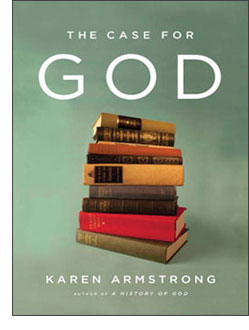
Twenty thousand years ago, Karen Armstrong tells us in 'The Case for God,' humans began to address needs that went beyond the facts of their existence. They created elaborate underground shrines in the caves of Lascaux, France. It was an evolutionary leap that helped to define us as human. In 'The Case for God,' Karen Armstrong argues that religion and spirituality are essential facts of what makes us human, facts that will not easily yield to factual examination. That paradox and how it has played out through history form the core of a book that may literally un-kink your mind and help you embrace the paradox at the core of who and what we are.
For an author quite concerned with examining the ineffable, Armstrong writes with precision and logic. She takes readers through the history of our relationship with religion, from its earliest incarnations to the polyglot, divisive and dangerous arguments that characterize religion today. Her writing is elegant and her prose is clear. But most importantly, Armstrong is a master of building prose effects, or setting the reader's mind in motion with gorgeous, smart sentences that will change the way you think, and change the way you view the world. The prose is dense and often quite intense. Reading 'The Case for God' is literally a mind-altering experience that describes mind-altering experiences.
Armstrong's observations of what religion was before the Enlightenment, and how the introduction of scientific thought changed our relationship with religion are gripping stuff. Along the way, she debunks cherished perceptions on both sides, for example showing Galileo to be more of a victim of his own hard-headedness than an innocent scientist sacrificed to ignorant religious dogma. The original readings of scriptures are examined, as are the birth of militant atheism and evangelical, fundamentalist religions. Armstrong manages to apply logic with a light touch, never losing the emotional core of her argument for the compassion she sees at the core of religious beliefs. At times, her approach to and visions of the divine are reminiscent of both H. P. Lovecraft and Stanislaw Lem; she firmly believes there is something beyond our comprehension that draws our attention to our own inner humanity. Call it what you like; it makes us human.
But also what makes us human is the process of reading. A large portion of this book looks at the way we read texts both spiritual and scientific, and suggests that we need to go beyond a daily recitation of the facts and engage in a dialogue with the texts we read. The depth of her writing and careful arguments in her prose draw the reader to just such a relationship with this book itself. Reading 'The Case for God' may or may not change your perception of religions and science, but it will certainly change your perceptions about the power of text — and the power of the readers who interpret that text every time they pick up a book.
New to the Agony Column
10-16-12: Commentary : Karen Armstrong Makes 'The Case for God' : Precisely Ineffable
10-11-12: Commentary : Worth Your Valuable Reading Time : Settle In For (Dis)Comfort Reading
Agony Column Podcast News Report: SF in SF Panel Discussion, September 15 2012: Roz Kaveney, Malinda Lo, Cindy Pon, Moderated by Rick Kleffel : "I'm a little bit of a namedropper." - Roz Kaveney
10-10-12: Commentary : Ramsey Campbell Finds 'The One Safe Place' : Nowhere
10-05-12: Commentary : Joann Rose Leonard Reveals 'The Healer of Fox Hollow' : Rural Magic Realism
Agony Column Podcast News Report: A 2012 Live Interview with Joann Rose Leonard at Capitola Book Cafe : "...how our beliefs color and change how we think about things..."
Agony Column Podcast News Report: Podcast Update: Time to Read Episode 68: Robert D. KaplanThe Revenge of Geography: What the Map Tells Us About Coming Conflicts and the Battle Against Fate
10-02-12: Commentary : Ruth Rendell Finds 'A Fatal Inversion' : Reading as Memory
Agony Column Podcast News Report: Malinda Lo Reads from 'Adaptation' at SF in SF on September 16, 2012 : "I'll begin with the epigraph, which is from Charles Darwin's The Origin of Species."
10-01-12: Commentary : D. T. Max is Haunted by 'Every Love Story Is A Ghost Story' : David Foster Wallace Writ Well
Agony Column Podcast News Report: A 2012 Interview with D. T. Max : "...for me there was a really funny, strange opportunity to write a biography about someone who listened to the same music as me."