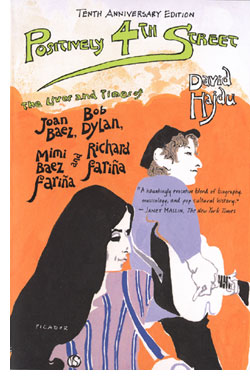
07-18-12:Archive Review: Positively Fourth Street: The Lives and Times of Joan Baez, Bob Dylan, Mimi Baez by David Hajdu
Time Capture
Editor's Note: I'll be in LA for much of this week, gathering audio for some new interviews. Here's a non-fiction pick from the archive, now restored to the new site, and a fine title as well. As a reader, I often find that music I listen to while reading (almost always instrumental) can change the reading experience. In this case, the reading experience will change your listening experience and have you excavating material from your own musical archive to listen with a new perspective. New perspective are what reading is all about; you cannot buy them, you can only read your way into them, which is why it is important to keep your books around for re-reading.
There are points in time, and places on this earth where for a few moments, days, weeks, or years, people who are destined to change things, people who are destined for fame, come together as mutual unknowns. Call it the "I knew you when" phenomenon. David Hajdu's 'Positively Fourth Street' captures that moment for Joan Baez, Bob Dylan, Baez's sister Mimi Farina Baez and Richard Farina. Through assiduous research and extensive interviews, big-time writer David Hajdu captures that moment perfectly, and has managed to get it all down in a readable book. His focus is so keen, his targets so concentrated that 'Positively Fourth Street' reads like an exciting, well-researched novel about the birth of folk music and the early 1960's in California. He actually manages the feat of making this material into a page-turning soap opera of particularly high intensity.
It probably helps that the material is all there. Back in the late 1950's, folk music was struggling to become a culturally defining force in America. The musicians were also struggling to make a living. Baez, with her huge mane of hair and her gorgeous voice had always been a natural, but she felt no small amount of insecurity because her sister, Mimi, was generally considered more beautiful, if less talented. Dylan is portrayed as a rather ambitious, almost mercenary young man, as is Richard Farina. Everyone wants to get to the top of the ladder, and Joan Baez is there first. Unless you're intimately familiar with this little corner of history, you won't be able to read fast enough to find out what happens to this mix of talented and volatile personalities.
Hajdu cuts easily between background fills to set the scene and the soap opera that Dylan, the Baez sisters and Richard Farina managed to live. He pulls out incidents small and large from his interviewees, and brings in a cast of other famous names as they move through the lives of the principles. What he does best is to keep the tension high, and he's amply aided by the actual events. There was more than a bit of musical beds with this quartet and their entry and competition in the field of folk music was nothing less than fierce. Hajdu punctures some legends (Dylan's famous electric guitar appearance) and creates others (Dylan's ride with John Lennon is a scream).
Through it all, he keeps his focus on the primal quartet as they try to make art, money and use fame when it helps the program. He expertly tracks the reversal of fortune experienced between Baez and Dylan. It's a fascinating musical tragedy. He also gets in a fair bit about the business of music, from the clubs that found they turned a profit with folk to the musical producers and promoters who helped Dylan find his voice. The primary interviewees seem to be the Baez's, and the picture of Dylan is not massively flattering. It certainly helps add the element of surprise and anxiety to the narrative.
'Positively Fourth Street' also benefits from focusing on a tiny slice of time, from the late 50's to the early sixties. By keeping things concentrated, he allows the personalities to become more like literary characters, and never drops into dry recitation. 'Positively Fourth Street' is a compelling, fascinating book that happens to be true — but don't hold that against it.
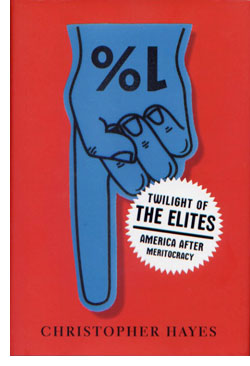
07-16-12:Christopher Hayes Greets 'Twilight of the Elites: America After Meritocracy'
Broken
"America feels broken," Christopher Hayes, Editor at Large for The Nation and host of MSNBC's Up w/Chris Hayes, tells us, as the opening of 'Twilight of the Elites: America After Meritocracy.' That's what we all know, and it's a good gambit to bring us in as readers, no matter what our political beliefs. It's a statement that feels right. The follow-up — to explain why, how it happened and what, if anything, we can do about it, and keep us reading, is much more difficult. Hayes is up to the task. In crisp, often personal prose, with carefully constructed arguments, good stories and a brisk sense of pacing, 'Twilight of the Elites' gets to the heart of what's wrong with a unique vision that combines cultural, historical, political and sociological analysis. In the process, Hayes sort of puts an arrow into the heart of the American Dream.
In 'Twilight of the Elites,' Hayes looks at a belief that is core to our understanding of how we are supposed to live in America, how that understanding misses the mark of what happens in the real world, and the serious consequences of the gap between belief and reality. He's smart, entertaining, and refreshingly agenda-free. While this is a book of social criticism, it does not criticize so much as clarify and analyze meritocracy, which on the face of it sounds like a pretty good idea; and Hayes concedes this — to a degree. What follows is fascinating and more than a little bit scary.
The basic idea behind a meritocracy is that you are appropriately rewarded for the combination of your talents and your efforts. Meritocracies like to test early and often, slot those who score well into advanced programs, and let them rise to the top. The idea is that we get those best suited for the job running the corporations and the country. That is indeed the system we're supposed to have in place in America, but it's not working out so well. Hayes undertakes a keen and intelligent analysis of the stories we've all seen in what he cleverly calls "the fail decade," and successfully sifts through them to find out the weaknesses hidden in the meritocratic system and suggest some remedies.
The first remedy is to question the infallibility of the meritocratic system. Hayes goes straight to his own experience at Hunter College High School. Hunter started out with simple idea; give students a test, and if they score high, admit them, and give them intensive training that will get them into the best colleges. The entry test was the proverbial "level playing field," until a cottage industry of test prep gave those who could afford the prep a means to game the system. It's a microcosm for what happens in all meritocracies.
But Hayes in no reductionist, and he examines a number of notable meritocratic failures with nuance and briskly paced prose writing skill. If you're looking for a heavy hand, look elsewhere; 'Twilight of the Elites' is an entertainingly nuanced vision. And while Hayes rummages through the rolodex of recent disasters with an alarming thoroughness, he also finds reasons for hope now and again. It's a very tricky business to give a refreshingly clear explanation as to why we feel as if the apocalypse has come to pass while we were not looking and then explain why this does not have to be the case without undermining what you've already established as a baseline. But 'Twilight of the Elites' manages the neat trick of showing us the dusk while reminding us that with luck and pluck we can live to see the dawn.
New to the Agony Column
09-18-15: Commentary : William T. Vollman Amidst 'The Dying Grass' : An Epic Exploration of Simultaneity
Agony Column Podcast News Report : A 2015 Interview with William T. Vollman : "...a lot of long words that in our language are sentences..."
09-05-15: Commentary : Susan Casey Listens to 'Voices in the Ocean' : Science, Empathy and Self
Agony Column Podcast News Report : A 2015 Interview with Susan Casey : "...the reporting for this book was emotionally difficult at times..."
08-21-15: Agony Column Podcast News Report : Senator Claire McCaskill is 'Plenty Ladylike' : Internalizing Determination to Overcome Sexism [Incudes Time to Read EP 211: Claire McCaskill, Plenty Ladylike, plus A 2015 Interview with Senator Claire McCaskill]
Agony Column Podcast News Report : Emily Schultz Unleashes 'The Blondes' : A Cure by Color [Incudes Time to Read EP 210: Emily Schultz, The Blondes, plus A 2015 Interview with Emily Schultz]
07-05-15: Commentary : Dr. Michael Gazzaniga Tells Tales from Both Sides of the Brain : A Life in Neuroscience Reveals the Life of Science
Agony Column Podcast News Report : A 2015 Interview with Michael Gazzaniga : "We made the first observation and BAM there was the disconnection effect..."
04-21-15: Commentary : Kazuo Ishiguro Unearths 'The Buried Giant' : The Mist of Myth and Memory
Agony Column Podcast News Report : A 2015 Interview with Kazuo Ishiguro : ".... by the time I was writing this novel, the lines between what was fantasy and what was real had blurred for me..."
Agony Column Podcast News Report : A 2015 Interview with Marc Goodman : "...every physical object around us is being transformed, one way or another, into an information technology..."
Agony Column Podcast News Report UPDATE: Time to Read Episode 199: Marc Goodman : Future Crimes: Everything Is Connected, Everyone Is Vulnerable and What We Can Do About It