As much as we are novel and non-fiction readers now, America is a nation that was defined first by the short story, and more specifically, the strange short story. Edgar Allen Poe, Nathaniel Hawthorne, and Washington Irving are among those who made us one nation under weird. It was in New England that H. P. Lovecraft found such fertile ground as to twist the minds of generations to follow, and in the quiet suburbs of Illinois and California, Ray Bradbury was haunted by the future and the past. Rod Serling re-defined the American myth with the help of Richard Matheson and George Clayton Johnson both in print and in the once futuristic medium of television.
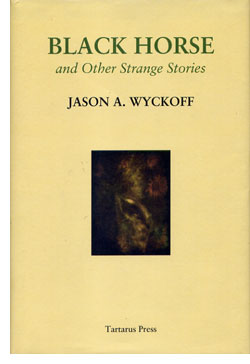
It's more than a bit ironic then, that noted British specialty publisher Tartarus Press is publishing Jason Wyckoff's 'Black Horse and other strange stories,' a miscellany of American Weird stories that would certainly feel right at home were one to have found them in Weird Tales. But for readers of the American Weird and Strange, and indeed, any sort of strange story, 'Black Horse' is good news. The sixteen stories in this volume offer a great example of the range possible in the American Weird story, and more than that, they're of uniformly high quality. Wyckoff is clearly a talented writer with an impressive imagination and an innate storytelling skill.
The stories here run the gamut of weird fiction. In "The Highgate Horror," Joe Ishler finds what appears to be a small hole in the fabric of his cubicle; from it emerge insects like no other he has ever seen. The hole proves to be much more problematic than Joe first presumes, as a science fiction underpinning leads to personal dissolution. The visionary vistas belie a psychological despair. A number of the stories feature disturbing portraits of minds gone awry in the face of the unknown; two hikers make an unfortunate find in "Intermediary," while in the superb "Panorama," an artist documents a reality that is at odds with the one we inhabit. Wyckoff knows how to create compelling characters in the confined space of a short story and then undo them when they are confronted with the products of his imagination.
Humor is a key component of the American Weird Story, and it is well represented here. Alan Burke, in the Department of Development deals with Bill's Middy's unusual housing problem in "A Civil Complaint," and he's a character I'd like to see again. Vampires get an original vision in "A Matter of Mirrors," while "The Trucker's Story" has the real ring of 20th century Weird Americana. Wyckoff never repeats his riffs, characters or prose stylings from story to story, so the humor seems fresh.
Not all the stories are rooted in science fiction and the supernatural. "The Mauve Blot" and "A Willow Cat in Meadowlark" are more in the realm of the surreal. "Knott's Letter" is a heretical take on cryptozoology that will boil the blood of those in the field. On the other hand, "The Bells, and Then the Birds" follows the folklore behind song lyrics and finds that unfortunately, there is indeed a reality behind every story in song. The title story is a perfect piece of weird fiction, quiet, unusual and evocative of place and character as a young man inherits a black horse. It proves to be an unfortunate inheritance.
In every story, Wyckoff displays an intuitive understanding of the demands of form, no matter what that form is. "The Night of His Sister's Engagement," for all its American feel, is a perfect example of the "strange story" style of Robert Aickman, and for that matter, Ray Bradbury. "An Unseen Hand" offers truly unique terror in the subway. It's short and very creepy. The more straightforward supernatural stories, "The Walk Home," "Raise Up the Serpent," and "Hair and Nails," mix smart prose and new angles even as they evoke the welcome familiarity of the American Weird.
'Black Horse and Other Strange Stories' may be something of a departure for Tartarus Press, but all the familiar quality of their work shows through. The literary quality is high, and the production values of the book itself are of course peerless. Readers looking for an original and entertaining voice in American Weird fiction — and proof that we can keep up with the rest of the world in this regard — need look no farther than this book. It's the sort of collection that you'll read slowly, deliberately, drawing out the pleasure on your porch in the long afternoons and haunted evenings.
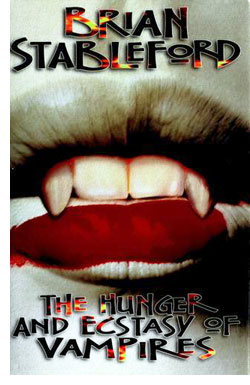
07-10-12:Archive Review: Brian Stableford Feeds 'The Hunger & Ecstasy of Vampires'
Vampire Anti-Series
Editor's Note: Brian Stableford was the first writer to bring me back to Vampires after a long time of ignoring the genre. 'The Empire of Fear', 'Young Blood' and this book, from a British publisher and more notably, the amazing Mark V. Ziesing, comprise a trio of very different visions of this critter. He'd follow it up with 'The Werewolves of London' trilogy, a magnificent story arc.
It's hard to write an original vampire novel. The field is so crowded with entries of all types — from SF to bodice-rippers, from punkettes to romantic poets — that to find a new niche in this overworked specialty category is quite difficult. The writer who seems most adept at this task is Britain's Brian Stableford, who's written three recent novels about vampires, all from very different perspectives. His "Empire of Fear" was a science fiction thought experiment set in the 16th century, while "Young Blood" was an existential examination of being, madness and disease. It was a message from the marketing department at his British publisher which resulted in his latest novel, "The Hunger & Ecstasy of Vampires". It seemed that they had deemed the title "Young Blood" was not catchy enough for the novel he had turned in, and they suggested something with the word "vampire" would be most appropriate. He suggested the title of the present novel, with a disclaimer that "the original title...was insufficiently sexy to hold its own in that perfervid hotbed of competition...". The marketing department yielded, "Young Blood" was published under its original title, and Stableford set forth to create a novel appropriate for his market-oriented title.
The result is a novel that begins in familiar territory but quickly journeys where no vampire novel has gone before. A duel of honor is fought before dawn in France, in 1894. A man is accidentally killed. A year later, the survivor is accompanying Oscar Wilde to a gathering being given by Professor Edward Copplestone. Attending the dinner are characters both real and assimilations of fictional and real characters. Professor Copplestone, clearly ill, gives his report on a drug-induced hallucination he experienced which may have been time travel. In three separate visits or visions, he traveled a future earth where humanity has been overrun by vampires.
Stableford does much more than create another alternate history novel, or steampunk adventure. In "The Hunger & Ecstasy of Vampires", he examines the character as a narrative device, and plays off his characters and the mystery of who they might be in a manner reminiscent of Stanislaw Lem or Philip K. Dick. He explores his possible realities with a remarkable Victorian vision, focusing everything through his own extensive historical and literary knowledge. Copplestone's visits to the future are remarkably well-rendered, and include some astonishing imagery. Stableford subtly pays heed to recent developments in nanotechnology and genetic engineering without being overbearing about it.
Central to the novel is the mystery of just who is sitting around this table listening to Copplestone's tale. Stableford mixes his fictional and real characters with perfect ease, while he peppers the text with informed speculation. For fans of Victorian SF and scientific romance, it's a feast of imagination. "The Hunger & Ecstasy of Vampires" is the third totally original vampire novel that Brian Stableford has written, in a sort of anti-series. For readers who like their vampire fiction imaginative, Stableford's anti-series is a breath of fresh air.
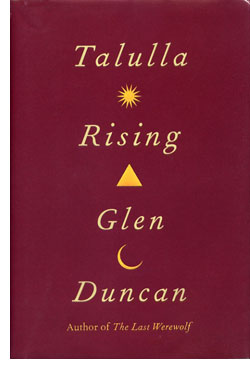
07-09-12:Glen Duncan Hails 'Talulla Rising'
Appropriate Responses
Glen Duncan's 'The Last Werewolf' was a highlight of last year's reading, an outstanding new take on a well-worn supernatural trope. Happily Duncan announced at the time it was the first of a trilogy, and now the second book in the series, 'Talulla Rising,' has arrived. 'Talulla Rising' can be read on its own, but the merits that make that possible also make it a superior second book in a trilogy, always a tricky proposition. If you're reading this review and you have not read the first book, do so; your only regret will be not having done so last year.
Talulla Demetriou, who tells the story, is raw, rough and angry. As the novel begins, she's pregnant and in hiding from vampires and WOCOP, the human hunters in charge of thinning the supernatural herds. In a trice, things go from bad to worse; worse even than Talulla can imagine, let alone predict. Now, she and her child are in danger from everyone in their general vicinity. She must hunt the hunters and the vampires, literally a lone wolf taking on those whose names might as well be legion, and the legions behind them. Readers will be quickly aware that there will be a lot of blood, a lot of violence, a lot of action and that the hearts we encounter are as likely to be ripped still beating from the chests of those who bore them as they are to be figurative metaphors for love and affection.
'Talulla Rising' is heavily and well plotted. Unlike many middle books in trilogies, it does spectacularly well in having a real beginning and a strong ending, while maintaining continuity between 'The Last Werewolf' and the third book in the series, at this point titled 'By Blood We Live.' Essentially the book is a chase scene, with Talulla on the run in the beginning and on the trail of those who would do her and those she loves harm soon after. Motives click, plans are revealed, and Duncan does a creditable job of opening up his supernatural universe. The vampires are waging an internecine war against a vampiric religious cult that has designs on Talulla, while the human hunters are also engaged in a fight between two rival factions with different approaches to the supernatural. The threads are intricately and well woven between smashing set pieces. This book is every bit the page-turner that 'The Last Werewolf' was.
Of course, plot was not the only or even the major draw of that novel; it was the narrative voice of Jake Marlowe. It didn't matter what he was on about or what was happening, Jake Marlowe had the sort of quirky black humor that made reading fun. Talulla Demetriou, who narrates this book, is not Jake, or even, very much like him, but she's just about as much fun to read. Where Jake was world-weary and bored, Talulla is raw and sexually alive, engaged in every moment with a sensuous arrogance that in many ways is the polar opposite of Jake's narrative style. That said, the feel of the two novels is similar in that both protagonists are in conflict with pretty much the entire world around them. Talulla is way, way, over the top so far as her outspoken and outgoing sexuality are concerned. It's a style choice, not a turn-on, and consistently entertaining and well done.
The characters who return from the last novel and those we meet here are a thoroughly entertaining bunch to spend time around. Duncan creates a villain every bit the match for his heroine, and lines up others in the queue who are charming where this gent is, well, awful. We see some interesting developments with regards to the on-going battle between humans and vampires and Talulla. Duncan's a canny writer, and he gives us new characters in this novel that we clearly are meant to and do anticipate seeing in the finale.
'Talulla Rising' is more than an entirely enjoyable and effective sequel to 'The Last Werewolf.' Like that novel, this one is filled with great sentences and witty, pithy explorations of what is means to be human by way of being inhuman. Duncan uses the elements of the fantastic to give us a ringside seat not just on the battle between vampires and werewolves, but as well the conflict between men, women and every day of the lives we are allowed to live. As we find the heart of each day, it is best consumed still beating, fresh, filled with blood.
New to the Agony Column
09-18-15: Commentary : William T. Vollman Amidst 'The Dying Grass' : An Epic Exploration of Simultaneity
Agony Column Podcast News Report : A 2015 Interview with William T. Vollman : "...a lot of long words that in our language are sentences..."
09-05-15: Commentary : Susan Casey Listens to 'Voices in the Ocean' : Science, Empathy and Self
Agony Column Podcast News Report : A 2015 Interview with Susan Casey : "...the reporting for this book was emotionally difficult at times..."
08-21-15: Agony Column Podcast News Report : Senator Claire McCaskill is 'Plenty Ladylike' : Internalizing Determination to Overcome Sexism [Incudes Time to Read EP 211: Claire McCaskill, Plenty Ladylike, plus A 2015 Interview with Senator Claire McCaskill]
Agony Column Podcast News Report : Emily Schultz Unleashes 'The Blondes' : A Cure by Color [Incudes Time to Read EP 210: Emily Schultz, The Blondes, plus A 2015 Interview with Emily Schultz]
07-05-15: Commentary : Dr. Michael Gazzaniga Tells Tales from Both Sides of the Brain : A Life in Neuroscience Reveals the Life of Science
Agony Column Podcast News Report : A 2015 Interview with Michael Gazzaniga : "We made the first observation and BAM there was the disconnection effect..."
04-21-15: Commentary : Kazuo Ishiguro Unearths 'The Buried Giant' : The Mist of Myth and Memory
Agony Column Podcast News Report : A 2015 Interview with Kazuo Ishiguro : ".... by the time I was writing this novel, the lines between what was fantasy and what was real had blurred for me..."
Agony Column Podcast News Report : A 2015 Interview with Marc Goodman : "...every physical object around us is being transformed, one way or another, into an information technology..."
Agony Column Podcast News Report UPDATE: Time to Read Episode 199: Marc Goodman : Future Crimes: Everything Is Connected, Everyone Is Vulnerable and What We Can Do About It