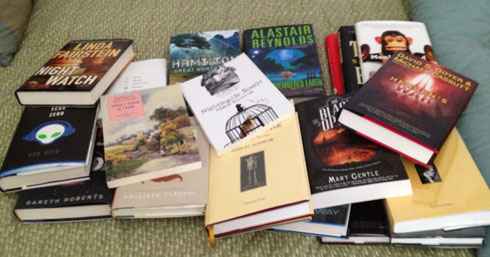
While the quality of other forms of entertainment seems to plummet downward faster than one might think possible, the reverse is actually true for books. I actually have two, no, make that three huge stacks of books of all varieties behind me that are more than worth your valuable reading time. I'll try to cover as many as I can, and try to group them as sensibly as I can.
Because I cover science fiction at all, to many this is an "SF website." Of course, because I don't cover only science fiction, to many in the SF world I'm invisible. That said, there is a lot of great science fiction in the written world, if not anywhere else. "Science fiction" covers a lot of territory, but it is most commonly associated with what those who read in the genre call Space Opera, grand tales of adventure in the whole wide universe; Kim Stanley Robinson's '2312,' recently reviewed here, with an author interview, is a perfect example of this form. But Robinson's not alone this summer, and three of my favorites have new books out now or on the way.
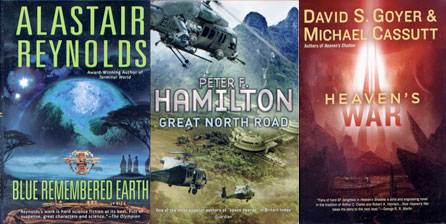
Alastair Reynolds is the reason I even read science fiction now; it was his first novel 'Revelation Space' which re-opened my interest in science fiction a little more than a decade ago. His newest novel is 'Blue Remembered Earth,' (Ace/Penguin Putnam ; June 5, 2012 ; $26.95), set one hundred and fifty years in a rather utopian future. Geoffrey Akinya would prefer to remain on earth, but finds himself drawn into space by family ties. Expect subtle characterizations, remarkable future-building and authentic space wonder on an ever grander scale as the story builds out across three volumes. To my mind, Reynolds is our most literary SF writer; his prose has a wonderfully detailed feel.
Peter F. Hamilton always plays the biggest game in town, and 'Great North Road' (Pan McMillan ; September 27, 2012 ; £20) tops out at 1088 pages. Hamilton's novel is set 130 years in the future, in Newcastle-Upon-Tyne and on the planet St. Libra. Murder on earth in the present echoes murder in the past on the planet, and Detective Sidney Hurst finds himself embroiled in politics and aliens. Both are deadly. 'Great North Road' is a standalone novel, not connected to any of Hamilton's previous universes or series, and it plays to his two greatest strengths; science fiction mysteries and humans on an alien planet. Expect a huge cast of colorful characters and lots of page-turning tension. This is the sort of book to make your world go away.
As far as series fiction goes, we have the much-anticipated 'Heaven's War' (Ace / Penguin Putnam ; June 5, 2012 ; $25.95) by David S. Goyer and Michael Cassutt, the sequel to 'Heaven's Shadow.' You'll definitely want to read 'Heaven's Shadow' first; it's a superb story of first contact, which in this sequel becomes even richer and more fraught with terror and tension. Cassutt spent a good deal of time talking to astronauts, which informs the characters as well as the tech. Goyer (Batman Begins) knows how tell a riveting story, but bear in mind you won't know who wrote what; the collaboration is seamless. They're also quite adept at the visionary side of science fiction as well, and they manage to evoke both wonder and terror. They also got this book out on time, which suggests they'll finish the series on time as well.
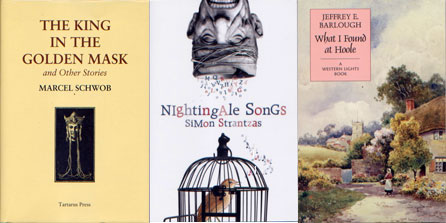
Readers looking to bring a chill to the summer need look no farther than Tartarus Press, where the latest work to my hands is 'The King in the Golden Mask and Other Stories' (£32.50) by Marcel Schwob (1867-1905), which collects from a writer famous in France but little-known in the English speaking world. Schwob, known as a Decadent, was influenced by Poe and Stevenson, and was himself arguably an influence on Borges. His stories are steeped in darkness, written with a steely formality and wrought in pain. 'The King in the Golden Mask' has all the usual amenities found from Tartarus Press titles; fine production, a stellar introduction by the translator, and work that is strange but of the highest quality. Reading it is the literary equivalent of visiting a museum in the hours after it closes. Shadows move; the curtains whisper your name and you are not sure if you are awake or dreaming.
Fine dark fiction is not just found in the UK; here in the US you can pick up 'Nightingale Songs' (Dark Regions Press ; January 2012 ; $17.95) by Simon Strantzas for a song and be rewarded with a superb collection of so-called "strange stories." This appellation is not deliberately vague; it's a spot-on description of the territory covered herein, as rich as life and death. Strantzas has a great feel for the suburbs, and he uses it wisely to evoke an otherworldly life in the midst of quotidian reality. Even as we drive our cars, go to work, live our daily lives, we are immersed in the unreality of emotions and perceptions that cannot be explained. Strantzas captures the ineffable with an astonishing ease. Dark Regions puts all this in a superbly published trade paperback. It's quite a dark joy to read.
I've been reading the work of the quite mysterious Jeffery E. Barlough since his first novel, 'Dark Sleeper' was published in 2000. In it, he created a peculiarly dark and lovely world, a sort of Victorian England in Arizona after what he calls "the sundering," vaguely referred to but never really described. The novels are a wonderfully wrought combination of Dickensian language and plots with Lovecraftian elements woven through Barlough's intricately constructed otherworld. The latest novel is 'What I Found At Hoole,' (Gresham & Doyle ; November 1, 2012 ; $14.95), and is a direct sequel, of sorts, to the second novel in the series, 'The House in the High Wood.' Dark goings-on in landscapes and townships both familiar and strange; delightful, light humor mixed with terror so dark and strong it barely admits to existence. Barlough is utterly unique and priceless. The books are as well.
All these choices and we have barely begun to read. Readers of the column, please have patience as I am working on a backup system while the main computer is being repaired. But have no worries, I will still take time to read — and report to you the results.
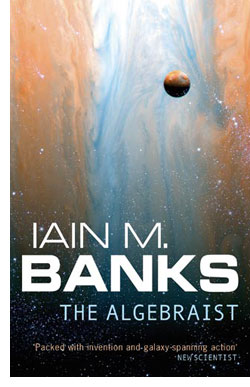
06-26-12:Archive Review: Iain M. Banks 'The Algebraist'
Wit and Wonder
Editor's note:
Iain M. Banks writes the kind of science fiction that holds up over the years. Here's a novel with lots of great scenes that are fun to dip into again and again. Humor is a highly underestimated aspect of exploring the universe at large! And yes, check out the Night Shade Books Edition if you're in the US.
I suppose that everyone has gaps in their reading, authors they'd love to have read but have not yet got round to. I grew tired of science fiction in the 1980's and didn't really return to the genre with any enthusiasm until the late 1990's. The authors who first really caught my eye — Alastair Reynolds and Peter F. Hamilton with their great cranking space operas — both mentioned Iain M. Banks as a primal influence. But by that time, Banks' Culture series was well under way. Though I bought the first couple of entries, both as trade paperbacks and even, more recently, in a first edition hardcover, I never got round to actually reading the work of the writer who cast such a large shadow on my new favorites.
Thanks then to Iain M. Banks himself, who neatly solves the problem for me and others like me with his most recent novel, 'The Algebraist'. Finally I get to see what all the fuss is about. In a word (or two): great writing. Banks brings a huge imagination, vivid scenarios, head-spinning speculations, fascinating scientific information, in other words all the expected bits. But it's the unexpected that we really expect in a novel like this. That frisson of surprise, the shock of the new. What could be shocking in space opera, the genre that has everything in the universe? Sex? Nah, zero-g and inter-species, it's been done and overdone. Violence? Heck, George Lucas blew up planets nearly thirty years ago. It was a yawner then, it's more so now.
What about wit? Wit — true wit, actual smarts manifested in cleverly written prose, now that always manages to shock no matter how outré or bland the subject matter. Iain M. Banks will shock the heck out of you in 'The Algbraist' with nothing more than a sharp mind, and he'll do so continually, surprisingly and in ways that will make you laugh out loud. Now, funny science fiction isn't all that unusual. But Banks' humor is not the broad satire of writers like Douglas Adams. Banks manages to meld his sense of humor with his sense of wonder. The humor never undercuts the awe, but oddly enough, contributes to it. His characters, confronted with the ultimate don't just sit there with their jaws dropped. They make a joke. They bicker. They needle one another. And what could be better? If you must blow your mind, the least you can do is laugh.
'The Algebraist' begins — after some framing shots — with Archimandrite Luseferous, Executive High General of — well, what turns out to be a bunch of well-armed starships traveling nearly the speed of light to conquer Ulubis, an unarmed and relatively obscure portion of the civilized galaxy. In the system of Ulubis, Fassin Taak is a Slow Seer, a human who has been trained to speak to the Dwellers, a nearly immortal race of beings that live in the gas giants throughout the galaxy. An easily broken system of wormholes connects some of the Mercatoria, the civilized planets, and the wormhole to Ulubis was recently destroyed by Beyonders. A fleet from theMercatoria is heading to fix the wormhole. Soon, Fassin Taak finds that his ability to speak to the Dwellers has unleashed a series of events that threatens to overturn galactic civilization.
Banks quickly offers up some fascinating ideas and runs with them in 'The Algebraist'. The Dwellers, who experience time at a slower rate than humans and other races throughout the galaxy are a fascinating thought experiment. Banks lays out and layers his presentation of a civilized universe with consummate skill. One of the true pleasures of reading space opera is the reader's slowly unfolding understanding of the universe created by the author. 'The Algebraist' manages just the right combination of "what-the-hell?" and "oh-my-god!" revelations as to how things work in Banks' vision. Banks knows when to zoom in and knows when to pan out. He goes from microscopic to telescopic as the situation demands. Much science fiction uses the devices of mystery, carefully holding back information from the reader to keep them guessing as to the true nature of things. Banks does this so well, one suspects that he might have a fantastic mystery novel out there somewhere. The plot grips the reader in the opening and moves at a steady, entertaining clip.
But where Banks really shines is in his ability to evoke subtle, satiric swipes at the world we know within the universe he creates. Much of this is down to great characters and witty dialogue. From their description — ancient and slow — one might suspect that reading about the Dwellers could be a tedious business. But nothing is further from the truth. Banks is practically antic as Fassin Taak speaks with the ancient creatures, who offer some of the best space slapstick you're going to find this side of the 'Hitchiker's Guide'. But it's also utterly unlike the more typical broad satire readers are used to in science fiction. His humor comes out of character and dialogue, the satire out of his conceptual societal relation and the dialogue. Readers who pick a space opera only to escape will find that being reminded of the Real Word by a master of science fiction space opera can indeed be a pleasant experience.
Banks doesn't stint on the awe and wonder however, nor does he hold back from offering full-scale space battles that have yet another twist of imagination and invention. The set-pieces in this novel are exciting, visually grand and quite inventive. Though some of the characters do seem to get a bit of a short shrift in the grand scheme of things, Banks is good enough at misdirection to keep the readers' eyes where he wants them to be. If you've not read Banks — or recent space opera — then 'The Algebraist' is a fine place to begin. It successfully offers nothing less than universe - with a few well-placed laughs.
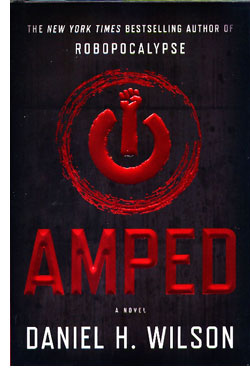
06-25-12:Daniel H. Wilson is 'Amped'
Civil iRights
Where will we draw the line between human and whatever it is that comes next? In what ways will our successors distinguish themselves from us, or we from them? Daniel H. Wilson's 'Amped' uses a classic science fiction literary technique to explore the emotional, legal, and societal impact of our inclination to define ourselves as human, and by doing so, exclude those who differ from ourselves. Wilson manages to elicit a lot of serious thought in the short space of an action-packed, engaging novel. 'Amped' is both entertaining and harrowing, a reminder of how often the future ends up repeating the past. Humans are ever so clever at learning new ways to make the same mistakes.
Before the novel begins, Wilson gives us his science fiction mcguffin, the "General Biologics Neural Autofocus MK-4," a brain implant that gives the recipient the ability to achieve more focused thought. It can help someone with ADD or PTSD live a normal life, or perhaps an even better than normal life. And it can confer upon someone who is normal a tremendous advantage over others. That's just the first of many problems, none of them with easy solutions. Wilson follows the manual for the MK-4 with the summary of a Supreme Court decision that declares those with this sort of hardware to not be a protected class. They can be legally discriminated against. And that's just page 5.
With this setup, we meet Owen Sharp, a schoolteacher whose father actually invented the MK-4, and installed an early model in Owen to cure him of epilepsy. It's his student who triggered the Supreme Court case, and helped to inspire the creation of a Pure Human Citizen's Council. The Supes' decision sends humans and "amps" into the streets, and Owen's father sends Jim to a refuge where amps try to keep themselves to themselves. It won't last long.
Wilson tells Owen's story in the present tense, and it's a tense tale, as the horror of oppression and institutionalized prejudice breaks out and tears apart families, friends and the nation. Amps and humans are headed for a violent clash, and Owen actually is someone who can make a difference. Maas violence seems inevitable, and readers will not be able to turn the pages fast enough to find out what is going to happen and why.
If it were merely an action-thriller, 'Amped' might be easily be competent and forgettable. But Wilson manages the difficult task of giving us a series of great characters and families who find themselves in the middle of a new struggle for civil rights. The character moments ring with sincerity, making the novel much powerful than you might expect. The perils they face are all-too real and relevant. Families pay a large part in what unfolds, as do the lower and middle classes. You do get a task force of military amps — they're veterans who have been shunted aside by the government that created them — but they're written more as homeless vets than military supermen. The focus in 'Amped' is on everyday Americans trying to come to grips with inevitable societal change.
Wilson's strong character work anchors the novel, but his ability to deuce the many implications of his single science-fictional invention is a constant source of delight and terror. Extremists on both sides of the divide create problems for everyone in the middle, as the legal and emotional ramifications of the technology unfold before our eyes. 'Amped' is a strong, smart, involving novel about the human addiction to human invention. As a very human invention, this novel itself is addicting. Be careful about when you pick it up, because it's hard to put down. It's fun even when it is very unsettling.
New to the Agony Column
09-18-15: Commentary : William T. Vollman Amidst 'The Dying Grass' : An Epic Exploration of Simultaneity
Agony Column Podcast News Report : A 2015 Interview with William T. Vollman : "...a lot of long words that in our language are sentences..."
09-05-15: Commentary : Susan Casey Listens to 'Voices in the Ocean' : Science, Empathy and Self
Agony Column Podcast News Report : A 2015 Interview with Susan Casey : "...the reporting for this book was emotionally difficult at times..."
08-21-15: Agony Column Podcast News Report : Senator Claire McCaskill is 'Plenty Ladylike' : Internalizing Determination to Overcome Sexism [Incudes Time to Read EP 211: Claire McCaskill, Plenty Ladylike, plus A 2015 Interview with Senator Claire McCaskill]
Agony Column Podcast News Report : Emily Schultz Unleashes 'The Blondes' : A Cure by Color [Incudes Time to Read EP 210: Emily Schultz, The Blondes, plus A 2015 Interview with Emily Schultz]
07-05-15: Commentary : Dr. Michael Gazzaniga Tells Tales from Both Sides of the Brain : A Life in Neuroscience Reveals the Life of Science
Agony Column Podcast News Report : A 2015 Interview with Michael Gazzaniga : "We made the first observation and BAM there was the disconnection effect..."
04-21-15: Commentary : Kazuo Ishiguro Unearths 'The Buried Giant' : The Mist of Myth and Memory
Agony Column Podcast News Report : A 2015 Interview with Kazuo Ishiguro : ".... by the time I was writing this novel, the lines between what was fantasy and what was real had blurred for me..."
Agony Column Podcast News Report : A 2015 Interview with Marc Goodman : "...every physical object around us is being transformed, one way or another, into an information technology..."
Agony Column Podcast News Report UPDATE: Time to Read Episode 199: Marc Goodman : Future Crimes: Everything Is Connected, Everyone Is Vulnerable and What We Can Do About It