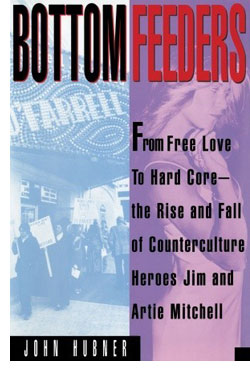
05-29-12:Archive Review John Hubner Nets 'Bottom Feeders'
Unclean Catch
Editor's note:
Here's another kind of American story, the Sleaze Epic, done up in great style by John Hubner. This was not the source of the Charlie Sheen movie, in you were wondering; but as a reading experience it is involving and quite unforgettable. You can likely pick up a nice hardcover version for a few bucks and settle up for some scuzzy summer fun.
The great American tragedy comes in all forms and happens at all levels of society. It's best when played out in public, most powerful when the participants are not gifted or insane, but ordinary people elevated by circumstance into the media arena. Few people could have started out more ordinary than career pornographers Jim and Artie Mitchell. The sons of an Antioch gambler, they were blue-collar boys with more ambition than talent, in-your-face hustlers with more luck than drive. John Hubner's "Bottom Feeders," the story of their rise and eventual fall, reads like a ballet of American sleaze, a carefully orchestrated true story that could only happen in San Francisco.
From the beginning, the two boys were inseparable. Hubner excels at evoking the down-and-dirty blue-collar environment of Antioch that spawned the Mitchell brothers. It was an environment they desperately wanted to escape. While Jim managed to make it to San Francisco State, college, Artie ended up in the Army. Jim was a film student who needed money, and the easiest money to be made was in "nudies," short, plotless exhibitions of sex recorded on 16 mm films and shown in theatres like the Roxie. Men were lining up around the block to see them. A couple of weeks later, Jim was walking up Ocean Beach with a still camera, looking for the right girl. He asked a bikini-clad beauty if she would let him take her picture with her top off.
"'We're looking for models, topless models. We couldn't pay you much, ten dollars maybe, but it wouldn't take very long. We could go over by the cliffs and take your picture right there. You'd be making lots of sailors real happy.'"
Hubner follows the Mitchell brothers' rise from stills to nudies, to porno loops to their first feature, 'Beyond the Green Door' in glorious, seamy detail. Their rise in the ranks of porno was accompanied by a series of fights in the courts for their First Amendment rights to exhibit their ware, and an increased and increasingly varied consumption of drugs.
It was the drugs that lead to the downfall, as both brothers became increasingly addicted and unstable. Jim escaped the downward spiral of cocaine addiction, but Artie never could. Hubner's vision of these events is largely untainted by bias either for or against the brothers. It is this even-handedness that lends the book its novelistic quality. "Bottom Feeders" is a beautifully written history of an ugly business.
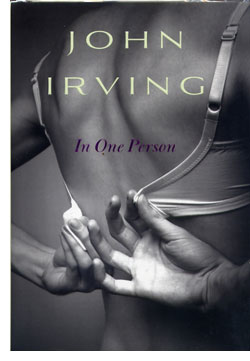
05-28-12:John Irving 'In One Person'
Multitudes
It's easy to meet Billy Abbott. You open John Irving's 'In One Person' and start reading. By the end of the first paragraph, you're immersed in the revelations of his first love, writing, and his other first love, the librarian Miss Frost. His imagination is born and without effort, you find yourself in First Sister, Vermont. It's 1961, and Billy is 13 years old. He imagines having sex with Miss Frost and he's re-reading Great Expectations. He never knew his father, but his grandfather plays women's roles in the local theater group. He's awash in a world of acceptable sexual ambiguity, and coming of age in a world that tolerates no sexual ambiguity.
But it is Billy Abbott of today who is telling the story. He already knows what will become of that young man we meet. He is what that young man has become. With a single voice, and really, just a single sentence, John Irving involves readers on an intimate level with one of the most memorable and complex characters they are likely to encounter. How the young Billy Abbott we meet on the first page becomes the man who tells his own story is a compelling mystery and history that is charming and edgy. Irving turns a not-so-ordinary life into a compelling portrait of a man, a nation and an era of changing sexuality. Billy is bisexual, a discovery he makes right in front of the reader's eyes. 'In One Person' is a bisexual bildungsroman.
'In One Person' spends more than half of the novel with Billy growing up in First Sister. Prepare to be engaged and entertained by Irving's wonderful first-person prose voice as Billy encounters a Dickensian cast of small-town sexual eccentrics. Irving manages a really remarkable balancing act with 'In One Person.' On one hand, it ventures well into territory that includes explicit sex, as Billy falls in love with both men and women, and might well be considered transgressive. But as Billy finds himself and his voice, he tells the story with such verve and heart that tenderness, not transgression is the primary response. Irving writes Billy's story with humor, but not as farce. Even in the face of a very dark future that readers know is to come, Billy Abbott's prose voice is one we want to hear.
Irving's plot is all about character, and since we love all the characters, even those who behave badly, 'In One Person' is a compelling quick novel to read. Irving intertwines timelines and stories seamlessly, telling the story in emotional, not chronological order. There are little arcs within the larger story, and many books within this single book. Readers who have a lingering self-awareness about reading will be rewarded with Irving's writing about reading, and about the joy of theaters and performances. The prose itself has the feel of a performance, and the prose tone is an essential plot point. When the AIDS epidemic arrives, late in the novel, we're prepared for the grim news, or as prepared as you can be when characters you care about find themselves in realistically written peril.
'In One Person' is probably not the novel you think it is, or the novel you are expecting. Given the timeliness of the topic, one might presume it to be a polemic, or to be overly explicit in a manner that could be off-putting to some readers. In fact, the opposite is true. Irving's charming characters embody the themes of the book, they live and breathe them. And these are not the only interests; irving returns to many of the tropes and themes that have haunted his other novels; those small New England towns, wrestling, love, plays, and writing.
The same engaging talent readers have enjoyed in his previous novels wrote 'In One Person,' and that talent is in top form. For all its political relevance and even power, 'In One Person' is a truly personal story. We care about Billy Abbott — enough to read the book twice, as Billy Abbott does with Great Expectations. Whatever your expectations are as you begin the novel, they will be both undermined and exceeded by the time you finish. 'In One Person' is the story of one Billy Abbott, yes, but it does as well, contain multitudes.
New to the Agony Column
09-18-15: Commentary : William T. Vollman Amidst 'The Dying Grass' : An Epic Exploration of Simultaneity
Agony Column Podcast News Report : A 2015 Interview with William T. Vollman : "...a lot of long words that in our language are sentences..."
09-05-15: Commentary : Susan Casey Listens to 'Voices in the Ocean' : Science, Empathy and Self
Agony Column Podcast News Report : A 2015 Interview with Susan Casey : "...the reporting for this book was emotionally difficult at times..."
08-21-15: Agony Column Podcast News Report : Senator Claire McCaskill is 'Plenty Ladylike' : Internalizing Determination to Overcome Sexism [Incudes Time to Read EP 211: Claire McCaskill, Plenty Ladylike, plus A 2015 Interview with Senator Claire McCaskill]
Agony Column Podcast News Report : Emily Schultz Unleashes 'The Blondes' : A Cure by Color [Incudes Time to Read EP 210: Emily Schultz, The Blondes, plus A 2015 Interview with Emily Schultz]
07-05-15: Commentary : Dr. Michael Gazzaniga Tells Tales from Both Sides of the Brain : A Life in Neuroscience Reveals the Life of Science
Agony Column Podcast News Report : A 2015 Interview with Michael Gazzaniga : "We made the first observation and BAM there was the disconnection effect..."
04-21-15: Commentary : Kazuo Ishiguro Unearths 'The Buried Giant' : The Mist of Myth and Memory
Agony Column Podcast News Report : A 2015 Interview with Kazuo Ishiguro : ".... by the time I was writing this novel, the lines between what was fantasy and what was real had blurred for me..."
Agony Column Podcast News Report : A 2015 Interview with Marc Goodman : "...every physical object around us is being transformed, one way or another, into an information technology..."
Agony Column Podcast News Report UPDATE: Time to Read Episode 199: Marc Goodman : Future Crimes: Everything Is Connected, Everyone Is Vulnerable and What We Can Do About It