Ask most booksellers, ask most authors (even those mentioned here, I'm guessing) and they will tell you that the short story collection is a non-starter; they don't, we are told sell. These days, they are generally created and sold by (what were once called) small press publishers in limited editions. And the odd conclusion sometimes seems to be that readers should neither look for nor buy them. But short stories make perfect palate cleansers to read between novels and works of non-fiction. At the moment, there are so many collections in my must-buy stack, I want to mention them before they sell out; and to my mind, they all should. There are a lot of terrific books out there. I'll have full reviews in the fullness of time, but if I were one of my own readers, I'd want to know about them now.
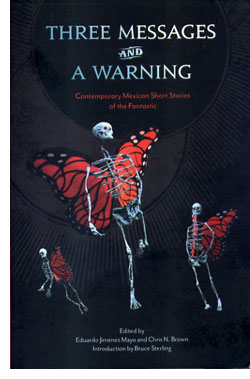
'Three Messages and a Warning: Contemporary Mexican Short Stories of the Fantastic' (Small Beer Press ; Trade Paperback ; $16), edited by Eduardo Jiménez Mayo and Chris N. Brown, with an introduction by Meister Bruce Sterling, is exactly what the title tells us and this proves to be a very good thing. With further introductions by Mayo and Brown, readers get a very nicely pixilated vision of what is to come before diving into this super-diverse collection of stories from all sides of the spectrum. As a reader, I like to mix it up often, and this book does a superb job of doing that for you. Ghost stories, science fiction, horror, fantasy parables, mainstream works with just a hint of the fantastic, Borgesian surrealism, you'll find it all here. A variety of translators kicked in, with the result that each story seems to have the right feel. There is at least one great story for all tastes here, and the feel of the new in all of them.
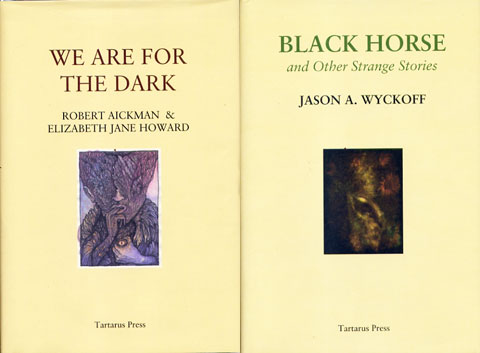
With 'We Are for the Dark' (Tartarus Press ; Limited Edition Hardcover ; £32.50) by Robert Aickman And Elizabeth Jane Howard, Ray Russell and crew bring back into print one of the long-lost giants of ghostly literature. First published in 1951, the stories inside were not attributed to one author or the other, and the thought was that all were collaborations. We now know that 'The Trains,' 'The Insufficient Answer' and 'The View' are from Aickman, while Howard wrote 'Perfect Love,' 'Three Miles Up,' and 'Left Luggage.' There's a reason the stories were thought to be collaborations; they're all excellent. 'We Are for the Dark' was and still is a not-to-be-missed collection.
I've mentioned 'Black Horse' by Jason A. Wyckoff (Tartarus Press ; Limited Edition Hardcover ; £32.50) in passing, and it deserves (and will get) a fuller accounting. But since, like all Tartarus Press books, it is limited to some mumble mumble copies, I'd suggest that if the idea of a brand new, modern Lovecraftian, and unique author appeals to you, Wyckoff is your man. Wyckoff goes far beyond Lovecraft of course; stories like "Panorama," about an artist's very disturbing masterpiece or "Intermediary," a snowbound tale of terror and guilt, are simply great writing. The works have a feeling of class and intelligence; it's a book you'll want to savor.
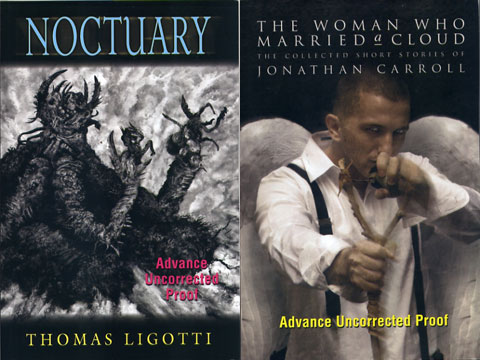
Subterranean Press continues its impressive reprints of Thomas Ligotti's indispensible work with 'Noctuary.' (Subterranean Press ; Deluxe Hardcover ; $45) Herein, you'll find some of his best work, from "Mad Night of Atonement" (a story that practically demands to be read aloud) to "The Medusa." This was a collection that broke ground when it was published and still creates a frisson of true fear. This version is greatly expanded and corrected to the degree that is almost seems to have little to do with the original version. It's appropriate for Ligotti's work to be transformed.
I can't find any news of a new Jonathan Carroll novel, sadly, but to get us through the dry spell, Subterranean Press has the huge (578 pages) collection of his stories, 'The Woman Who Married a Cloud' (Subterranean Press ; Deluxe Hardcover ; $45). It's an amazing bargain that contains two novellas, 'Black Cocktail' and 'The Heidelberg Cylinder' that would alone justify the price. Carroll is the one of the foremost practitioners of what might be called "American Magic Realism," but what it boils down to the reading level is great storytelling with a touches of the fantastic that seem imaginatively conceived beyond the mere conceits themselves. He's funny, poignant and willing to employ his talents to terrorize his readers now and again. Many of these stories ended up in or are tangential to his novels. He's not like any other writer out there, and this is a great way to explore the range of his work.
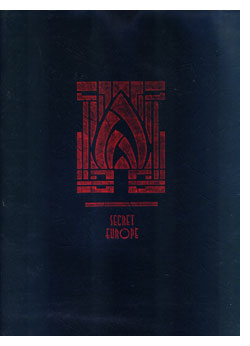
It may seem early, but I'd give odds on (were I the sort to make "best this" lists), that 'Secret Europe,' by John Howard and Mark Valentine (Ex Occidente ; Limited Edition Hardcover ; $160) would easily top any such list. This book is easily worth the cover price and more. 'Secret Europe' is a collection of invented histories from a Europe that is not the quite the continent we know. Valentine and Howard have remarkably similar tones, crafting stories that are poignant, powerful and very strange. This is a history of Europe in the early twentieth century as Jorge Luis Borges might mis-remember it, shining, vivid, subtly heroic and horrific. The prose and stories alone justify the price tag, so the incredible production values — it looks like a literary monument that came from the Europe it describes — make it all the more striking. Ex Occidente has made one of the most beautiful books that has ever crossed my hands. It's the sort of book that gets put on display. Valentine wrote to tell me that Ex Occidente is currently running a special that lets readers choose two other Ex Occidente books free if they buy 'Secret Europe.' I don't imagine there will be copies around for very long; it will become part of Ex Occidente's secret history, and part of the histories of those who read it. You will remember where you were when you read 'Secret Europe.'
04-11-12:Archive Review Ann Arensberg 'Incubus'
Suburban Surreal
Editor's note:
Editor's Note: Though it has been thirteen years since I read this novel, it stands out as a superb work of low-key, surreal horror fiction. Alas, the author has not gifted us with any work since, though at least two more were promised. I'd love to see her work in this terrain once again. Now it seems as if she was ahead of her time. The book is still available in trade paperback, and in hardcover used editions, and is well worth your valuable reading time.
Even horror novels written by women are not often written from a woman's point of view. Ann Rice and Poppy Z. Brite both seem more comfortable speaking from mouth of a feminine man. Other female writers who do create female leads — Charlee Jacob, for example — are not creating characters you would be likely to meet in a grocery store.
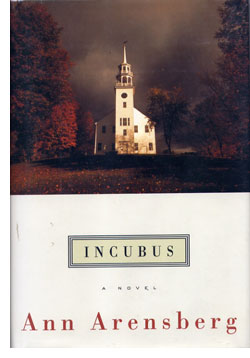
'Incubus', by Ann Arensberg is striking because its main character, Cora Lieber is exactly like someone you might meet in a grocery store, or at Back to School Night in the cafeteria. She is skeptical, intelligent, and above all, normal. She bakes, she cleans, she's the minister's wife in the small town of Dry Falls, Maine, and she's being hunted by extra-dimensional entities that are very interested in sex and terror. What makes this novel fascinating is its intermingling of the ordinary and the extra-ordinary and the very female voice that tells such an unusual story.
This novel is a feast of Fortean (that is weird and usual, as in Charles Fort) subjects and events, including the being that is mentioned in the title. If one ever needed to see the wonderful rewards of Fortean research, 'Incubus' is the place to find it. Weather extremes, rains of unusual items, lost time, entities that would delight John Keel — it's all here in 'Incubus'. This is not to say that we haven't seen these things in novels before, but Arensberg has converted her character from a pure housewife and newspaper columnist into a Fortean researcher. It's the housewife who wins the reader over, with her careful recording of a subtle and horrific series of events.
'Incubus' tells the story of Dry Falls, Maine, during the summer of 1974, when droughts blight the lawns of the town, and the men of the town en masse lose interest in sex. Marital discord becomes the law of the land, and a whole group of girls pass out simultaneously at a school function. Strange things are surely afoot, so the minister and his wife are the natural first resort for the people of the town to come to. What makes Arensbug's novel so powerful is her intimate intermingling of things domestic — the chores of cooking, of having guests, of being the minister's wife — and the supernatural.
More and more women in town confess to having the incubus experience. There appears to be something — maybe more than one thing — that is determined to assault the women of the town, even if the intelligence behind the assaults has no body. Arensberg's scenes of the supernatural are chilling and always effective. It's a tribute to Arensberg's skills that even during the most extreme moments of terror, she maintains a low-key reality-driven skepticism. It makes the supernatural bits even more believable than those in a book where it's a given that there are ghosts, witches, goblins, vampires or whatever the monster of the week may be.
The action in this novel is low-key, everyday life, and the realistic scenes are so well drawn that the supernatural effects are cast into doubt. That's the point. Readers may find themselves wondering whether this is going to be another novel where the monster is a "no-see-um". It most definitely is not, but you'll watch Cora prepare a few dinners and deal with her dysfunctional mother and sister, who are, in their way just as disturbing.
These are realistic characters who deal with the unreal in straightforward, everyday manner. They become more dysfunctional when presented with the supernatural. They don't pick up arcane tomes of magic, do a bit of research and slip comfortably into woman-witch-warrior roles. Instead, they bicker, fight, and act immaturely, which of course, makes the supernatural battles more entertaining and more complex. Arensberg's ability to mix the mundane and the magical is itself quite bewitching. The studied, quiet power of suburban women proves to be an excellent match for the fantastic creations of a universe where the real and the unreal are given power and the responsibility to use it.
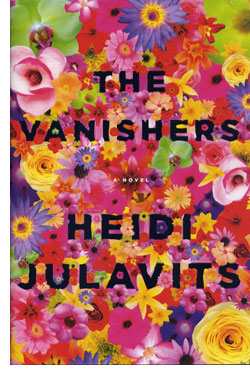
04-09-12:Heidi Julavits Joins 'The Vanishers'
Psychic Trap
For every gift, there is a curse. Humans have the gift of storytelling, of crafting meaning and intent from a series of random events; and to counter this talent, we have self-doubt, the ability to undermine and question our every action and belief. Are we worthy of those who admire us? Are we worthy of our own self-admiration? We tell ourselves a story about who we are and how we came to the circumstances in which we find ourselves. It's a solid story. But we're our own perfect interrogators. We can ask all the right questions to undo our own sense of self.
Julia Servern is much more talented than she lets on, at least as Heidi Julavits' novel 'The Vanishers' begins. Julia is portrays herself as the underachiever at The Workshop, an elite school for psychics that somehow most of us (who are not psychics) have never heard about. But in spite of Julia's low self-esteem, she's been chosen by the Workshop's fearsome headmistress, Madame Ackerman, to take dictation, including psychic dictation as Ackerman knocks herself out to find the work of a missing, unsavory artist. Success is achieved, but Julia finds herself on the outs, then on the run from a psychic attack. The cure proves to be every bit as dangerous as the disease as Julia finds more questions than answers. The facts she discovers reveal toxic emotions and the love that kills. Julavits has created a psychic trap for the reader, a ripping yarn with raw and powerful emotions.
Julia tells the story in 'The Vanishers,' so character and prose are mashed into one seamless, utterly entertaining whole. She's a smart storyteller and an unreliable narrator with a great voice. 'The Vanishers' is easy to read and superbly, smartly well-written. For all the serious and intense emotions that ultimately drive the novel, 'The Vanishers' is really very, very funny, as Julia and Julavits send up academia, the art world, recovery centers and everything else in the novel's path. The ease with which the prose is read masks the skill with which it was written; only in retrospect will readers realize that every word is perfectly placed, and just how much we feel Julia's character through the writing. Because Julia is such a smart and observant character, her portraits of those around her are entertaining, insightful and often flawed in a manner that reader can spot even when the storyteller cannot.
'The Vanishers' is a novel about secret societies, and secret societies within secret societies, like a series of Russian nesting dolls. The conceit behind the title involves a service that will help you disappear from this world without killing yourself, a sort of death-free version of suicide. You have the option of leaving behind a filmed last message to your loved ones (or those you know if you were indeed without love). There are secret wellness centers, and a whole network of psychics with varying abilities who walk among us unseen, or at least unseen by the network news. Julavits creates this world with a terse precision that makes it seem real. It's a great pleasure to read her world building efforts within the world we inhabit.
Using her well-designed elements of the fantastic, Julavits turns pulse-pounding narrative elements into poignant plot points to engage the reader on all levels. For a novel set entirely in the world we think we know, Julavits has put a lot of work into her invention, and the surprise of discovering what is "real" seems untoppable until Julavits manages to do just that by making the emotional impact match the danger level. And there's the twist that catches us all; that the gift of our feeling, caring life is the curse to counterbalance it. Emotional pain, like its physical counterpart, exists to warn us of danger. Those whom we dare to love are perfectly poised to become our most effective assassins.
New to the Agony Column
09-18-15: Commentary : William T. Vollman Amidst 'The Dying Grass' : An Epic Exploration of Simultaneity
Agony Column Podcast News Report : A 2015 Interview with William T. Vollman : "...a lot of long words that in our language are sentences..."
09-05-15: Commentary : Susan Casey Listens to 'Voices in the Ocean' : Science, Empathy and Self
Agony Column Podcast News Report : A 2015 Interview with Susan Casey : "...the reporting for this book was emotionally difficult at times..."
08-21-15: Agony Column Podcast News Report : Senator Claire McCaskill is 'Plenty Ladylike' : Internalizing Determination to Overcome Sexism [Incudes Time to Read EP 211: Claire McCaskill, Plenty Ladylike, plus A 2015 Interview with Senator Claire McCaskill]
Agony Column Podcast News Report : Emily Schultz Unleashes 'The Blondes' : A Cure by Color [Incudes Time to Read EP 210: Emily Schultz, The Blondes, plus A 2015 Interview with Emily Schultz]
07-05-15: Commentary : Dr. Michael Gazzaniga Tells Tales from Both Sides of the Brain : A Life in Neuroscience Reveals the Life of Science
Agony Column Podcast News Report : A 2015 Interview with Michael Gazzaniga : "We made the first observation and BAM there was the disconnection effect..."
04-21-15: Commentary : Kazuo Ishiguro Unearths 'The Buried Giant' : The Mist of Myth and Memory
Agony Column Podcast News Report : A 2015 Interview with Kazuo Ishiguro : ".... by the time I was writing this novel, the lines between what was fantasy and what was real had blurred for me..."
Agony Column Podcast News Report : A 2015 Interview with Marc Goodman : "...every physical object around us is being transformed, one way or another, into an information technology..."
Agony Column Podcast News Report UPDATE: Time to Read Episode 199: Marc Goodman : Future Crimes: Everything Is Connected, Everyone Is Vulnerable and What We Can Do About It