The best monsters have something to say. The idea is not new; in fact it is as old as written literature and storytelling itself. From Beowulf's Grendel to the monstrous creation of Mary Shelley's Frankenstein, to Hannibal Lecter, the most memorable monsters are those with a voice.
"Killing machines" may strike fear into us for a moment, but reasonless appetite is not, in the final analysis, something that is particularly entertaining to read about. When those who are about to slay us sit us down and explain why we deserve to die — those are the monsters who stay fixed in our mind long after we've finished reading the book.
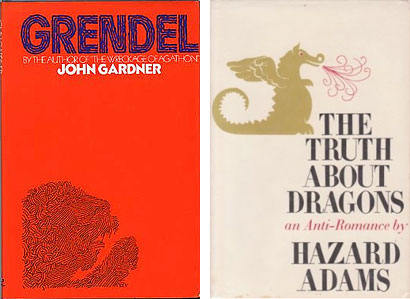
But even the best monsters in literature rarely get to tell their side of the story the first time around. And it has become a time-honored tradition for our best writers to turn the stories we know upside-down. Literary critic John Gardner gave us the story of Beowulf's foe in his magnificent work, 'Grendel.' Another literary critic, Hazard Adams, gave us 'The Truth About Dragons,' which he called, "An Anti-Romance."
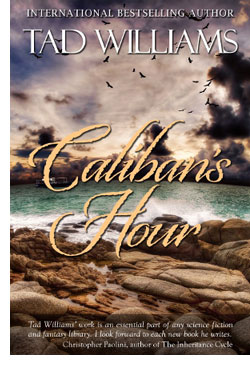
And back in what seems to be the dawn of time, comparatively speaking — the early 1990's, in the heyday of a series of books I loved called the Legend Novellas — one Deborah Beale commissioned 'Caliban's Hour' (The Beale-Williams Enterprise ; July 25, 2011 ; $9.99) by Tad Williams. It must have been a daunting project, but Williams proved himself up to the task. Now available as an e-book, it's a fine use of electronic publishing to bring back an obscure but ultimately rewarding story that gives one of literature's most famous and entertaining monsters time to strut and fret upon the stage.
Legend Novella
The novella begins with Caliban's appearance Italy, as he seeks out the now-middle-aged Miranda, intent on telling her his story; the island was, after all, his alone before she arrived with her father — and after. 'Caliban's Hour' becomes both a prequel and sequel, of sorts, to The Tempest. But it mostly becomes a gorgeously voiced exploration of what happens when those who have no voice, have no words, those for whom the world is simply as it is, are given language. As with most gifts, it is both a blessing and a curse.
Williams spends a bit of time setting up his scene, but once he lets Caliban's voice fly, readers will find themselves trapped and mesmerized not just by the prose, but as well by Williams' sophisticated and extended exploration of language itself. It's the sort of book that you'll find yourself reading aloud, even as Williams expertly cranks up the tension as to what precisely, Caliban will do after he is done talking.
Just as it was back in 1994, 'Caliban's Hour' is once again a publication pre-cursor of Things to Come. (The Legend Novella series anticipated the inception of PS Publishing, which also started out with novellas by genre-fiction writers, but has since branched out into many formats.) It's not the first, but 'Caliban's Hour' is part of a growing trend of backlist and out-of-print titles that can be reasonably brought back into the market as ebooks. One hopes this is a trend that will continue, as another monster — change — speaks without asking for permission. As voiced by Tad Williams' impeccable prose, Caliban is much easier and more entertaining to listen to than change. And much less destructive, unless you're a middle-aged Miranda hoping to leave magic behind.
09-14-11:Tad Williams and Deborah Beale Reap the Harvest of 'The Dragons of Ordinary Farm' and 'The Secrets of Ordinary Farm'
California Magic
Forget the gold. Take a drive down Pacific Coast Highway, and what you'll sense behind those hills is magic.
I live in northern California, but often have reason to go to Los Angeles. When I do, I always drive, and I always take Highway 101. Since I live just south of Santa Cruz, the endless green — or brown, depending on the season — hills start rolling away on both sides as soon as I hit the freeway. And for the next six or so hours, that's all I see. That, and what lies beyond, in my imagination.
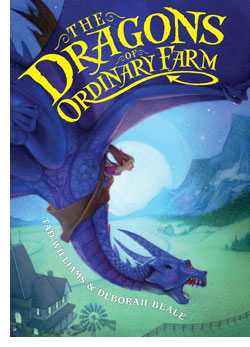
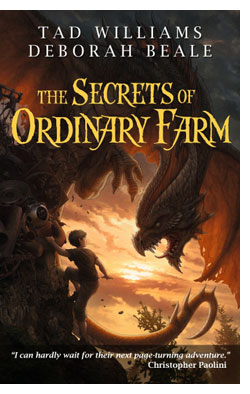
Deborah Beale and Tad Williams seem to have my number because 'The Dragons of Ordinary Farm' (HarperCollins ; June 2, 2009 ; $16.99) and the sequel 'The Secrets of Ordinary Farm' (The Beale-Williams Enterprise ; August 18, 2011 ; $9.99) transpire in precisely the sort of places I imagine just beyond the hillsides I can see. These are very real places, mind you. It's very easy to imagine stopping the car, striking out into the grassy hills and walking until you find Ordinary Farm, which is, of course, not ordinary at all.
'The Dragons of Ordinary Farm' sets up a large cast of characters and the setting, while offering a nicely propelled plot to keep readers immersed in the world that Williams and Beale create. This is a gorgeously sculpted world-within-our world and quite rewardingly clever. Tyler and Lucinda Jenkins are sent to spend the summer with relatives at Ordinary Farm, perched amidst those lost hills in California. What they find are not just dragons, but a bestiary of mythical creatures, and crackingly fine explanation for how they came to be there. And that's where the adventure begins.
Williams and Beale are in this for the long haul, but given that they are setting up quite a complicated little worldlet, they manage to keep the action nicely humming as they bring readers into the world and introduce us to a large cast of characters. They manage to make the difficult feat of distinguishing all these people and critters, from Colin Needle to Mr. Wakewell to the Dragons themselves, quite seamlessly easy. Moreover, they are not sparing to their characters. Nobody's perfectly good, nor perfectly bad. In fact, getting to know them takes a while, just as it happens in life itself. There's a relaxed, wistful feel to the books that matches the timeless, gorgeous setting.
Since the authors don't talk down to their characters, they also don't talk down to their audience. Since there are no freeway adjectives to be found, you can comfortably teach them in school, for example, but you can also read them as well-written adult fantasy; Tad Williams is a major name for a good reason. His collaboration with his wife Deborah Beale is seamless and smart. There's a great bit of world-building here, with a very enjoyable setup and follow-through in the second novel. I read both electronically, and enjoyed them both immensely. I've always wondered just what it would be like to stop by the side of the road and walk into those hills. What sort of magic might I encounter? Tad Williams and Deborah Beale have crafted two fine novels that seem to the perfect answer.
09-12-11:George Pelecanos Makes 'The Cut'
Chiseled Prose
With a single paragraph, we are in the world. A DC lawyer's office, where ex-Iraq war vet Spero Lucas listens to Tom Petersen, a pretty high-powered lawyer who wants Lucas to check out the scene of a carjacking for a client who is dead-to-rights guilty. One of two young men, boys, really, high on stupidity and testosterone. The other kid is SOL, stuck with a PD. To Petersen's annoyance, Lucas insists on taking notes even though Petersen has all the relevant facts on printouts. But Lucas finds that writing it down helps his mind focus. He's a focused guy.
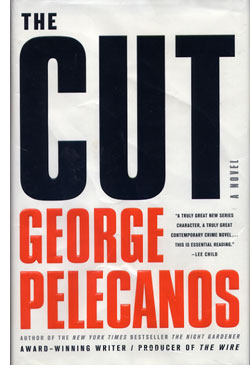
George Pelecanos is a focused writer. You won't close the book until you've finished reading, and only then will it occur to you that you have been reading, and not simply living in the world he created, in these lives you have experienced. 'The Cut' is a seamless novel of incredible social realism, to the degree that the world Pelecanos builds will be as or more memorable than one you return to when you finish the book.
World-building is a term generally used for science fiction or historical novels, but 'The Cut' demonstrates quite ably that it applies to mainstream literary novels as well. The Washington DC that Pelecanos creates here, house-by-house, is vivid and often shockingly familiar. Spero, his family, his friends, his clients and the criminals that people the novel come to life a manner so filled with the right details that they seem intimately familiar even as they are observed from the outside, as if by a particularly perceptive anthropologist. There's not one detail, not one word on any page that doesn't seem both necessary and true.
You won't notice while you are reading, but the key to the power of this novel is the understated prose of George Pelecanos. He knows how to strike the perfect balance. He gives readers all the details they need to build the neighborhood and the people in it, but no more. There's a pleasant sense of absence when you read 'The Cut,' because the prose is so transparent. Pelecanos does not needlessly elaborate on details that don't matter. His characters don't think about things to explain something the reader does not know. The prose immediately engages our sense of the reading experience and makes it so easy we don't seem to be reading; we're living, in DC, as Spero Lucas.
Spero's a vet back from Iraq, who works as a finder. He will find anything you need, for a 40% cut. He's smart, but not introspective and he pursues his tasks as an investigator with a very satisfying sense of logical progression. His only tools are an iPhone and a moleskin notebook. His notes and sketches help him intuit that which a photograph or voice recording might miss. Asked by a dodgy client to recover a dodgy parcel, Spero finds even his smart sensibility challenged by circumstances that run out of control like a brakeless truck on a steep decline.
The characters here are laid out simply, but Pelecanos has a knack for layering these simple setups into complicated, very real relationships. Spero comes from a big, multi-racial adopted family, and they're all important to his life. His client, and those who work with his client, cut across a variety of economic levels, never managing to rise beyond the middle class. You'll be able to sit down in the living room of your mind and shoot the shit with any of these men or women. And you'll enjoy doing so even with some of the very bad antagonists. Pelecanos has a very understated sense of humor that can undercut a rush to judgment.
For all the propulsiveness of the plot in 'The Cut' — you'll barely be able to leave your chair while you're reading it — the events never seem forced. In fact, there's an almost kicked-back sensibility at work here, except when your head is getting kicked around by carefully orchestrated and visualized scenes of action. Pelecanos visits all the places he writes about. These are all real places in DC. The world-building pays off in more than just atmosphere and realism. It also makes the story slide by at a breathless pace. The major threads of plot and character are resolved in an incredibly satisfying manner. You'll want to shake the hand of a fictional character when you finish, and hope that he'll stick around for a beer.
Fortunately, Pelecanos leaves more than a few things unresolved. We meet characters that we want to see more of, but, as it happens in reality, there's no time for them in this story. Pelecanos never pushes any of his people to serve the demands of plot. He creates characters who, by virtue of who they are, find themselves drawn towards a dangerous personal precipice. Some may step over and others may step back. Once you take your part of 'The Cut,' you won't be going back, and you won't want to.
New to the Agony Column
09-05-15: Commentary : Susan Casey Listens to 'Voices in the Ocean' : Science, Empathy and Self
Agony Column Podcast News Report : A 2015 Interview with Susan Casey : "...the reporting for this book was emotionally difficult at times..."
08-21-15: Agony Column Podcast News Report : Senator Claire McCaskill is 'Plenty Ladylike' : Internalizing Determination to Overcome Sexism [Incudes Time to Read EP 211: Claire McCaskill, Plenty Ladylike, plus A 2015 Interview with Senator Claire McCaskill]
Agony Column Podcast News Report : Emily Schultz Unleashes 'The Blondes' : A Cure by Color [Incudes Time to Read EP 210: Emily Schultz, The Blondes, plus A 2015 Interview with Emily Schultz]
07-05-15: Commentary : Dr. Michael Gazzaniga Tells Tales from Both Sides of the Brain : A Life in Neuroscience Reveals the Life of Science
Agony Column Podcast News Report : A 2015 Interview with Michael Gazzaniga : "We made the first observation and BAM there was the disconnection effect..."
04-21-15: Commentary : Kazuo Ishiguro Unearths 'The Buried Giant' : The Mist of Myth and Memory
Agony Column Podcast News Report : A 2015 Interview with Kazuo Ishiguro : ".... by the time I was writing this novel, the lines between what was fantasy and what was real had blurred for me..."
Agony Column Podcast News Report : A 2015 Interview with Marc Goodman : "...every physical object around us is being transformed, one way or another, into an information technology..."
Agony Column Podcast News Report UPDATE: Time to Read Episode 199: Marc Goodman : Future Crimes: Everything Is Connected, Everyone Is Vulnerable and What We Can Do About It