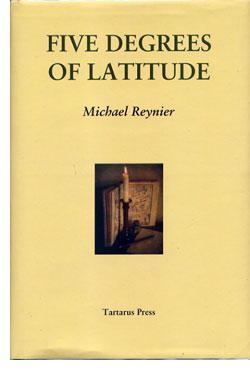
08-10-11:Mario Guslandi Reviews 'The Five Latitudes'
Mesmerized
Life is full of surprises and the life of book lovers makes no exception. Sometimes you happen to find in your hands a volume by a perfectly unknown writer, an absolute beginner, and you get mesmerized by his/her debut collection. This is exactly the case with Michael Reynier 's first collection of short stories (well, more accurately "longish" stories…) just published by Tartarus Press. Reprinting past gems of dark and weird fiction is not the only scope of that excellent UK imprint. Discovering new, extraordinary talents is their purpose as well. Fine examples are Mark Samuels, Quentin S. Crisp and Angela Slatter, just to mention a few.
'Five Degrees of Latitude' includes, as the title suggests, five pieces of uncanny fiction. The first two stories are simply outstanding.
"Le Loup-Garou" is a stunning, very dark piece depicting a series of disappearances and animal mutilations taking place in a remote French mountain village. Partly a horror story, partly an intriguing whodunit, the story is told in a detached but enticing narrative style quite amazing for a newcomer.
"No. 3 Hobbes' Lane" is another astounding, quite original tale cleverly built around the mystery of a house on a cliff devoid of windows facing the breathtaking view. It's an extraordinary story, graced by a superior storytelling ability, which analyzes in depth the events — imbued with a supernatural nature — revolving around that puzzle.
The third story in the volume, "The Rumour Mill", is not quite outstanding (actually, I found it a bit overlong) but surely very good. It investigates the life and the experimental research in verbal communication by a distinguished academic, whose work came unexpectedly to grief.
In the fully enjoyable "Sika Tarn" we can savour the vivid report of the weird experience of two hikers exploring woods, cliffs and a forsaken mountain lake. Dark, supernatural secrets from the past become gradually unearthed.
The last piece "The Visions of Lazaro" didn't work for me. Therein Reynier tries to melt in the same pot two different stories (one concerning a religious sect from the past, the other, an expedition to a deserted outpost), continuously shifting from a sort of magic realism to a kind of soft SF. In spite of the author's solid narrative technique, the plots do not really grip the reader's attention and the result is somehow unconvincing.
With this distinct exception, 'Five Degrees of Latitude' remains an extraordinary book, featuring stories with very original subjects and such a mature, superior writing style that it's hard to believe that this is the debut work of a brand new author and not the product of a skilful veteran storyteller.
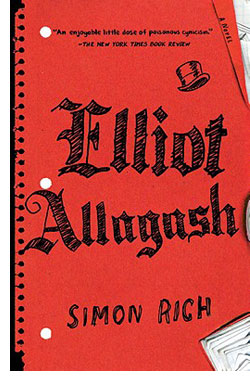
08-08-11:Simon Rich Wishes For 'Elliot Allagash'
The Unbottled Genie
In fiction wishes tend to be granted only when their effects will be unfortunate for those who make them. The upshot of this trope is to exaggerate the worst aspects of the character who seems to have the genie in his command. When the genie is a supernatural being, the supposedly fortunate finder rarely twigs to the fact that it is the genie running the show.
When the genie is human being, however, it's clear from the get-go who is in charge. The trick for the writer of such tales is to have it both ways; to make the genie both a villain with unlimited powers and a flawed, frail human being. Simon Rich unbottles his genie in the form of an ultra-rich, ultra-spoiled student, who lends his name to the title of Rich's first novel 'Elliot Allagash' (Random House ; June 14, 2011 ; $15).
The lynchpin of this novel is the naïve narrative voice of Seymour Herstein; he's the middle-class nerd at the bottom of the heap who tells the story. The prose is so breezily transparent that many readers will finish this book in day. It's so skillfully written that you can re-read it another day and find more than you as a reader could possibly wish for.
Rich never wastes a word, and puts us right into the thick of the story. Seymour is the ultimate loser at his private high school. Elliot Allagash is the ultimate villain with so much money he can accomplish feats that are nearly supernatural. Elliot targets Seymour immediately. First he pushes him around. Then he decides to apply his money and his mind to making Seymour the king of this very small hill. He certainly has the power to do so. But what will be left of Seymour after Elliot is done with him?
Reading this novel is always a pleasure because Seymour has such a charming and engaging voice that he can make it a hoot to hang out with even an evil monster like Elliot. Rich writes with a decisively minimalist feel, though this is not formal minimalism. Seymour is no angel, but he's a pretty sweet-natured kid. He's a little bit oblivious to the extent of Elliot's evil, but he also sees lots of things that Elliot does not see. He's as reliable a narrator as a pre-teen boy can be, but there are clearly limits as to what he can understand. He knows some of his limits, but not all of them. Rich manages to make all of this clear to the reader, in a well-executed exercise of achieving complexity via layered simplicity.
Hardcover First edition
While Elliot and Seymour are the main players, they are by no means the only characters. Seymour's parents are very middle-class, and pretty ordinary, but charming in their economic insecurity. They're balanced by Terry Allagash, Elliot's over-the-top father, who is a terrifying and pathetic creation. He's perfectly happy to act as a patron of the arts, with the proviso that he will be the only one to see the work produced — and sometimes, on a whim, destroy them. Simon mines this material for lots of great humor, and uses this to make these larger-than-life figures human.
Though the through-line of the plot is perfectly apparent, the way there is entertainingly episodic. Rich takes a page from crime fiction and crafts some incredibly clever and complicated cons, all of them facilitated by Elliot's invincible wealth. Each of these brings the characters and the readers closer to the brink. He continually ups the ante. But the emotional arc of the story is what keeps us engaged while the episodes keep us entertained.
'Elliot Allagash' is an almost alarmingly easy novel to read. But the ease with which it reads belies a very complicated and crafty construction. The naïveté of the narrator effectively conceals the sophistication of the author. Rich is a master of letting the reader in on secrets that none of the characters can quite see. The end result is a novel that is so much fun, and so funny, as to make one forget the very real emotions that empower the humor. Here is a rare exception to the Twilight Zone Rule of Wishes; readers who yearn for a good novel can find that wish granted in 'Elliot Allagash,' with no backlash beyond inappropriate laughter and the desire to read it again.
New to the Agony Column
09-05-15: Commentary : Susan Casey Listens to 'Voices in the Ocean' : Science, Empathy and Self
Agony Column Podcast News Report : A 2015 Interview with Susan Casey : "...the reporting for this book was emotionally difficult at times..."
08-21-15: Agony Column Podcast News Report : Senator Claire McCaskill is 'Plenty Ladylike' : Internalizing Determination to Overcome Sexism [Incudes Time to Read EP 211: Claire McCaskill, Plenty Ladylike, plus A 2015 Interview with Senator Claire McCaskill]
Agony Column Podcast News Report : Emily Schultz Unleashes 'The Blondes' : A Cure by Color [Incudes Time to Read EP 210: Emily Schultz, The Blondes, plus A 2015 Interview with Emily Schultz]
07-05-15: Commentary : Dr. Michael Gazzaniga Tells Tales from Both Sides of the Brain : A Life in Neuroscience Reveals the Life of Science
Agony Column Podcast News Report : A 2015 Interview with Michael Gazzaniga : "We made the first observation and BAM there was the disconnection effect..."
04-21-15: Commentary : Kazuo Ishiguro Unearths 'The Buried Giant' : The Mist of Myth and Memory
Agony Column Podcast News Report : A 2015 Interview with Kazuo Ishiguro : ".... by the time I was writing this novel, the lines between what was fantasy and what was real had blurred for me..."
Agony Column Podcast News Report : A 2015 Interview with Marc Goodman : "...every physical object around us is being transformed, one way or another, into an information technology..."
Agony Column Podcast News Report UPDATE: Time to Read Episode 199: Marc Goodman : Future Crimes: Everything Is Connected, Everyone Is Vulnerable and What We Can Do About It