08-03-11:Scott Simon Knows 'Baby, We Were Meant for Each Other'
The Family We Choose
Family is averse to definition. Ask anyone about his or her family, and you'll find out in a hurry; no two are anything alike. For everyone who likes to think that family runs in the blood, you'll find some who will argue that it runs in the love. If you're looking for definition, then it won't be long before you find yourself retreating to Supreme Court Justice Potter Stewart's famous line; "I know it when I see it."
Mostly, we know family only when we realize we are part of a family, as those around us become as family to us. Sometimes, people are thrust into our lives (or we into theirs!), and sometimes, we bring people into our lives and tell them; you are now my family. We may consider our friends to be our family, the family of our choice. There's no graven-in-stone definition that cannot be eroded away by examples and counter-examples.
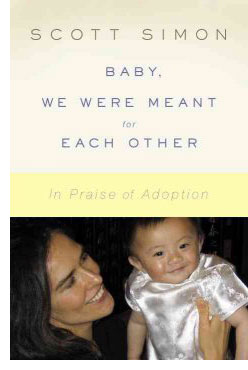
Many of us might consider writer and broadcaster Scott Simon family by virtue of the fact we spend two hours every Saturday morning listening to him. He's a personable guy even when he's dispensing national news over public radio. He has the voice of family. And now that he has written about his family in 'Baby, We Were Meant for Each Other: In Praise of Adoption' (Random House ; August 1, 2010 ; 192 pages ; $22), he offers readers a vision of family as expansive as the world itself.
Simon is a smart writer, who knows how to speak to readers personally and intimately without overload. The book begins with Simon and his wife, Caroline, on a small bus in Nanchang, China, immersed in the "adopto-tourism" that will ultimately lead them to their first baby daughter, Feng Jia-Mai — Elise. By putting us on the ground, amidst strangers, Simon quickly brings readers into his family. Yes, we are all strangers when we first meet — even family.
Simon's book is a compulsively engrossing account of his first, then his second adaption from China, from red tape to diapers to the simple joys of discovering love. It is the origin story and the creation story for a family of choice. Powering the book is Simon's prose, which is often shockingly clear and direct. He really knows how to move the narrative and keep the reader focused on the story with detailed descriptions, subtle humor and well-paced and placed dialogue. Readers will be tempted to say of Simon himself, 'Baby, We Were Meant for Each Other.' The language just happens for you as you the stories unfold.
And yes, while this is primarily one story, it is also many stories, as Simon takes us into the lives of others he knows to share the joys of adoption. It's not an easy gig; parenthood never is, but Simon manages to make the rewards he and others experienced palpable for the reader. If you have a family, no matter how it is put together, you will feel yourself within that family again as you read Simon's account of his and other clans. As a narrative species, human define themselves and their families not so much by personality traits but by stories. Simon is wise enough to know this and smart enough to put it into immersive prose.
Not everything in this book is happiness and light; but for Simon it is all family, and the real accomplishment here is that he is able unite the family with his voice. We've all heard that voice on the radio for years, uniting us, in a very real and important sense. In this book, Simon speaks to us the prose version of his radio voice and he manages to bring to readers into his life, into the lives of others who have built their families, and in so doing, he brings us back to our families and our lives. 'Baby, We Were Meant for Each Other' is reading as a return to presence, a means of finding our own stories when we look up from the printed page. We can close the book, and for a moment, open our lives.
08-01-11:Glen Duncan Transforms 'The Last Werewolf'
The Literature of Ennui
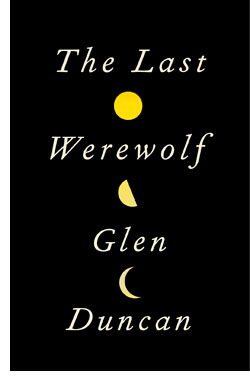
The world is too much with us. Every morning, we hope for something to offer a reason to live, and all too often we are given just enough to make it to the end of the day. Whether we want to or not, we just keep going, even though our lives lack a coherent plot line. Jake Marlowe does not have that problem. In Glen Duncan's superb 'The Last Werewolf,' (Alfred A. Knopf / Random House ; July 12, 2011 ; 297 pages ; $25.95 ; 978-0-307-59508-9) he's embroiled in plot and story up to his shape-shifting eyebrows.
But even with all the blessings of a good story, Jake is tired of life. He's had two-hundred plus years of it, and he could give a toss. As the novel opens, he's informed that he's officially the last of his kind. He's OK with that; the end cannot come soon enough. Readers are likely to differ with that diagnosis. 'The Last Werewolf' is a superb novel that will give them reason to live for as many days as it takes to read it. And for most, that will be just about one.
Duncan captures readers from the outset with a strong, literate voice and a plot delivered with outstanding economy. Jake tells the story in the first person, and he's a gentleman we're happy to hear from. He's intelligent, blackly humorous, and accomplished beyond mortal measure but not egotistical. He manages to make readers feel that they, too might be living a life like his had they been bitten by a werewolf back in the 19th century. Jake's life if not all that easy, but it has its rewards. On one hand, he has to kill and eat a human every month, and that human soul will settle in his as part of an ever-growing chorus of voices to haunt him. But in his many years, he's accumulated a vast, well-hidden wealth and skills that allow him to deal with his enemies as effectively as James Bond.
The upshot of all these skills and all this wealth is that Jake is tired. He's tired of living, tired of running, tired in the manner every human who wakes up in the morning is tired. Duncan's ripping prose manages to keep the plot moving while allowing Jake time for plenty of memorable asides. 'The Last Werewolf' is one of those books that will inspire readers to read aloud and take notes.
Of course all these notes and reading aloud will have to happen after you've finished the book for the first time. The plot of 'The Last Werewolf' is smart, gripping and very engaging. Duncan writes with an admirable economy, and uses his supernatural setup to nicely complicate the problems that will keep Jake Marlowe on the run for the brief duration of the novel. While there is plenty of sex and lots of violence, none of this is gratuitous, excessive or unnecessary. It all goes to make the plot and characters richer, more dangerous and more exciting. And it's served up with the timeless panache of a literary spy novel, both wry and exciting.
An atmosphere of ennui permeates the novel, and informs the vision of Jake Marlowe. As a cohesive agent, ennui might seem to be a dangerous choice, but Duncan uses this to his advantage. For all his prowess and powers, for all the weirdness and wild times, readers are able to identify with Jake because he's simply as bored with his life as the rest of us are with ours. Duncan manages the seemingly impossible task of giving readers a rip-roaring, head-severing, over-the-top plot lived by a character we can understand, even if our head-severing days are long behind us.
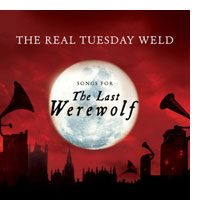
Readers who want more than a novel can also find 'The Last Werewolf: A Soundtrack' by The Real Tuesday Weld (Six Degrees Records ; July 12, 2011 ; $11.97), a gorgeous and haunting companion to the novel. Stephen Coates, who leads an eclectic ensemble, has crafted a shifting, subtle musical reflection of the novel. The production is intricate and atmospheric, and the songs, which feature a variety of vocalists and vocal styles, offer both the darkness and the sense of humor found in the novel. In spite of the title, what you're getting is more than a soundtrack or a backdrop. The songs are smart and stand on their own, though readers of the novel will find additional resonances in such titles as "I Always Kill the Things I Love." There are bits of prose from the novel woven in here and there, but the kinship between the novel and the album is complex enough that the album stands on its own as a listening experience. If you enjoy the novel, chances are that you're going to enjoy the album as well.
But for the novel, the proof is in the reading, and reading 'The Last Werewolf' is a total blast. The book oozes cool and fun, and here's the really good part — it does so not in spite of, but especially when Duncan-as-Jake-Marlowe is being particularly pithy. Duncan is happy to slaughter his way to intelligent writing, to wreak bloody havoc in the name of literature. He earns your tears even as he feeds your fears. 'The Last Werewolf' is certainly not the last word in the ever shape-shifting world of werewolf lore. And readers will certainly hope that it's not the last we'll hear from Duncan on the subject. It's a brainy, glorious howl under a full moon, and the spell does not end even when the book does.
New to the Agony Column
09-05-15: Commentary : Susan Casey Listens to 'Voices in the Ocean' : Science, Empathy and Self
Agony Column Podcast News Report : A 2015 Interview with Susan Casey : "...the reporting for this book was emotionally difficult at times..."
08-21-15: Agony Column Podcast News Report : Senator Claire McCaskill is 'Plenty Ladylike' : Internalizing Determination to Overcome Sexism [Incudes Time to Read EP 211: Claire McCaskill, Plenty Ladylike, plus A 2015 Interview with Senator Claire McCaskill]
Agony Column Podcast News Report : Emily Schultz Unleashes 'The Blondes' : A Cure by Color [Incudes Time to Read EP 210: Emily Schultz, The Blondes, plus A 2015 Interview with Emily Schultz]
07-05-15: Commentary : Dr. Michael Gazzaniga Tells Tales from Both Sides of the Brain : A Life in Neuroscience Reveals the Life of Science
Agony Column Podcast News Report : A 2015 Interview with Michael Gazzaniga : "We made the first observation and BAM there was the disconnection effect..."
04-21-15: Commentary : Kazuo Ishiguro Unearths 'The Buried Giant' : The Mist of Myth and Memory
Agony Column Podcast News Report : A 2015 Interview with Kazuo Ishiguro : ".... by the time I was writing this novel, the lines between what was fantasy and what was real had blurred for me..."
Agony Column Podcast News Report : A 2015 Interview with Marc Goodman : "...every physical object around us is being transformed, one way or another, into an information technology..."
Agony Column Podcast News Report UPDATE: Time to Read Episode 199: Marc Goodman : Future Crimes: Everything Is Connected, Everyone Is Vulnerable and What We Can Do About It