07-21-11:'Song of Slaves in the Desert' by Alan Cheuse
Voices, Stories and Songs
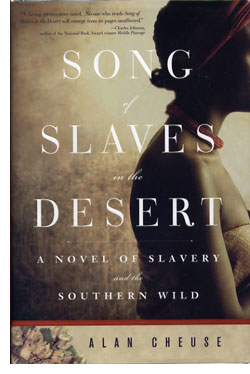
In his book reviews for NPR, Alan Cheuse speaks with a voice that is powerful and unique. In his fiction, he speaks with voices that are equally powerful, but not always his own. He becomes his characters to take us into their lives, no matter how remote they may from our own. 'Song of Slaves in the Desert' (Sourcebooks Landmark ; March 1, 2011 ; 978-1-402-24299-1; 504 pages ; $25.99) is a chorus of voices, one voice, one story, many stories, it is a song comprised of stories sung in many voices.
But for all the music in these words, all the joy and pain and art you'll find in here, be warned; this is also a compelling, propulsive, single-minded novel. It is a journey that that will take you to your destination far more swiftly than you will be able to imagine.
Cheuse is nothing if not ambitious. The book is divided into two different streams that eventually flow into one river of prose. Cheuse begins about as close to the beginning as you can, with scenes of geological age. These portions of narrative are sparsely poetic. We begin in Africa, with an indentured artisan's family and a carved stone. They flee from danger into slavery and from slavery into slavery as history unfolds. The story is fast paced, adventurous and fraught with emotion. Cheuse also offers some visionary passages that are striking and make fine use of elements of the fantastic.
Before we are out of danger, Cheuse introduces us in a second strand to Nathaniel Pereira, "A Hebrew of New York" as he calls himself. He tells his own story. It is sometime before the Civil War, and Nathaniel, a young man of some means, wants nothing more than to embark upon the European trip his father has promised him. But his father has other ideas, and asks Nathaniel to first journey to his uncle's plantation in South Carolina. Nate's uncle is a Jewish slaveholder. There are some problems, and Nathaniel's father sends his son to see if the business is worthy of investment. Upon his arrival, he experiences American slavery first-hand. But he also finds himself mesmerized by one of his uncle's slaves, Liza. It is the first step on a journey that Nathaniel never intended to take.
Cheuse writes the novel in two very different voices. The portions that follow a slave family through generations are told from a perspective that at first seems to be written in the third person, but gradually reveals itself to be something else entirely. The mystery of the narration itself is an effective plot point that lends these passages a feeling of earned poetry and real urgency. Nathaniel Pereira, on the other hand, is a young man rather taken with his own eloquence and unaware of his own inexperience. He thinks himself to be more mature and worldly than his actions prove him to be. Pereira is a very entertaining and straightforward first-person narrator, one who offers readers the pleasure of showing us more than he himself is able to see.
Cheuse challenges both himself and the reader with a large cast of characters. He succeeds by virtue of his plotting and his skills as a writer. The propulsive power of his generational slave plotline, weaves us in and out of characters who have powerful moments on stage to become family legends for the next generation. On the plantation, Cheuse simply creates memorable characters and by virtue of Nathaniel's wordy but entertaining prose, makes them quite clear. All of them are enjoyable to read about, even if they prove to be on the far side of despicable.
But for all the parts and persons, the characters and prose styles, the voices and visions you'll find in 'Song of Slaves in the Desert,' this is a very unified novel, with a rather breathtaking scope. And given the scope, the cast, the power of characters and their entanglements, the fact that Cheuse keeps us reading as fast as we can from beginning to end is every bit as remarkable as the rest of the novel. There's a lot of setup here and Cheuse delivers more than readers will expect. There are many voices, visions and songs in 'Song of Slaves in the Desert.' Cheuse is as much of a maestro as he is a writer, orchestrating story and character, plot and perception into novel that readers will remember as if they had experienced the events first hand. Ultimately, Cheuse speaks to us in our voice.
07-18-11:David Eagleman Goes 'Incognito'
Dethronement
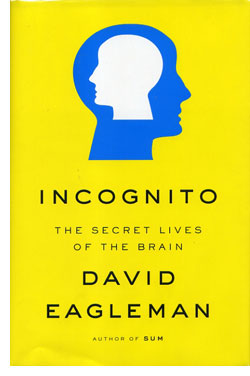
We like to believe that we know who "we" are. Each of us supposes that the consciousness that wakes up in the morning comprises pretty much all of "me." David Eagleman has a very different idea, one that is supported by a whole lot of science, entertainingly documented in 'Incognito,' (Pantheon / Random House ; May 31, 2001 ; $26.95 ; 301 Pages ; 978-0-307-37733-3) which upends our notion of "I." Eagleman's exploration of the mind we do not know is a gripping and engaging thought experiment that manages to actually "think out of the box," an "action" whose difficulty is made startlingly clear by the very text that manages to do so.
Eagleman may be writing science fact, but he's perfectly at home using the tools of literature and in particular, science fiction to make the facts and perceptions his work offers clear. His premise is essentially that the conscious "I" who wakes up in the morning is very much indeed like the captain of a huge ocean liner; that is, mostly a figurehead along for the ride on a machine so complicated that no single "I" can really wrap the "I" that they generally consider their "brain" around all or even most of the parts of that enterprise. Eyes are not cameras and ears are not tape recorders. The evidence of the senses is not a real-time feed from objective reality, but instead, a calculated, low-resolution guess manufactured by a super-complicated mass of cells in your skull. It's a pretty damn good guess, though, one that enables some superb physical feats for which the puny "I' will erroneously take the lion's share of the credit.
Eagleman is a very smart scientist, bursting with grand ideas, but more importantly, he is also a grand communicator, able to convey those ideas to those who might not come up with them on their own steam. 'Incognito' is funny, gripping and often shocking. His case histories are bizarrely compelling but ultimately offer crystal clear examples of how the mind works. His analogies and metaphors are charmingly well-written; we would expect nothing less from the author of 'Sum.' On the prose level, Eagleman writes great sentences of the sort that you might inclined to read to those in your general vicinity as he makes his case for the "dethronement" of the mind doing the reading, and for that matter, the writing.
But Eagleman wants to do much more than inform us that we are not really "we" and we aren't really in charge. He pursues the implications of his thesis and his work into philosophical and legal realms. Free will? Probably not. Crime and punishment? Soon to be as outdated as those orreries with the earth in the center of the solar system. Eagleman is relentless as he hunts down notions of blame and responsibility. His conclusions are bond to make some readers uncomfortable. Not surprisingly, he's very comfortable with that notion.
But no matter how disturbing some of Eagleman's idea may be, his writing is impeccable. Lively prose serves a well-organized series of arguments and visions. And while the dethronement of the self may seem to be a depressing realization, Eagleman is able to use his skills as a writer to convince the dethroned that this is not the case. He envisions our minds opening up to ideas as foreign to us as notion of a galaxy might have been to Pope Urban VIII, who found Galileo "vehemently suspect of heresy."
Notions of human boot sectors are interwoven with stories of men who have iron tamping rods driven through their brains. By the time you finish reading 'Incognito' you might feel very sympathetic towards all those folks who had chunks of metal embedded in their skulls. But it's only David Eagleman, proving that ideas can be just as dangerous as we all thought possible. We seem to be constantly at risk of escaping our shackles. Reading proves to be a good way to break free. It has history behind it, and now, with 'Incognito,' David Eagleman is well in front.
New to the Agony Column
09-05-15: Commentary : Susan Casey Listens to 'Voices in the Ocean' : Science, Empathy and Self
Agony Column Podcast News Report : A 2015 Interview with Susan Casey : "...the reporting for this book was emotionally difficult at times..."
08-21-15: Agony Column Podcast News Report : Senator Claire McCaskill is 'Plenty Ladylike' : Internalizing Determination to Overcome Sexism [Incudes Time to Read EP 211: Claire McCaskill, Plenty Ladylike, plus A 2015 Interview with Senator Claire McCaskill]
Agony Column Podcast News Report : Emily Schultz Unleashes 'The Blondes' : A Cure by Color [Incudes Time to Read EP 210: Emily Schultz, The Blondes, plus A 2015 Interview with Emily Schultz]
07-05-15: Commentary : Dr. Michael Gazzaniga Tells Tales from Both Sides of the Brain : A Life in Neuroscience Reveals the Life of Science
Agony Column Podcast News Report : A 2015 Interview with Michael Gazzaniga : "We made the first observation and BAM there was the disconnection effect..."
04-21-15: Commentary : Kazuo Ishiguro Unearths 'The Buried Giant' : The Mist of Myth and Memory
Agony Column Podcast News Report : A 2015 Interview with Kazuo Ishiguro : ".... by the time I was writing this novel, the lines between what was fantasy and what was real had blurred for me..."
Agony Column Podcast News Report : A 2015 Interview with Marc Goodman : "...every physical object around us is being transformed, one way or another, into an information technology..."
Agony Column Podcast News Report UPDATE: Time to Read Episode 199: Marc Goodman : Future Crimes: Everything Is Connected, Everyone Is Vulnerable and What We Can Do About It