07-15-11:A 2011 Phone Interview with David Darlington
"...the fact that so many wineries mouth this catechism while behind the scenes they are doing something completely different..."
—David Darlington
I suppose it goes without saying that David Darlington is immersed in his subject. When I called him to speak before his appearance at Capitola Book Café, he spoke so easily about his book, that the non-fiction work started to seem more like a novel. Darlington has known his characters for nearly forty years, and he is truly immersed in their life arcs. He's uniquely equipped and positioned to tell their stories.
One of the most interesting aspects of Darlington's book was his ability to convey the complexity of the technology that is becoming increasingly entrenched in the wine industry. The new gear that is being used to bring wines to an "ideal" state is, fascinatingly, a reflection of the critical terminology that is used to rate the wine.
07-13-11:Howard V. Hendrix Interviewed at SF in SF on May 9, 2011
"We're going to bring in people from all different menus who have talked about Mars."
—Howard V. Hendrix
Howard V. Hendrix is one of those science fiction writers who works well beyond the genre, a fact he easily demonstrated at the SF in SF reading on May 9, 2011. His most recent book back then was 'Visions of Mars,' the result of a academic literary conference. As he told me, it was not an easy sell to get what were (to begin with) academic papers about all things Mars published. Of course in retrospect, it seems like an obvious subject for a book.
I've been reading Hendrix since forever, and remember the experience of reading 'Empty Cities of the Full Moon' as if it were yesterday. At SF in SF, we kept the focus on his upcoming novel, and his sort-of non-fiction anthology, 'Visions of Mars.' But what was really interesting to me was the library.
Apparently, out there on the edge of the California desert, they've got a gigantic collection of science fiction papers and letters. Again, it seems like something that is obviously a good idea when you hear it has actually happened, but I must admit it also seems like something that might be only remotely possible if you were to suggest it out of the blue. But as more and more of our literature and our lives are dominated by the visions of science fiction, it seems that even academia is coming to understand just how important this form of writing is. You can hear a conversation with poet, critic, novelist and scholar Howard V. Hendrix by following this link to the MP3 audio file.
07-12-11 UPDATE:Podcast Update: Time to Read, Episode 2: Erik Lasrson, In the Garden of Beasts
Here's the second episode of my new series of podcasts, which I'm calling Time to Read. The podcasts/radio broadcasts will be of books worth your valuable reading time. I'll try to keep the reports under four minutes, for a radio-friendly format. If you want to run them on your show or podcast, let me know.
My hope is that in under four minutes I can offer readers a concise review and an opportunity to hear the author read from or speak about the work. I'm hoping to offer a new one every week.
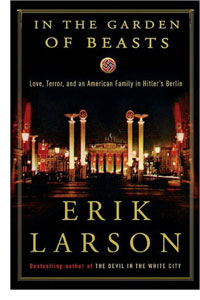
The second episode is a review of Erik Larson's 'In the Garden of Beasts,' featuring comments about Larson's reasearch, his travel, and his intentions for his world of historical non-fiction. Here's a link to the MP3 audio file.
07-11-11:A 2011 Interview with Erik Larson
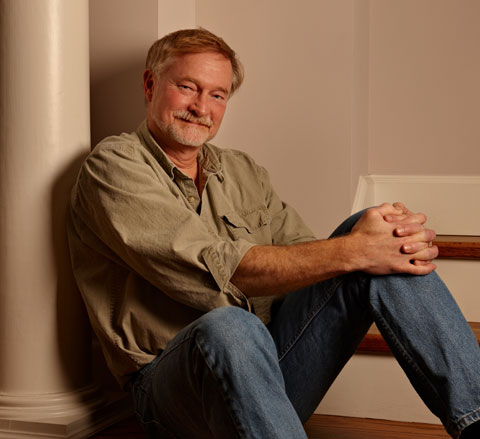
Click image for audio link.
"...here's this innocent, being thrown into this cauldron..."
—Erik Larson
Erik Larson is a man with a singular talent for turning well-known historical events into page-turning historical non-fiction. He's every bit as interesting to speak to as he is to read, and my conversation with him about his latest book, 'In the Garden of Beasts,' was like getting to hear a director's commentary to a major movie. We got behind the scenes of what he found, what he saw, and what he used to create a powerful reading experience.
The key to this book, and what I wanted to pursue with Larson, was his ability to enable readers to forget what they knew about history and sympathize with characters who saw Nazis people, not a monolithic block of pure evil. There's no doubt that Nazis became that block of pure evil, but what this book does is chronicle the perspective of those who saw the journey of a country towards a destination that was itself the beginning of the journey to pure evil.
Larson and I talked about his methods of research, and his methods of writing. It is one thing to dislodge facts, and quite another to use them to create a reading experience that engages our sympathy with those for whom the Nazis are not yet a done deal. And not surprisingly, nothing — travel, archival material, published work — plays the part you as a reader might expect. This book really plays on the wide screen of your reading mind. We keep the conversation substantive but spoiler-free. Settle back and hear the Erik Larson speak by following this link to the MP3 audio file.
New to the Agony Column
09-05-15: Commentary : Susan Casey Listens to 'Voices in the Ocean' : Science, Empathy and Self
Agony Column Podcast News Report : A 2015 Interview with Susan Casey : "...the reporting for this book was emotionally difficult at times..."
08-21-15: Agony Column Podcast News Report : Senator Claire McCaskill is 'Plenty Ladylike' : Internalizing Determination to Overcome Sexism [Incudes Time to Read EP 211: Claire McCaskill, Plenty Ladylike, plus A 2015 Interview with Senator Claire McCaskill]
Agony Column Podcast News Report : Emily Schultz Unleashes 'The Blondes' : A Cure by Color [Incudes Time to Read EP 210: Emily Schultz, The Blondes, plus A 2015 Interview with Emily Schultz]
07-05-15: Commentary : Dr. Michael Gazzaniga Tells Tales from Both Sides of the Brain : A Life in Neuroscience Reveals the Life of Science
Agony Column Podcast News Report : A 2015 Interview with Michael Gazzaniga : "We made the first observation and BAM there was the disconnection effect..."
04-21-15: Commentary : Kazuo Ishiguro Unearths 'The Buried Giant' : The Mist of Myth and Memory
Agony Column Podcast News Report : A 2015 Interview with Kazuo Ishiguro : ".... by the time I was writing this novel, the lines between what was fantasy and what was real had blurred for me..."
Agony Column Podcast News Report : A 2015 Interview with Marc Goodman : "...every physical object around us is being transformed, one way or another, into an information technology..."
Agony Column Podcast News Report UPDATE: Time to Read Episode 199: Marc Goodman : Future Crimes: Everything Is Connected, Everyone Is Vulnerable and What We Can Do About It