We live in a world that increasingly not only encourages but expects, indeed requires us to embrace contradictory ideas. Religious belief and science-proof faith are now the stuff of science, hard-wired into our brains to ensure that we discover that the science which brought about that discovery will never satisfy the brains that created the science in the first place. The whole thought-path is enough to make the brains that lead the way hurt.
Humanity's literature is no less self-contradictory. Charles Stross is a perfect example, a science fiction writer who wrote a novel that was lampooned as impossible to write by another science fiction writer, Stanislaw Lem. In Lem's 'A Perfect Vacuum,' which purports to be perfect reviews of non-existent books, there's a review of Toi, a French experimental novel written entirely in the second person. It's a great joke. But when Charles Stross actually wrote 'Halting State,' he brought that joke to life and while the novel itself is quite funny, it is no joke. It's a superb crime novel, written in the second person, and seemingly an impossible act to follow.
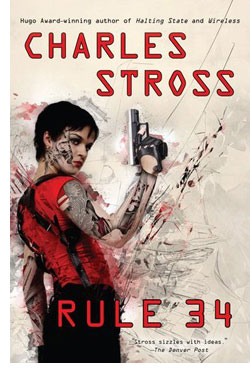
Credit Stross then for ignoring the impossibility of his own achievement and upping the ante in 'Rule 34,' the second Liz Cavanaugh near-future cyber-crime procedural — also written in the second person. I suppose it's not surprising that I can tell readers — you're going to enjoy 'Rule 34' immensely. But I do suggest you read 'Halting State' first.
Stross may be churning out the novels at a speed that seems ill-advised for superb literary quality, but that he manages to do so is probably not the last self-contradictory thought you'll encounter in his vicinity. In theory, writing a novel in the second person presents a difficult challenge for the writer and the reader, but tuck into 'Rule 34' and you'll wonder why it isn't done more often. That's because Stross makes what must be rather difficult to write engagingly easy to read. He mines the immediacy of the second person to turn what would otherwise have already been a page-turning crime novel into well, an even more page-turning crime novel.
The trick here is not just the second person perceptions, but Liz Kavanaugh's voice. She's a perfect vehicle for the day-after-tomorrow sensibility that Stross succeeds in creating. She's wry, funny, and tends to be self-disparaging even as she finds herself plunged into fairly horrific crimes. Keeping up with the whole aura of self-contradictory themes, in 'Rule 34' it is criminals who are being murdered, and extremely unsympathetic ones at that. But Stross manages to keep the reader's sympathies as Cavanaugh and her unit pursue a criminal who may help to redefine the word.
With prose that is consistently funny and often quite rude, without being out-and-out crude, characters we really care about and a near future that's built from imperishable pieces of the past and present, the first and main victim of 'Rule 34' is any doubt the reader may harbor that Stross can pull off the impossible twice. One is more given to wonder just what sort of wonder he will perform next.
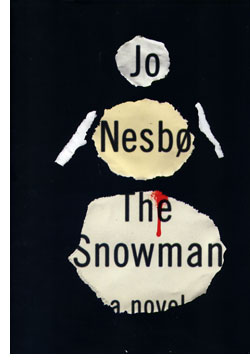
06-13-11: Jo Nesbø Builds 'The Snowman'
Heart of Ice
Harry Hole is not a happy man. It's an unsuitable state for driven cop with a drinking problem, an ex and her son. He starts at complicated, and then things get messy. Which, conversely, is why he is so well suited to solve complicated crimes where evidence, suspects and victims all seem to be in conflict, completely unassociated with one another. Harry Hole need only look within to find the same sort of violent chaos.
But Norwegian author Jo Nesbø has something special on ice for Harry Hole in 'The Snowman,' (Knopf / Random House ; May 10, 2011 ; $25.95). And like most terrible things, it starts quite simply, with a snowman found by a boy in his front yard. The snowman is wearing the boy's mother's scarf — and the mother is missing. But that's not the strange part. What bothers Harry, and the boy, is that the snowman in front of the house is not looking out on the street. It is looking up at the house.
Nesbø is a master of building suspense, layering in his clues and his miscues with close attention and detailed, almost gnarly prose. He revels in the grit of Harry's unfortunate life and Harry's bad choices. Those bad choices have led Harry to some very bad people, including the man who sent Harry a note months ago, signed "The Snowman." Winter is coming and Harry will soon find out how cold his heart can be.
'The Snowman' is the seventh Harry Hole novel, and the fifth to be published in English. The first two are slated to be published in English soon, so if you want to wait and read the whole series in order, the wait may not be that long. But it's going to be hard for most readers to hold back from such a tantalizing book, especially since it lives up to the setup. "The Snowman" is a tense, terrorizing novel, with a great gallery of characters good, bad, and distressingly evil.
The first strength of the Harry Hole novels is the cast of characters that Nesbø has created, and those who are added for each book. Harry Hole himself gets more and more complex and detailed with every outing, and even readers who have not read the series before will find him an alluring and innovative take on the classic broken-man detective. His new partner, Katerine Bratt, is smart and self-possessed enough to keep up with Harry, providing a protagonist who, in fighting with Harry, manages to bring out the strengths of both. Rakel and Oleg, his ex and her son, provide even more context. Nesbø's ability to evoke thorny relationships gets under the reader's radar. We feel we might know these people outside the book.
Don Bartlett's translation of Nesbø's prose is really quite superb. 'The Snowman' has a creepy, sort of horror-novel feel to it. Nesbø is quite descriptive and his evocations of landscapes, crime scenes and even everyday domestic tableaus are somehow chilling beyond the frigid weather. The weather doesn't hurt, though, and Oslo itself seems on the verge of becoming a character.
But we ostensibly read mystery novels for plot, and Nesbø keeps us riveted and off-balance by zipping back and forth, offering us one suspect here, two there, building something up and then effectively misdirecting the reader. 'The Snowman' plays fair, but like Harry Hole, readers will find themselves up against an exceptionally smart and powerful antagonist. This is why we read mysteries, and 'The Snowman' is dark and dense enough to bear a second reading, as the first two books come into English. We have a long journey ahead of us with Jo Nesbø. Harry Hole has a story all his own, and 'The Snowman' is a chilling entry in a superb series.
New to the Agony Column
09-05-15: Commentary : Susan Casey Listens to 'Voices in the Ocean' : Science, Empathy and Self
Agony Column Podcast News Report : A 2015 Interview with Susan Casey : "...the reporting for this book was emotionally difficult at times..."
08-21-15: Agony Column Podcast News Report : Senator Claire McCaskill is 'Plenty Ladylike' : Internalizing Determination to Overcome Sexism [Incudes Time to Read EP 211: Claire McCaskill, Plenty Ladylike, plus A 2015 Interview with Senator Claire McCaskill]
Agony Column Podcast News Report : Emily Schultz Unleashes 'The Blondes' : A Cure by Color [Incudes Time to Read EP 210: Emily Schultz, The Blondes, plus A 2015 Interview with Emily Schultz]
07-05-15: Commentary : Dr. Michael Gazzaniga Tells Tales from Both Sides of the Brain : A Life in Neuroscience Reveals the Life of Science
Agony Column Podcast News Report : A 2015 Interview with Michael Gazzaniga : "We made the first observation and BAM there was the disconnection effect..."
04-21-15: Commentary : Kazuo Ishiguro Unearths 'The Buried Giant' : The Mist of Myth and Memory
Agony Column Podcast News Report : A 2015 Interview with Kazuo Ishiguro : ".... by the time I was writing this novel, the lines between what was fantasy and what was real had blurred for me..."
Agony Column Podcast News Report : A 2015 Interview with Marc Goodman : "...every physical object around us is being transformed, one way or another, into an information technology..."
Agony Column Podcast News Report UPDATE: Time to Read Episode 199: Marc Goodman : Future Crimes: Everything Is Connected, Everyone Is Vulnerable and What We Can Do About It