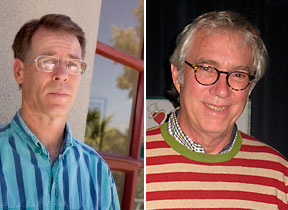
"There needs to be an explanation for that person."
—Geoffrey Dunn
Performing an interview live in the studio, while soliciting call-ins, is a very different environment from my usual style of conversation. For one thing, I have to operate a console and make sure that if we get phone calls, everyone is patched through and heard. But more importantly that console is between me and my guest so there can be a kind of barrier. But not if you've got a great guest with a great book and real questions to which you do not know the answers. It's tense though, you have to hit the ground running and never stop until you're through. Geoffrey Dunn made it easy.
Still, live radio is something of a sprint, since there are no chances to go back. But there was so much to cover in Dun's book that I knew we'd have to really skip lightly just to give readers a sense of what to expect. To be honest, I was hoping for some call-ins and I thought that Sarah Palin might be divisive enough to bring them in. Also, call-ins fill time. We did get some calls after the show and I['d like to thank those callers.
05-31-11:Agony Column Live, June 4, 2011 Preview : Seeing the Future with Kim Stanley Robinson and Rudy Rucker
"It's a good place to set a science fiction novel."
—Rudy Rucker
Rudy Rucker told me that he manages to make it to Santa Cruz about once a month, and I suppose, given that there is a fairly active "KEEP SANTA CRUZ WEIRD" movement in town, with bumper stickers, and t-shirts, it's not surprising that he'd set a novel here. Rucker's not alone in his visits to Santa Cruz; Kim Stanley Robinson manages to make it here regularly as well. And as they are gracious gentlemen, they'll be joining me this coming Saturday June 4, at the Capitola Book Café at 6:30 PM, to talk about science fiction, writing, Santa Cruz and their latest novels.
I must say that I feel lucky to have two such super-stars willing to join me. Rudy Rucker is one of the creators or founders of the cyberpunk movement. I remember reading the paperback editions of the Wares novels shortly after my arrival here and my re-introduction to science fiction. I really had to wonder what else I'd been missing.
Kim Stanley Robinson entered my reading world before I fell off the wagon, as his Three Californias trilogy was set in Orange County. If, as William Gibson suggested, the future has arrived but it is not evenly distributed, then I'd have to say a bigger chunk of that future has been dumped into OC, for both good and ill. Not surprising then that Robinson picked up on that.
I've spoken with Rucker many times, both at SF and for an NPR report I did on the suit against the LHC, files to help prevent the end of the world. Stan has also contributed to my NPR work, in a piece I did on the discussion that was going in within the science fiction genre about what we now call "Global Climate Change."
This coming Saturday, we'll be talking about their new books; Rudy's is 'Jim and the Flims,' set in Santa Cruz and "the Flimsy," a netherworld next door that might be the afterlife, but in Rudy's hands is considerably stranger than the average afterlife. Stan's newest novel is 'Galileo's Dream,' a delightful comic look at Galileo and his life; both the one we know about, and the other one, that involved time travel. Readers who'd like a preview can follow this link to the MP3 audio file of our conversation.
05-30-11:A 2011 Interview with Eugene Linden
Click image for audio link.
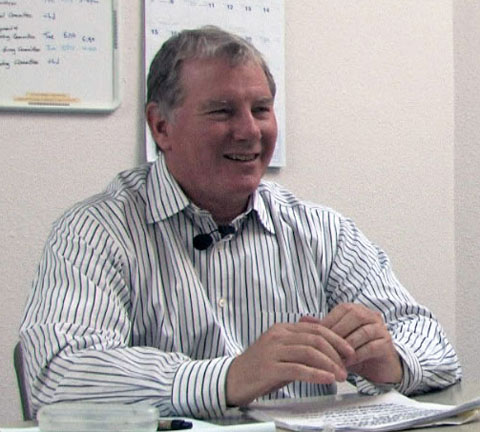
"While I was there, there was a very dramatic meeting."
—Eugene Linden
You can imagine that Eugene Linden might be the guy to find himself amidst a "very dramatic meeting," simply because he is so even-keeled. As I sat down to talk to him at KUSP, the clouds scudded overhead in the skylight, changing the color of the light in the room. It was eerie, and the right kind of eerie for a conversation with Linden.
It was interesting to speak with this talented writer not just about the subject of the book, and his many intriguing journeys, but as well about the creation of such a book. It's one he has been working on for many years. This shows in the craft of the prose and the construction of the book. Linden has been writing for magazines for long enough to know the virtues of brevity.
We also talked about many of the specifics in the book. One expects places like Vietnam and Africa to show up in such a book. One does not expect Cuba, or his experiences with healers and shamans. It is one thing to be open to physical exploration of the frontier. But Linden also takes himself to psychological frontiers as well, and manages to write about everything with the eye of a scientific artist.
08-21-15: Agony Column Podcast News Report : Senator Claire McCaskill is 'Plenty Ladylike' : Internalizing Determination to Overcome Sexism [Incudes Time to Read EP 211: Claire McCaskill, Plenty Ladylike, plus A 2015 Interview with Senator Claire McCaskill]
Agony Column Podcast News Report : Emily Schultz Unleashes 'The Blondes' : A Cure by Color [Incudes Time to Read EP 210: Emily Schultz, The Blondes, plus A 2015 Interview with Emily Schultz]
07-05-15: Commentary : Dr. Michael Gazzaniga Tells Tales from Both Sides of the Brain : A Life in Neuroscience Reveals the Life of Science
Agony Column Podcast News Report : A 2015 Interview with Michael Gazzaniga : "We made the first observation and BAM there was the disconnection effect..."
04-21-15: Commentary : Kazuo Ishiguro Unearths 'The Buried Giant' : The Mist of Myth and Memory
Agony Column Podcast News Report : A 2015 Interview with Kazuo Ishiguro : ".... by the time I was writing this novel, the lines between what was fantasy and what was real had blurred for me..."
Agony Column Podcast News Report : A 2015 Interview with Marc Goodman : "...every physical object around us is being transformed, one way or another, into an information technology..."
Agony Column Podcast News Report UPDATE: Time to Read Episode 199: Marc Goodman : Future Crimes: Everything Is Connected, Everyone Is Vulnerable and What We Can Do About It