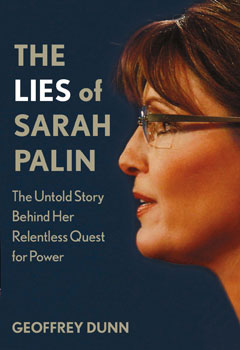
06-01-11:Geoffrey Dunn Exposes 'The Lies of Sarah Palin'
All the Queen's Mendacity
The truth is, in itself, not a particularly interesting story. It may be news, and it's certainly important to know the truths about those who govern us, but we can and should read news differently from the way we read books. As participants in a civil society, we need to be able to distinguish between truth and lies. Both books and news can help us make the distinction, but they do so in different ways. News is best as succinct reportage, a recitation of facts that gives readers raw information from which to make decisions.
Books are by my definition, at least, longer than news and necessarily have a different aim. Books should tell stories, even if those stories are current events, non-fiction news. News can tell stories but it need not do so to be effective, and some times it should not. Moreover, the language of books is different from that of the newsroom. It goes back to the story. We want to hear a voice.
Even the raw facts about Sarah Palin are compelling, and for those who are inclined, you can find lots of book-length collections of news (or pure fantasy) about Palin masquerading as books. Huffingon Post blogger Geoffrey Dunn dug deeper, and went back again and again to find the facts of Sarah Palin's life. He went behind the 24-hour news churn to look at stories that were yesterday's news. There is a lot we do not know. But most importantly, he found the story in her life. With so much new material, there is undeniably quite a bit of news in his new book, 'The Lies of Sarah Palin.' But it is the story that keeps us hooked, the voice we want to hear. 'The Lies of Sarah Palin' is a book.
Dunn's book is pretty simply constructed. We get the life of Sarah Palin, as told by those who know and knew her, in roughly chronological order. It stands in pretty stark contrast to the official version, however, and here's where Dunn shows his ability to write more than news. While carefully documenting everything he writes about Palin, he also manages to give readers a story, to put things in context. Through fine prose, a remarkable job of excavating witnesses and friends from across the years, and the ability to craft character from fact, Dunn tells us the story of Sarah Palin.
This story is not without controversy, and what Dunn presents contradicts much of the publicity associated with Sarah Palin's carefully constructed image. In a sense, this is also a book about the state of news coverage in American media, where competence and coherence compete for our attention with sheer chutzpah, while we select facts to bolster our own opinions from a buffet of boutique made-for-me outlets. Dunn's story is powerful and convincing, no matter what your political inclinations may be. Of course, you'd have to read it, and by virtue of the title alone, many will understandably be disinclined to do so. They'll certainly miss a compelling story of American politics.
Dunn's telling is a quick read; it seems almost like a political thriller, and his sense of characterization is strong. From her earliest years, Dunn finds strong evidence that Sarah Palin found it natural and easy to say whatever she thought might help her accomplish the goals immediately before her. Dunn's portrait, his work of non-fiction, is not less than the political arc — and thus far, incomplete — of a natural storyteller. 'The Lies of Sarah Palin' manages the difficult feat of being a powerful book about the powerful lies of Sarah Palin.
05-31-11:Alastair Reynolds Plays a 'Troika'
What We Can Never Decode
It's been just over ten years since Alastair Reynolds brought me back to the fold. I'd stopped reading the sort of science fiction you now find shelved with Stars Wars and Star Trek novelizations sometime after I ran out of books by Philip K. Dick and Stanislaw Lem, back in the before-time. But David Langford's review of 'Revelation Space' was just enough to pique my interest, which the novel itself rewarded more than I could possibly imagine. Reynolds' combination of hard science, gothic imagination and carefully wrought prose created a memorable reading experience. I can still walk through the drippings of that ship as if I'd just finished the book yesterday.
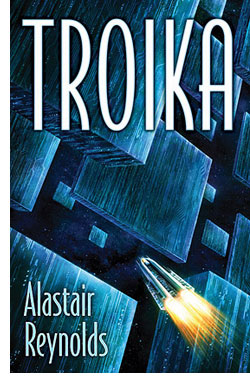
Reynolds has kept up the quality of his work, and he's been on my auto-buy list since then. His latest to land my way is 'Troika' (Subterranean Press ; July 2011 ; $35/Trade, $60/Limited). With it, Reynolds demonstrates something rather remarkable about his fiction and about science fiction. We're used to seeing massive epics in massive volumes, long sweeping sagas that we can only hope are actually finished. Reynolds himself turned 'Revelation Space' into such a saga and told one of those wonderful science fiction stories on a massive scale over five novels with some associated novellas.
We like these long sagas; we want them to go on long enough, but not too long. There's a joy in being immersed in a universe, getting involved with its characters, and seeing them face life-changing challenges. It's like a long vacation. And like vacations, we look forward to the sort of endings that Reynolds provided.
But brevity has its power as well, and in 'Troika' Reynolds once again proves that the reason he can mine the toolbox of science fiction so effectively is that he's also a highly skilled prose stylist. Here's a 114-page novella that has the power of revelatory science fiction bolstered by strong literary prose and great character insights wedded to the premise.
'Troika' presents humanity with a problem it cannot solve; an incomprehensible alien artifact appears in the Solar System, and humans inevitably try to understand, to explore, to define and confine it. Like the universe, the Matryoshka defies any easy, human explanation, and like the universe, it changes those who confront it, even if they come from a society that perceives itself as changeless. Dubbed the Matryoshka because it seems to be an enormous alien version of the Russian nesting dolls, it is a puzzle that begins to look more human the more humans look at it.
Reynolds is in top form here, combining deft but probably unreliable narration with appropriately brain-bending science. It's one thing to simply toss out lots of technical jargon, but Reynolds is a top-notch artist who knows just how much to tell us to create what science fiction readers call "a sense of wonder." It's something that you'll pretty much only find in the science fiction genre, and it's rarely done with Reynolds' panache.
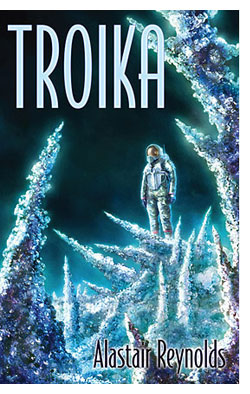
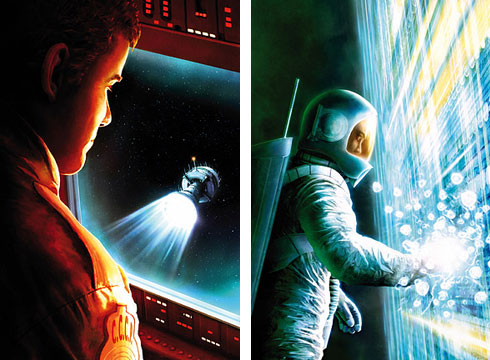
Subterranean Press does everything it can to make Reynolds' fine work an even better reading experience. The trade edition is a wonderful hardcover, generously printed and very easy to read. The limited edition comes signed, bound in leather, features a different (and to my mind, better) dust jacket illustration, as well as color plates not found in the trade edition. The plates and covers, all by Tomislav Tikulin are something of a double-edged sword. They're nice, all right, in the Chesley Bonestell tradition — very pretty. But Reynolds' work hardly needs illustration. His prose does all the work for you. Still, it's a nicer book for a mild increase in price.
'Troika' originally appeared in the anthology 'Godlike Machines,' edited by Jonathan Strahan. It's unclear to me if the text of this version is substantially different, but the presentation is different, and presentation matters, to this reader at least. Reynolds deserves a hardcover that matches the quality of his writing, and Subterranean Press is up to the job. Besides, you'll need your own hardcover version because even before you finish reading this for the first time, you know that you will be back again. Reynolds does not write science fiction for fans; he writes fiction about science for readers.
05-30-11:Eugene Linden Explores 'The Ragged Edge of the World'
Encounters at the Frontier Where Modernity, Wildlands, and Indigenous Peoples Meet
We like to think we know — but we don't. By now, the world should be mapped to the nearest inch. But it isn't, and it cannot ever be simply by virtue of the fact that it is changing, and we are the ones responsible. Eugene Linden has been on the track of this change for his whole career. Fresh out of college, he went to Vietnam to see first-hand a war that he had signed up to fight.
But it was another war that would draw his attention, another war that has not ended and shows no sign of ending; the war that consumer culture wages upon the very earth itself. Then and now, Linden has put himself on the front lines. And he's been doing so for long enough to see change over the long run. Eugene Linden has indeed been to 'The Ragged Edge of the World,' and in the years he has been there, he's seen what happens when busy, industrial man meets raw nature.
'The Ragged Edge of the World: Encounters at the Frontier Where Modernity, Wildlands, and Indigenous Peoples Meet' (Viking / Penguin Putnam ; March 17, 2011 ; $26.95 ; 978-0-670-02251-9 ; 260 pages) is first and foremost a rip-roaring, exciting reading experience. Be prepared for the kind of compulsive reading that will eat up your weekend. Linden's world is so strange, you simply do not want to put the book down until you have completed his tour, even if the places he goes seem utterly inhospitable. His prose is lively, and he takes us there one-on-one. Of course, that's the draw.
The plan is pretty simple; Linden has been to a lot of edgy places in his years as a writer and journalist. In this book, he talks both about his first visits to those places, and more recent return visits, to see what has changed in the course of some thirty-odd years. Since Linden's travel agenda takes him to the places where most of us can't go, 'The Ragged Edge of the World' is a fascinating examination of an essentially alien world on earth. But it's not just a look at the alien worlds on Earth, it's a look at what happens when an alien world is invaded by modern humans.
Linden is expansive in his explorations and economical in his storytelling. He knows how to edit his adventures into what amounts to a series of "just the good parts" scenes, whether he's seeing the counter-intuitive effects of the Vietnam war on ancient forests, examining the Cargo Cults as a consumer society, listening to pygmies, exploring the arctic or chronicling the battle for the planet of the apes; in this case, the real battles between chimpanzees and gorillas.
Linden seems drawn to the most inhospitable and unpleasant places on the globe, where he not surprisingly finds life rich, abundant and threatened by just about every aspect of Western society. But what could be a very bleak and depressing book is livened by fine writing and an eye that not only appreciates the virtues of the places he visits but is able to convey a true sense of wonder.
Linden is also practical and smart, with an eye to what can be done to preserve parts of this world that may disappear forever in our lifetimes. He even presents a workable plan to make this happen. It's a very nice way to finish a book that explores the world, to preserve for readers the visions that the author has brought back from places that may no longer exist. We are the aliens; we are the invaders. This is a war of the worlds, and we can only hope that as invading aliens we do not find ourselves take down by an unfamiliar microbe.
New to the Agony Column
09-05-15: Commentary : Susan Casey Listens to 'Voices in the Ocean' : Science, Empathy and Self
Agony Column Podcast News Report : A 2015 Interview with Susan Casey : "...the reporting for this book was emotionally difficult at times..."
08-21-15: Agony Column Podcast News Report : Senator Claire McCaskill is 'Plenty Ladylike' : Internalizing Determination to Overcome Sexism [Incudes Time to Read EP 211: Claire McCaskill, Plenty Ladylike, plus A 2015 Interview with Senator Claire McCaskill]
Agony Column Podcast News Report : Emily Schultz Unleashes 'The Blondes' : A Cure by Color [Incudes Time to Read EP 210: Emily Schultz, The Blondes, plus A 2015 Interview with Emily Schultz]
07-05-15: Commentary : Dr. Michael Gazzaniga Tells Tales from Both Sides of the Brain : A Life in Neuroscience Reveals the Life of Science
Agony Column Podcast News Report : A 2015 Interview with Michael Gazzaniga : "We made the first observation and BAM there was the disconnection effect..."
04-21-15: Commentary : Kazuo Ishiguro Unearths 'The Buried Giant' : The Mist of Myth and Memory
Agony Column Podcast News Report : A 2015 Interview with Kazuo Ishiguro : ".... by the time I was writing this novel, the lines between what was fantasy and what was real had blurred for me..."
Agony Column Podcast News Report : A 2015 Interview with Marc Goodman : "...every physical object around us is being transformed, one way or another, into an information technology..."
Agony Column Podcast News Report UPDATE: Time to Read Episode 199: Marc Goodman : Future Crimes: Everything Is Connected, Everyone Is Vulnerable and What We Can Do About It