05-03-11: Catherynne M. Valente Aims for 'Deathless'
A World Transformed by Life
There's a power to folklore and fairy tales that goes beyond the written word. Stories that are in fact or even simply pretend to be those handed down by previous generations can, if well written, strike that part of the reading soul that is without defense. We know, going in, that these stories are not literally true, and so we let them in without question. But that only leaves us more vulnerable to their ethical, moral and emotional truth.
There's also an exoticism to fairy tales. By adapting the ethnic trappings of a country or a time now-passed, they gain an authenticity that should be at odds with their fantastic nature. The fantastic itself lends them an air of authority.
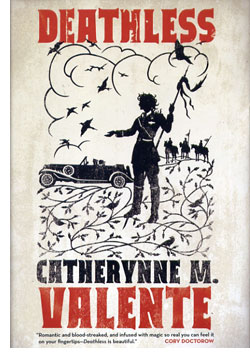
All of this, of course, requires a prose voice up to the task. Few writers can manage that sort of voice; it requires lyricism, poetry and grittiness, and a sort of spoken cadence. In all her work, Catherynne M. Valente has demonstrated a talent for this kind of prose, so it is no surprise that she shape-shifts again and becomes more Russian than mother Russia itself in her latest novel, 'Deathless.' It is another remarkable work that offers many aspects of her previous work, but a very different vision as well.
With 'Deathless,' Valente fearlessly re-writes her prose style to a sleeker, cleaner standard, one that seems perfectly matched with the fairytale and folkloric nature of the story she is telling. The writing is still very musical, but the storytelling language is much more straightforward. The poetry comes in with her utter and complete assimilation of the ethic elements in her story. Balance is key; she retains the Russian vocabulary and names but keeps the plot moving at a brisk pace.
Maria Morevna lives in a realm where fantasy and reality are seamlessly wed and becomes the bride of Koschei the Deathless. Baba Yaga requires she complete three tasks and the real horrors of Stalinist Russia serve as a backdrop for the surreal supernatural agenda. Valente offers a rich, dark, powerful novel full of the stuff of life – romance, terror, doubt, and ignorance. For all the complicated mythology and plotting, the book successfully offers the appealing simplicity of folklore.
Valente is particularly skilled at creating a reading experience that is satisfying in two very different realms. On one hand, she offers wonderfully fun gods and monsters in a fantastic landscape. But we as readers know that the fantastic here has a real-world origin in folklore. This is not fantasy for fantasy's sake; there's a rich and powerful political and historical backdrop as well. Valente has done more than research her subjects; she's assimilated them so well that they have become natural to her; even those that are supernatural.
As much as we might like to think that the triumph of science and rational thinking has helped us to leave superstition and the irrational behind, that is simply not the case. These perceptions are a part of being human, and what led to the invention of science in the first place. 'Deathless' reminds us that every moment of our lives can be important to us, and that should we choose to read, we'd best do so carefully.
05-02-11:Daniel Clowes is 'Mister Wonderful'
The Cringe Binge
We adore embarrassment, so long as it is not our own. Those who make us uncomfortable, whose misfortunes are so overwhelming as to inspire laughter instead of tears, are beacons of hope to anyone with anything left to lose. But it takes a consummate artist to create losers we love.
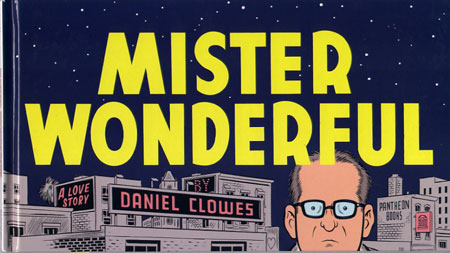
Daniel Clowes has proved time and again that he is just such an artist — a graphic artist whose unique stories combine a seemingly simple visual style with a sophisticated psychological understanding. In his latest work, divorced, 40-something Marshall is set up on a blind date. What could go wrong? The result lives up to the title, 'Mister Wonderful,' a pitch-perfect combination of poignant and painful.
Like most brilliant writers, Clowes makes it all look very easy, so easy the reader must slow down to understand all the complicated effects that go into the story. Visually, his cartooning style is very simple, but the details are telling and powerful. He manages, with a few brief strokes, to use an abbreviated technique that creates a hyper-realistic texture. The reader feels right at home in his bars, diners, and city streets. When he adopts a more impressionistic feel, the results are powerful.
As in most of his recent work, character is king in 'Mister Wonderful.' Marshall is a powerfully realized character precisely because the story that unfolds is so everyday, so lose-lose. From the very first frame, the tension is high, as we wonder if Marshall's date will show, or worse, if she will show up and be unpalatable even to Marshall. What follows is a comedy of small-scale urban terrors, the kind of things we're all scared will happen to us precisely because we know we can and will live through them.
Marshall is nicely balanced by his blind date Natalie. Marshall starts off a bundle of nerves whose internal monologues blot out the words of those around him, including Natalie. She seems so nice, and Clowes draws her as attractive. But as the story evolves, we learn that she may indeed be an appropriate date for Marshall. This does not bode well for Marshall, Natalie, or their date.
Clowes keeps his plot in concert with the visuals; it's brisk and sparse. There are just enough details to ensure the we are immersed in the reality that Clowes is giving the readers, but not so many as to overwhelm story and character. The bad party, and the other entertaining events that accost our unfortunate couple seem like the sort of ill luck that the Marshalls of this world manage to draw to themselves with little or no effort. He even gives us a welcome glimpse of the couple who set up Natalie and Marshall. It's a great perspective and perfectly in keeping with the low-key nature of Clowes' world.
Clowes is a clever writer of graphic novels even when he is restraining his work and focusing on realistic characters. There are lots of nice touches here, with childish fantasies drawn in a child-like manner, inner monologues that blot out actual speech, and imagined mini-Marshalls, little jerks that encourage a self-destructive self-perception. Anxiety has never been so richly rewarding.
For all the initial squirming and teeth-grinding that 'Mister Wonderful' inspires, it ultimately lives up to the title. Marshall is not totally redeemed, but Natalie is not the gift from above that every schlub hopes to find. Still, the two of them, in their wittily rendered world, are indeed a joy, and their discomfort proves to be something of a balm for readers who might themselves have felt a bit left behind by the go-getters in this world.
Clowes writes and illustrates with the kind of smart perceptions and depths of understanding that reward repeated readings. The fact that readers might want to relive Marshall's and Natalie's first date ultimately says more about Clowes' writerly skill than it says about his readers' social lives. We cringe and cringe again not because we like to see Marshall feel bad, but because Clowes' artistry makes us feel good, no matter how embarrassing or familiar his subjects may be.
New to the Agony Column
09-05-15: Commentary : Susan Casey Listens to 'Voices in the Ocean' : Science, Empathy and Self
Agony Column Podcast News Report : A 2015 Interview with Susan Casey : "...the reporting for this book was emotionally difficult at times..."
08-21-15: Agony Column Podcast News Report : Senator Claire McCaskill is 'Plenty Ladylike' : Internalizing Determination to Overcome Sexism [Incudes Time to Read EP 211: Claire McCaskill, Plenty Ladylike, plus A 2015 Interview with Senator Claire McCaskill]
Agony Column Podcast News Report : Emily Schultz Unleashes 'The Blondes' : A Cure by Color [Incudes Time to Read EP 210: Emily Schultz, The Blondes, plus A 2015 Interview with Emily Schultz]
07-05-15: Commentary : Dr. Michael Gazzaniga Tells Tales from Both Sides of the Brain : A Life in Neuroscience Reveals the Life of Science
Agony Column Podcast News Report : A 2015 Interview with Michael Gazzaniga : "We made the first observation and BAM there was the disconnection effect..."
04-21-15: Commentary : Kazuo Ishiguro Unearths 'The Buried Giant' : The Mist of Myth and Memory
Agony Column Podcast News Report : A 2015 Interview with Kazuo Ishiguro : ".... by the time I was writing this novel, the lines between what was fantasy and what was real had blurred for me..."
Agony Column Podcast News Report : A 2015 Interview with Marc Goodman : "...every physical object around us is being transformed, one way or another, into an information technology..."
Agony Column Podcast News Report UPDATE: Time to Read Episode 199: Marc Goodman : Future Crimes: Everything Is Connected, Everyone Is Vulnerable and What We Can Do About It