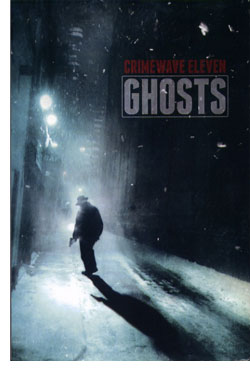
03-17-11:'Crimewave 11: Ghosts' Reviewed by Mario Guslandi
Excellent Stories
Review By Mario Guslandi
I'm not attracted by e-books and I dislike PDF files, which, instead of a nice book, print out as hundreds of loose paper sheets. I guess many people share my view and prefer to read fiction on printed paper.
But I've got another idiosyncrasy: I don't like reading fiction in magazines; I only enjoy it if it's bound in an actual book. So I never gave much thought to Crimewave (in my mind just a magazine of crime stories), being already busy enough with horror and dark fiction books. But after reading Rick Kleffel's presentation of issue 11, I realized that Crimewave is actually a real book. The latest Crimewave anthology was attractively entitled Ghosts and Rick was rather enthusiastic about it.
So, here I am, wondering how and why I have been so stupid to miss the previous ten volumes. Because, believe me, this is a great anthology featuring a lot of excellent stories.
Dave Honig sets the standard with "The Shoe Store/The Blood Cools" an outstanding piece about serial murders in a small town, which bookends splendidly the volume as a great example of fascinating storytelling. The eclectic Christopher Fowler contributes "The Conspirators", a perfect piece of cold, ruthless fiction depicting the ferocity of the unforgiving world of business, where crime is simply part of the game.
Nina Allan's "Wilkolak" is another extraordinary tale providing the insightful description of the dangerous relationship between an amateur photographer and the man he thinks is a murderer. In the captivating and gripping "Holderhaven" Richard Butner probes a wealthy family's old secrets still hidden in a mansion now turned into a museum. "Eleven Eleven" by Cheryl Wood Ruggiero, featuring an amazing twelve year-old girl, is a delicate, bitter story of innocence and murder, love and vengeance, faith and despair. In "Living Arrangement" Steve Rasnic Tem draws the masterfully cruel portrait of a hellish family life where a grandfather has to take care of a problem in a tragic but effective manner, while in "4am, When the Walls Are Thinnest" Alison J Littlewood gives a supernatural twist in the tail of a chilly tableau of prison life.
Among so many incredibly good stories the one ranking first, in my opinion, is "Where the Bodies Are" by Ilsa J Bick, graced by a superb narrative style and a great characterization. A psychiatrist and her former lover, a detective, meet again after many years to deal with a case of possible infanticide and with long buried secrets from their own past.
I strongly recommend this book not only to crime fans, but to any fiction lover.
03-16-11:Kris Saknussemm Returns to Zanesville
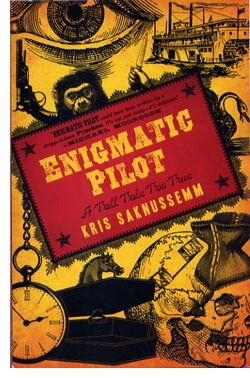
'Enigmatic Pilot'
We all have a past, even books. Take, for example, Kris Saknussemm's 'ZanesVille' which unfolded in the near future, but began with Lloyd Meadhorn Sitturd back in 1839. Now, in 'Enigmatic Pilot: A Tall Tale Too True' (Del Rey / Random House ; March 22, 2011 ; $16), Saknussemm steers an eccentric and entertaining course through a surreal version of our past. It's a secret history, stories hidden within our past, a book of lies that feel true and truths that seem to damage our minds. But ultimately it's the story of a family, of a son coming of age. And a lot of clockwork.
'Enigmatic Pilot' is beyond the world of regular books. Saknussemm is a very peculiar writer, who manages to write outside of just about any box you might seek to contain him. He uses elements of every type of fiction, but the result is a cohesive whole that resists labeling, summary and description. He seems blissfully unaware of anything that has come before him. In a sense, he's a perfect example of American Invention.
The America he invents in 'Enigmatic Pilot' is not the one we generally hear about in history books. Saknussemm's mid-nineteenth century America is a place of wonders and weirdness. A clockwork falcon threatens a US Cavalry Scout and Mother Tongue whispers into young Lloyd Sitturd's ear. Ambassadors from Mars, or perhaps not from Mars, fall from inside a tornado. Secret societies are jockeying to control the timeline, but ultimately, Saknussemm prevails.
The key to this assemblage is Saknussemm's prose, which is sharp and marvelously prickly. He captures the unseeable and makes plain the unknowable. There's s rich feeling to his words that helps him slow down time so that we can enjoy every morsel of story. He keeps the dialogue in the 19th century where it belongs, a technique that is especially effective in keeping us firmly rooted in his version of the real world.
We need those roots, because the plot of Enigmatic Pilot' is literally all over the map. We start in ZanesVille, Ohio, with the clubfooted Hephaestus Sitturd, who takes delivery of a message from his half-brother, Micah. But it's no simple envelope; instead it's an invitation take his wife, Rapture and their son, Lloyd, from Ohio to Texas. The quintessential westward journey, with promises of riches beyond avarice when they arrive. But this is also a spiritual journey for the reader, a mind-expanding experience meant to undercut our understanding of what was and replace it with the products of Saknussemm's fertile imagination. Here's where the author really succeeds; he deftly turns story into history.
'Enigmatic Pilot' is often very funny and subtly scary. There's a deeply paranoid feeling about Saknussemm's vision, and he's great at evoking the uncanny to make the reader uneasy. The real feat is that Saknussemm does this in a rip-roaring adventure full of close calls and great set pieces. Language itself springs to life. Nothing is what it seems; America itself is hiding something. 'Enigmatic Pilot' is a vision of the hidden, an excavation of the past we never knew that leads us to a present we know all too well.
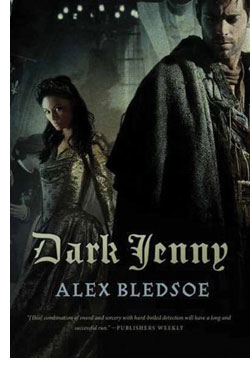
03-15-11:Alex Bledsoe Sheds Light on 'Dark Jenny'
Drink Deep From the Well of Death
Fantasy fiction is in many ways our oldest fiction and our oldest literature. The problem is that it is difficult to tell where history leaves off and fantasy begins. The legends of King Arthur provide a perfect example of this. Arthur's actual existence is debated, but his importance to history as a character in fantasies and romances make the actuality irrelevant. He's a great fountain of stories that can be told, untold and retold with each passing generation. From Le Morte D'Arthur to 'The Once and Future King' to 'The Mists of Avalon,' King Arthur continues to live a full literary life.
Alex Bledsoe has been offering readers some delightful sword-for-hire fantasies featuring Eddie LaCrosse; LaCrosse's debut was 'The Sword-Edged Blonde' from Night Shade Books, followed up by 'Burn Me Deadly.' Given the setting it was probably only a matter of time before we'd meet 'Dark Jenny' (Tom Doherty Asssociates / Tor Books ; March 29, 2011 ; $14.99).
'Dark Jenny' begins with the arrival of a coffin at Angelina's Tavern in the dead of winter. Of course, LaCrosse knows the contents and finds himself telling the tale of what's inside and how it got there. Eddie buys the drinks and takes his listeners back some twenty years, the Golden Isle of Grand Bruan and the Golden Age of King Marcus Drake and his queen Jennifer. Eddie was there when things started to sour, and found himself accused of a crime he did not commit. His only hope is to find the real killer.
If the story sounds familiar, that's because Bledsoe is working on a Myth that refuses to die. Of course, this being an Eddie LaCrosse story, the myth is not the only thing that refuses to die. The pleasures to be found in the latest Edie LaCrosse adventure are many. Bledsoe has a great hold on every aspect of the writing and story. From the first word, we know we're getting a hard-boiled detective story, but the cognitive dissonance caused by the Arthurian setting sets up a pleasant buzz. Bledsoe's prose is tight and self-assured, with just the right amount of swagger for the PI role, but just enough diffidence to the fantasy setting to keep things lively. It's really fun to read Bledsoe, because he's able to pull off interrogation scenes involving poisoned apples; "Did you really have those apples with you the entire time?" Clearly this is a man who takes his setting but not himself quite seriously.
But it's not just the prose that makes this book enjoyable. Bledsoe has lots of fun with the plot, jockeying the familiar elements around enough to create a compelling mystery in a wonderfully evoked setting. His take on the Arthurian legends gets a great hard-boiled spin that keeps it fresh and unpredictable. But there's also a nice counter-current of wry literary humor at work here. Bledsoe is smart enough to keep the action on the up-and-up, and never turns the work into overt satire of any of the genres he's exploring.
Bledsoe's latest is a superb work of fantasy; he treats the Arthurian Legend template with respect, and does some great imaginative updates. The mystery itself is solid and compelling, and LaCrosse is an appealing character who becomes richer and complex with every novel. Though it is part of a series, it works well enough alone. 'Dark Jenny' is just the sort of bright light that the fantasy genre and its readers deserve.
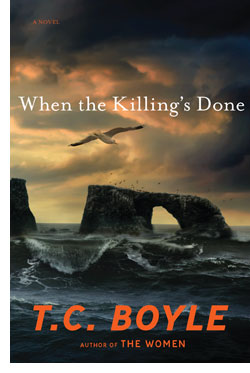
03-14-11:T. C. Boyle Knows 'When the Killing's Done'
Human Nature
We have National Parks, National Forests, and National Marine Sanctuaries — the wild defined and enclosed. Within those designated spaces is nature, red in tooth and claw. The untamed wild is set aside and preserved in an outdoor version of the jam jars with holes punched in the lids we used as kids to hold our insects captive. The creatures in those jars were indeed wild, even after we set them on our nightstands, usually condemning them to death. But if we set aside a portion of the land and call it nature, what do we become when we enter that domain? Are we human on one side of the line and something else on the other?
Blurring lines is one of T. C. Boyle's many literary strengths, and he draws up overlapping maps of human perception in 'When the Killing's Done' (Viking / Penguin Putnam ; February 12, 2011 ; $26.95). Boyle's latest novel pits two natural — in all senses of the word — allies against one another in a complex contemplation of where exactly nature ends and man begins. It's a ripping yarn that encompasses the rage of nature and the frailty of human morals, then lets the reader wonder whether or not there is a difference.
Boyle begins with a telling epigraph from the Bible, wherein Gods hands over ownership of the animals to humanity. The problem is, of course, that we are animals, even Alma Boyd Takasue, the National Park Service biologist in charge of exterminating invasive species on California's Channel Islands, and Dave LaJoy, an animal rights activist who opposes killing of any animal. Boyle balances these potential allies nicely. Alma is quiet and reserved, but dedicated to the preservation of the species unique to this environment. Of course, she'd prefer not to kill anything. But looking at the potential extinction of species unique to the Channel Islands, it is clear to her that she has no choice. She has made the right decision for nature and for herself. Boyle immerses readers in the perceptions of a character who sees everything around her in terms of a balanced or unbalanced ecosystem, even traffic jams. She's a joy to read.
Dave LaJoy, on the other hand, is a cranky self-made minor millionaire who has a moment of insight that turns his inner selfishness into a single-minded mission to "save the animals," no matter how repulsive or destructive they may be. He's certainly not a guy you want to eat dinner with, as the chances are great that he will send back his meal if it doesn't suit his tastes. Not much suits LaJoy except his girlfriend, Anise Reed, and the elaborate pranks he pulls to carry on his quest. LaJoy's character inspires Boyle's prose to sublime comedic highs.
'When The Killing's Done' fires off with a powerfully written shipwreck off the island of Anacapa, a historical tale that leads us into the present. Throughout the novel, we read of shipwrecks and awful island conditions, and it's Boyle's descriptive prose that puts us in these rough, natural landscapes. Boyle's so good you won't think until well after you've finished the book about how the very-human Boyle managed to evoke the ravaging awe of nature with nothing but words. What could be more artificial than words, a uniquely human creation? And that is indeed the question that Boyle spotlights from all angles, casting shadows in every direction. The dead-certain moralities of the characters serve only to highlight the readers' more ambiguous overview. This book is a pleasure to read on a variety of levels.
As a novel, 'When the Killing's Done' is both fast-paced and cleverly constructed. The set pieces offer comedies that escalate into tragedy, and grand human suffering that is dwarfed by the machinations of the Rube-Goldberg results when man tries to manipulate nature. Every line is drawn with crystal clarity and then blurred by the farcical nature of that busiest of animals, Homo sapiens. Perhaps "sapiens" is overstating the matter. We like to think we can think. But we're just walking chemical factories like every other living thing on this earth. The problem is that we're able to build chemical factories. It's natural for us to do so. But are the factories themselves natural? 'When the Killing's Done' is a page-turner that will alter your perceptions of your own place in nature, and make it entertainingly difficult to decide where you end and nature begins.
New to the Agony Column
09-05-15: Commentary : Susan Casey Listens to 'Voices in the Ocean' : Science, Empathy and Self
Agony Column Podcast News Report : A 2015 Interview with Susan Casey : "...the reporting for this book was emotionally difficult at times..."
08-21-15: Agony Column Podcast News Report : Senator Claire McCaskill is 'Plenty Ladylike' : Internalizing Determination to Overcome Sexism [Incudes Time to Read EP 211: Claire McCaskill, Plenty Ladylike, plus A 2015 Interview with Senator Claire McCaskill]
Agony Column Podcast News Report : Emily Schultz Unleashes 'The Blondes' : A Cure by Color [Incudes Time to Read EP 210: Emily Schultz, The Blondes, plus A 2015 Interview with Emily Schultz]
07-05-15: Commentary : Dr. Michael Gazzaniga Tells Tales from Both Sides of the Brain : A Life in Neuroscience Reveals the Life of Science
Agony Column Podcast News Report : A 2015 Interview with Michael Gazzaniga : "We made the first observation and BAM there was the disconnection effect..."
04-21-15: Commentary : Kazuo Ishiguro Unearths 'The Buried Giant' : The Mist of Myth and Memory
Agony Column Podcast News Report : A 2015 Interview with Kazuo Ishiguro : ".... by the time I was writing this novel, the lines between what was fantasy and what was real had blurred for me..."
Agony Column Podcast News Report : A 2015 Interview with Marc Goodman : "...every physical object around us is being transformed, one way or another, into an information technology..."
Agony Column Podcast News Report UPDATE: Time to Read Episode 199: Marc Goodman : Future Crimes: Everything Is Connected, Everyone Is Vulnerable and What We Can Do About It