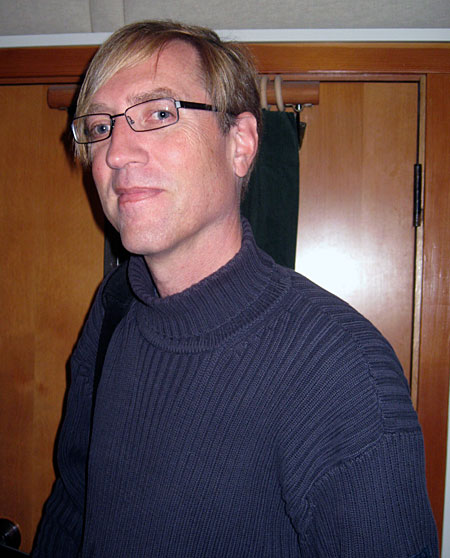
01-27-11:Chuck Palahniuk Interviewed on Stage at Café du Nord on May 20, 2010
"..now we're sophisticated enough to recognize the language of movies...."
—Chuck Palahniuk
Movies, books — when you're talking to Chuck Palahniuk, what's the difference? Palahniuk's vivid imagery, his plotting, his delivery all translate so seamlessly in our minds into movies that adaptation seems like an afterthought. That's particularly true of 'Tell-All,' which shortcuts the process by being written in the language of movies.
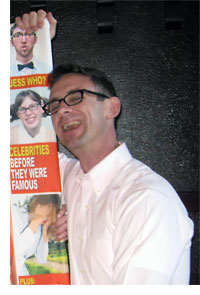
My conversation with Chuck Palahniuk on stage at the Café du Nord took place only a few hours later than the hotel-room interview, but the circumstances could not have been more different. By the time we sat down to talk, I was sweating bullets because I was wearing a long-sleeve cotton shirt. By that time, I'd been admonished about not like, destroying the light fixtures by virtue of my wild throwing technique. [I'd also like to add that blow-up Oscars are not particularly aerodynamic or made for hurling long distances.]
But I was super-prepared for that interview. There were more stickies in that book than pages, so when we sat down finally, it was really a relief. There was just one more trick to pull off — to do a completely different interview than the one I'd just done not 7 long hours ago.
01-26-11:Dale Pendell Reads at SF in SF on November 13, 2011
"The Great Bay"
We need live literary events for a lot of reasons. Book readers benefit from meeting other readers, from the discourse of talking with a stranger with whom you share a very intimate experience — a reading experience.
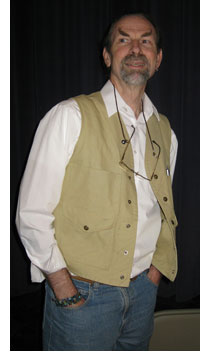
But the main thrust of live literary events is exposure to new writers, and in the case of SF in SF, writers like Dale Pendell. Here's a guy I should have heard of long ago, but might never have crossed my path were it not for the efforts of Rina and Jacob Weisman and Terry Bisson. Pendell is a truly unique writer who in a sense works his own one-man genre.
Pendell has written a lot of weird stuff, the kind of books you can't really categorize. Terry Bisson notes in his introduction to Dale that Dale won a Best Green Book Award for 'The Great Bay.' He's best known for the Pharmako trilogy.
OK, I said trilogy and immediately you were thinking ... fantasy.... science fiction, some sort of future deal in a druggish world, right? Sorry, please play again. Pendell's idea of a trilogy is three books about psychedelic plants, based on his experiences with them. They are scientific treatises and poetic explorations of consciousness and states of mind. They're both hard to find and not to be missed.
01-25-11:A 2011 Phone Interview with Siobhan Fallon
"I really liked that idea of one of the characters eavesdropping and the things that she would be aware of in that housing community."
—Siobhan Fallon
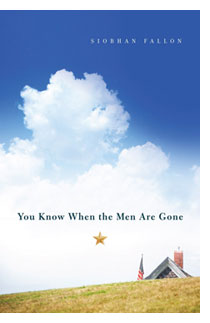
If you're looking for a good bet on collectible first-edition hardcovers, step on over and make sure you're first in line for Siobhan Fallon's 'You Know When the Men Are Gone' (Amy Einhorn Books / G. P. Punam' Sons / Penguin/Putnam ; January 20, 2011 ; $23.95). The last book to come out from this imprint was 'The Help,' and that's still on the bestseller lists. But the real reason to look for this book is the fact that the stories are stellar.
I managed to get Siobhan (shu-VAHN, in case you were wondering, and I must admit that I was wondering), on the phone to talk about her collection before her upcoming appearance at Capitola Book Café, this Thursday, January 27. I'm sure she'll be near most of my readers soon, so keep an eye out for appearances at your local independent booksellers. You do want a first edition here, or more likely two, one to file, and one to read then loan to your friends who miss out, just to make sure that they don't have to miss out.
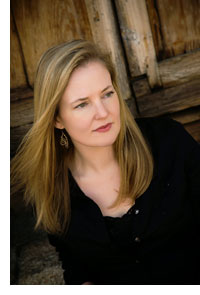
Siobhan took the old writer's line, write what you know and ran with it; and what she knew as she wrote these stories, was the life of an Army wife at Fort Hood, Texas. It's an insular community, full of odd rules and rife with intense emotional currents. Women and their children live on top of one another, know one another's business and see one another's lives. Fallon captures this gracefully in a series of linked stories.
I talked to her about the short story form, her character arcs and her note cards. Oh yes, she has note cards. I wonder; how come we never see the note cards when they're being created? It's the kind of thing that makes you want to look more closely at those around you. So ask yourself; who in your general vicinity, is eavesdropping on you? What are you saying and what are they making of it? What notes are being cribbed onto index cards right now?We only hear about them when it is too late, when the book is in the stores, as you can, when you listen to the linked MP3 audio file.
01-24-11:A 2011 Interview with Paul Pierson
"There's a particular story that's going on here."
—Paul Pierson
I take a fair number of road trips to gather audio for this podcast, and my broadcast show on NPR affiliate KUSP. To my mind, these trips are a great way to get out of my usual habitat. By virtue of having to take my gear hither and yon, I get a new perspective on what I'm hearing.
To speak to Paul Pierson, I set up studio time at KPFA in Berkeley. Here I get the best of both worlds. They have superb studios with great sound and comfortable seating. These are great places to talk. But I can also just bring my own portable recorder and record on an SD card. I've been lugging that recorder around for years now, and the familiarity of the equipment means I get good recordings in a somewhat unfamiliar setting. And as I sat down to talk to Paul Pierson, I asked him to read from his book. Surprisingly, nobody else had bothered to do this.
The conversation that followed the reading was easy to start and actually rather hard to stop, once we got going. Pierson is an engaging speaker, happily well-versed in his own book, and there's a lot of great material to talk about that is on the edges of the narrative itself.
One of the most interesting aspects of the book and their thesis centers around the idea of what they call "drift." Pierson and I talked quite a bit about how what is not done is sometimes more important than what is done. This is not an easy thing to wrap your brain around, because actions are easily tracked and described; inaction is by definition not trackable. But in conversation, we got to the core of how drift not only preserves and enlarges the luxury gap, it also makes changes that would correct the problems more difficult.
One thing that is easy to get wrong is the pervasive effect of the wealth of the wealthy. It's easy to assume that it affects one side of the political divide and not the other, but that is not the case. Both parties have found themselves working at the behest of the upper, upper echelons. Some of the most ardent ostensible foes of the trickle-up economy unfortunately happen to have those who benefit as their constituents by virtue of geography. Pierson and I talked about these "Republicans for a day," and how the corrosive nature of the huge figures involved — and the huge figures required to run for office, erode the best of intentions.
08-21-15: Agony Column Podcast News Report : Senator Claire McCaskill is 'Plenty Ladylike' : Internalizing Determination to Overcome Sexism [Incudes Time to Read EP 211: Claire McCaskill, Plenty Ladylike, plus A 2015 Interview with Senator Claire McCaskill]
Agony Column Podcast News Report : Emily Schultz Unleashes 'The Blondes' : A Cure by Color [Incudes Time to Read EP 210: Emily Schultz, The Blondes, plus A 2015 Interview with Emily Schultz]
07-05-15: Commentary : Dr. Michael Gazzaniga Tells Tales from Both Sides of the Brain : A Life in Neuroscience Reveals the Life of Science
Agony Column Podcast News Report : A 2015 Interview with Michael Gazzaniga : "We made the first observation and BAM there was the disconnection effect..."
04-21-15: Commentary : Kazuo Ishiguro Unearths 'The Buried Giant' : The Mist of Myth and Memory
Agony Column Podcast News Report : A 2015 Interview with Kazuo Ishiguro : ".... by the time I was writing this novel, the lines between what was fantasy and what was real had blurred for me..."
Agony Column Podcast News Report : A 2015 Interview with Marc Goodman : "...every physical object around us is being transformed, one way or another, into an information technology..."
Agony Column Podcast News Report UPDATE: Time to Read Episode 199: Marc Goodman : Future Crimes: Everything Is Connected, Everyone Is Vulnerable and What We Can Do About It