12-21-10:Karen Armstrong Offers 'Twelve Steps to a Compassionate Life'
Smart Programming
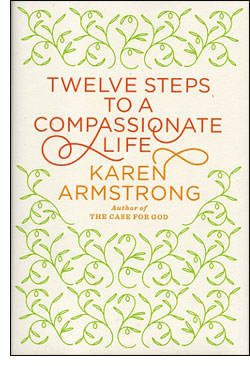
If you pay attention to books, if you read deeply and across a wide variety of subject and style, one of the rewards you will find is that you begin to develop a sense of cultural convergence. And from the conversations that I have had of late, with writers like Stephen S Hall, about his book 'Wisdom,' Karen Armstrong, about her book 'The Case for God,' Steve Kotler on his book 'A Small Furry Prayer,' or novelist Philip Roth about his book 'Nemesis,' it seems that we are heading towards a deeper understanding of the importance of compassion. In a sense, you would know that 'Twelve Steps to a Compassionate Life' by Karen Armstrong (Alred A. Knopf / Random House ; December 28, 2010 ; $22.95) was ordained.
Here's a perfect excuse for you to go to your local independent bookseller and buy not just one, but two or three copies of a book that will certainly change your life and the lives of those you give it to for the better. Trust me, before you finish this book, you will want to give it to someone you love; and not just because it is a perfect book-as-gift, but as well, because you will know not just that giving is the right thing to do, it is the thing that will make you feel best, and actually make you better. Just be sure to tell the person that you give it to that you are grateful to have them in your life, and that this is your way of showing that gratitude.
Karen Armstrong and I talked for quite a while about the virtues of compassion, and its central role in most of the world's religions. In her latest book, she both concisely and at length looks into the value of compassion; what it is, and how it makes us better, happier and more able to make those around us better and happier. But this is not glib advice or Pollyanna happiness. Armstrong takes an exciting, scholarly approach to the subject, exploring from the inside out. From you to the world.
Armstrong's book is divided into a Preface and Twelve Steps, or more precisely, rings. The Preface ("Wish for a Better World") talks about her TED award in 2007, which led to the creation of the Charter for Compassion. It's admirably succinct and very smart. She follows on with some history of the word itself, and lays out a bit of a map of the book. This is a different sort of journey and these are different sorts of steps. You start by learning what compassion is, and then look not at the world, but at yourself.
For all that Armstrong cites positivism, 'Twelve Steps to a Compassionate Life' is not necessarily what you would call a feel-good book. It is a smart look at what it argues is our most important emotion, an exciting academic exploration. Here is where Armstrong's prose comes to the fore. She has a talent for writing sentences and paragraphs that are compellingly crafted arguments, the sort of writing that at once makes complex concepts seem simple, while making the reader feel really smart. She's clear, but chock-a-block with the sort of details that stick in your mind. Her words almost act like illustrations in a book on anatomy.
But this is indeed a book about the best parts of our mental, perceptual and cultural anatomy, those things that make the human race capable of greatness. Rather than recite a laundry list of chapter titles and attempt to summarize what Armstrong herself summarizes so well, I'm going to suggest that readers make the trip to the bookstore and start by showing compassion to their booksellers. As with all compassionate acts, the doing will reward you more than you yourself are giving away, or as it were, "spending." Start by being compassionate to yourself, then journey outward. You will find your path converging with others, and chances are that they have read some of the same books you have. Exercise your mirror neurons. When any of us looks in the mirror, we all see the same thing: human.
12-20-10:David Rohde and Kristen Mulvihill Offer 'A Rope and a Prayer'
Personal History
Every day we live to look back upon is history. Yet even when we live it, it's difficult to learn from our own history. So often, we make the same mistakes in our lives again and again. But that does not stop us from trying to improve our lives. It is the hope that has launched a thousand thousand self-help books. These books often turn on a single thought; they force us to examine our personal histories from the perspective of the author's premise. In a sense, they personalize our personal histories.
So how can the people of a country or a culture learn from history? The details of our nation's exploits are there for all to see and none to agree upon. Viewed from afar, what should be perspective is transformed into wiggle room. We pick and choose the facts to suit our beliefs.
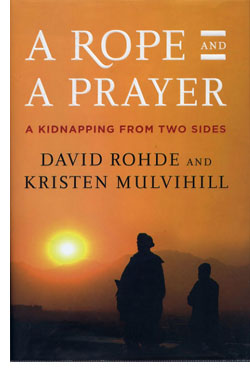
There's no picking and choosing going on in 'A Rope and a Prayer,' by David Rohde and Kristin Mulvilhill. The story of the kidnapping of New York Times reporter David Rohde, and how his new wife, Kristen Mulvihill, negotiated for his release, is laid out in sparse, harsh details. Though it reads like a page-turning action-packed thriller, it's all undeniably true. A reader cannot help but be moved, and moved to think about our nation's foreign policy. This is history wrought small, and very powerful. This is personal history.
The game plan is simple. In alternating chapters, 'A Rope and a Prayer' tells the story of David Rohde's 2008 kidnapping by a sort of Taliban mafia, from his perspective, and from that of his new wife, Kristin Mulvihill. Neither wastes a single word. Eight pages in, Rhode, who is hoping to score one more interview that will add perspective to his book on Afghanistan, is kidnapped by armed men, including the man he was supposed to interview, Abu Teyy. His translator, the man who set up the interview, Tahir, and their driver, Asad, are also taken. His kidnappers initially seek $25 million ransom and the release of some fifteen prisoners. Kristin Mulvihill, his wife, first gets the news from David's older brother Lee, but her smart, accommodating relatives let her take charge of the negotiations. It's not fun — the Taliban call collect when they demand these multi-million dollar ransoms.
The back and forth story constantly seems about to come to an abrupt and generally unhappy end as Rohde's captors consistently lie to him about his fate. He's dragged from one surreal situation to another and along the way meets a variety of fascinating and weird people. High-tech jihadis and suicide bombers are his guards, and the man who seems to be in charge of his kidnapping take on a variety of names and personalities, sometimes kind, sometimes hectoring, sometimes casually brutal. Rohde is well-taken care of physically, and lackadaisically guarded. He often contemplates escape.
Mulvihill finds herself in equally surreal albeit seemingly friendlier company. The FBI steps in with silent power, but not a lot of grace. Legally, it seems there is little they can do beyond provide helpful advice and gather potential evidence for eventual prosecution. All our laws, police and armies are legally prevented from participating — officially. Mulvihill's and Rohde's families are Kristen's first line of help. She has allies beyond, but they are not easily found, and what they can do is quite unpredictable.
'A Rope and a Prayer' is a compelling, engaging book to read, and it is almost possible to read it for thrills alone. Rohde and Mulvihill are both engaging writers with very different voices. Rohde writes hard facts with a deep feeling of regret and responsibility. If anything, he underplays the severity of what happens to him, because he is busy taking the brunt of responsibility for getting himself into this position in the first place. But he has a keen eye for developing the characters of his comrades and his captors, as well as his own state of mind. And he is being dragged at gunpoint, generally laying down in the back seats of cars, around one of the most dangerous places in the world.
Mulvihill finds herself stepping into situations whose contrasts threaten to submerge her in the surreal. She's supervising the photo shoot of a fussy celebrity, then stepping out to view kidnap video in a car parked in front of Starbucks. She approaches her extreme situation with an understated appreciation of the absurdity, a quiet sense of humor that is pretty funny given the horror she is clearly simultaneously experiencing. She's deeply in love with her new husband and intent on following her gut instinct, which generally proves to be correct.
Beyond the thrilling and the emotional power of this book, there is a deep sense of the cultural and political decisions that have created the world in which we find ourselves. Rohde has been in Afghanistan for years now, and his captivity offers him a chance to reflect and recount the actual history that not only got us into this conflict, but beyond that, the deep history of the region. All of this is tied into the deeply personal history of what is happening to Rohde at any given moment, and it's a potent combination. Rohde makes history exciting, relevant and real. Mulvihill, meanwhile, offers a concise vision of the kidnapping process from the perspective of those being compelled to pay ransom or meet demands. As readers, we join her on a crash course in Kidnapping 101. The lessons we learn are not comforting.
But the overall arc of 'A Rope and a Prayer' does indeed offer substantial comfort — the comfort of knowledge, both factual and emotional. In their entrancing duet, Rohde and Mulvihill manage to make a very complicated message entertainingly and often excitingly clear. This is the excitement of understanding for the first time, the arcane history that has trapped us in a dangerous situation. We see the levers that have been pushed and pulled for centuries. Their history becomes ours — and something we can, potentially, learn from.
New to the Agony Column
09-18-15: Commentary : William T. Vollman Amidst 'The Dying Grass' : An Epic Exploration of Simultaneity
Agony Column Podcast News Report : A 2015 Interview with William T. Vollman : "...a lot of long words that in our language are sentences..."
09-05-15: Commentary : Susan Casey Listens to 'Voices in the Ocean' : Science, Empathy and Self
Agony Column Podcast News Report : A 2015 Interview with Susan Casey : "...the reporting for this book was emotionally difficult at times..."
08-21-15: Agony Column Podcast News Report : Senator Claire McCaskill is 'Plenty Ladylike' : Internalizing Determination to Overcome Sexism [Incudes Time to Read EP 211: Claire McCaskill, Plenty Ladylike, plus A 2015 Interview with Senator Claire McCaskill]
Agony Column Podcast News Report : Emily Schultz Unleashes 'The Blondes' : A Cure by Color [Incudes Time to Read EP 210: Emily Schultz, The Blondes, plus A 2015 Interview with Emily Schultz]
07-05-15: Commentary : Dr. Michael Gazzaniga Tells Tales from Both Sides of the Brain : A Life in Neuroscience Reveals the Life of Science
Agony Column Podcast News Report : A 2015 Interview with Michael Gazzaniga : "We made the first observation and BAM there was the disconnection effect..."
04-21-15: Commentary : Kazuo Ishiguro Unearths 'The Buried Giant' : The Mist of Myth and Memory
Agony Column Podcast News Report : A 2015 Interview with Kazuo Ishiguro : ".... by the time I was writing this novel, the lines between what was fantasy and what was real had blurred for me..."
Agony Column Podcast News Report : A 2015 Interview with Marc Goodman : "...every physical object around us is being transformed, one way or another, into an information technology..."
Agony Column Podcast News Report UPDATE: Time to Read Episode 199: Marc Goodman : Future Crimes: Everything Is Connected, Everyone Is Vulnerable and What We Can Do About It