12-16-10:Karen Joy Fowler Interviewed at SF in SF on October 16, 2010
"...usually, I like to be the person who has the great idea and somebody else does the work of making it happen..."
—Karen Joy Fowler
Interviews can have a variety of formats; and what I have begun to realize is that they all have their virtues. Sure, if you want to get an in-depth vision of an artist at work on a particular title, the long-form interview is the best way to do so. It's tricky to avoid talking just about the content, thus giving away the plot or surprises a book has to offer, while still giving a flavor of the work.
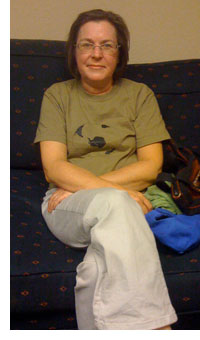
But short form, "pick-up" interviews are fun as well. When I last spoke with Karen Joy Fowler, I had just finished her wonderful short-story collection, 'What I Didn't See.' As I walked out of the interview, I realized that I never got round to those notes I'd taken for her part in '80,' the feschrift for Ursula K. LeGuin
But I had a chance to make up for that oversight when I chatted with Fowler at SF in SF back in October. I call it an oversight, but in reality, when I first spoke with Fowler about her short story collection, by the time I finished covering that, I realized that we'd spoken for nearly an hour. Even though I like to be thorough, I also don't want to try the patience of those I am speaking to — or my podcast audience.
It's always something of a challenge to do these one-on-one interviews at SF IN SF. In the first place, I am constrained by time in two regards. First, there's only a limited amount of time before the show and between the segments, so I just don't have the length of time to do the in-depth thing. Also, though I could go longer were I wait until after the show, by that time, my own internal clock is grinding down. I have a half-hour pack-up and trudge to get the PA and recording stuff back to my car and a two-hour drive home at 10 PM after that, all of which diminish my inclination to do an interview after the show.
Another limitation is the fact that the recorder is patched into the PA. So when I do these interviews, I'm doing a one-mic interview while sitting next to the PA. Fortunately, the guests tend to be as stellar as Karen Joy Fowler, and this time we had a definite but limited subject of my interest at least. But still, very writerly and very interesting to a wide cross-section of readers.
And finally, there is the environment. When I do these interviews we're often surrounded by audience members engaged in their own conversations, which sound incredibly loud to me. It is only because I trust the directionality of my microphones that I can conduct these interviews. But even if the noise is not directed at the conversation I am recording, it can still be distracting.
12-15-10:Claude Lalumière Interviewed at SF in SF on October 16, 2010
"...they're very primal...and they refer to an instinctual memory that we might have ..."
—Claude Lalumière
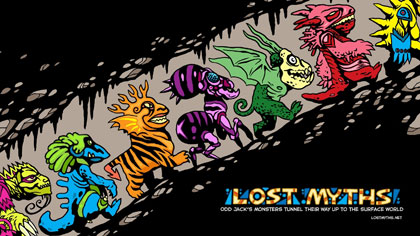
It took me a while to get the name right; not just in print, but also on mic. I guessed wrong, and wrong, and wrong again, but eventually, when he told me I was able to get it right. And then in the first article, the accents. Aigu instead of grave. Well, the beauty of the web is that one can correct such problems, which after all, are only a distraction from the main event — a casual conversation with Claude Lalumière about Lost Myths and found stories.
Lalumière is an interesting fellow in person; he's that sort of writer who is in large part a performer, and you can imagine him, Robert Howard-style, pounding the keys of his computer and shouting out the words as he types them.
For a short reading, Lalumière packed a lot of variation and offered me a lot to talk about. His lost myth really opens up the world of myths, and that's a big conversation, because myths are the original religions and pulp tales rolled into one. For all that the two now occupy utterly opposite regions of the literary world — sacred texts versus profane texts — they once were one and the same. I asked Laumiere about his approach to myth, which proves to be multi-faceted.
I was also quite interested in the performance aspects of Lalumière's reading. It happens that they are not accidents, or just the inspiration of the moment. Lalumière is very deliberate about everything he does in front of an audience, including in this case, the interview in front of an audience that was yet to materialize, and shall not have done so until you follow this link to the MP3 audio file.
12-14-10:SF in SF, October 16, 2010 : Terry Bisson, Karen Joy Fowler and Claude Lalumière
"I think that I'm involuntarily very imitative of voice and rhythm..."
—Karen Joy Fowler
Terry Bisson is always looking to shake things up, and as the moderator for the SF in SF series of conversations with writers, he's got lots of options. He can simply start talking, and that's his best gambit. He's prone to make observations about genre fiction that many are not, given his long experience on all sides of the field. But he can also play with the process of the show, and that's what he did on October 16.
Rather than going on for a while in a discussion with the two writers, Bisson opened things up to questions off the floor pretty quickly. Fortunately, those in attendance were not shy, and there were enough pros or semi-pros there to keep the questions relevant.
And better still, we got Karen Joy Fowler talking about her writing process with Claude Lalumière. Fowler is a natural teacher of sorts, and she has the skill to talk about her writing in a manner that makes what she writes seem as interesting to hear about as it is to read. Her insights into the writing process are valuable information to any sort of writer.
"...there was no coming back, and yet we were storing our stuff..."
—Syed Afzal Haider
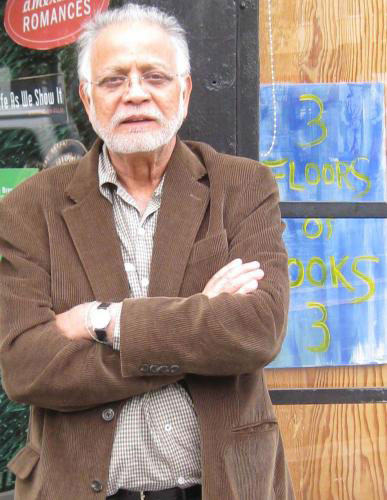
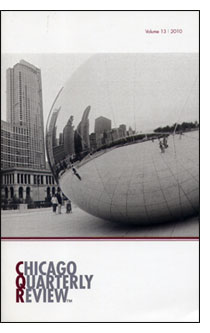
Some things come together quite quickly and unexpectedly. So when Elizabeth McKenzie, author of 'McGregor Tells the World' sent me an email asking me if I wanted to interview Syed Afzal Haider, I reflexively said yes. Then I realized that I was driving down to Los Angeles that day. That's how I came to be sitting with Haider in the office at Capitola Book Café at 8 AM on a Monday morning, talking about his work as an editor for The Chicago Quarterly Review. I didn't realize that I'd be making a side trip to Pakistan via India.
Haider's first novel is an immigrant's bildungsroman, novelized, as it were from his experiences abroad and in the US. Frankly, my first interest was his gig as the Editor of one of our still existing esteemed literary journals. For me as a writer (in the distant past, in another quantum reality), I used to see these literary journals as having always existed, from Time Immemorial. How could they not? The true arbiters of literary quality in the United States, the last bastions of the non-genre short story, the bricks from which our literary heritage is being built must have simply been ordained into existence.
Actually, that turns out not to be the case, and Haider told me the fascinating story of how the Chicago Quarterly came to be. It was not decreed at a meeting of the Poets Laureate, Living and Dead, nor was it cast into stone by Herman Melville and Norman Mailer with the aid of H. G. Wells' Time Machine. The beginnings of this journal speak to the quality it has attained, through the hard work of writers and editors like Haider.
As we began to speak about his novel, he told me his personal story, which not surprisingly, sounds itself like a novel. It was a very bracing and informative conversation, one of those sparks that happens when two people who care greatly about writing happen to tuck in to the rough and tumble stuff of life and literature. To be honest, I went in expecting some twenty minutes of talk about The Quarterly and some about the novel; not the kind of connected conversation that could have gone on longer. I have to admit that the interview rather propelled me right out of the bookstore with all the energy I needed to make the six-hour drive from Aptos to Topanga Canyon. After all, I'd already been from India to Pakistan, skirting the massacres, in this conversation that you can hear by following this link to the MP3 audio file.
New to the Agony Column
09-18-15: Commentary : William T. Vollman Amidst 'The Dying Grass' : An Epic Exploration of Simultaneity
Agony Column Podcast News Report : A 2015 Interview with William T. Vollman : "...a lot of long words that in our language are sentences..."
09-05-15: Commentary : Susan Casey Listens to 'Voices in the Ocean' : Science, Empathy and Self
Agony Column Podcast News Report : A 2015 Interview with Susan Casey : "...the reporting for this book was emotionally difficult at times..."
08-21-15: Agony Column Podcast News Report : Senator Claire McCaskill is 'Plenty Ladylike' : Internalizing Determination to Overcome Sexism [Incudes Time to Read EP 211: Claire McCaskill, Plenty Ladylike, plus A 2015 Interview with Senator Claire McCaskill]
Agony Column Podcast News Report : Emily Schultz Unleashes 'The Blondes' : A Cure by Color [Incudes Time to Read EP 210: Emily Schultz, The Blondes, plus A 2015 Interview with Emily Schultz]
07-05-15: Commentary : Dr. Michael Gazzaniga Tells Tales from Both Sides of the Brain : A Life in Neuroscience Reveals the Life of Science
Agony Column Podcast News Report : A 2015 Interview with Michael Gazzaniga : "We made the first observation and BAM there was the disconnection effect..."
04-21-15: Commentary : Kazuo Ishiguro Unearths 'The Buried Giant' : The Mist of Myth and Memory
Agony Column Podcast News Report : A 2015 Interview with Kazuo Ishiguro : ".... by the time I was writing this novel, the lines between what was fantasy and what was real had blurred for me..."
Agony Column Podcast News Report : A 2015 Interview with Marc Goodman : "...every physical object around us is being transformed, one way or another, into an information technology..."
Agony Column Podcast News Report UPDATE: Time to Read Episode 199: Marc Goodman : Future Crimes: Everything Is Connected, Everyone Is Vulnerable and What We Can Do About It