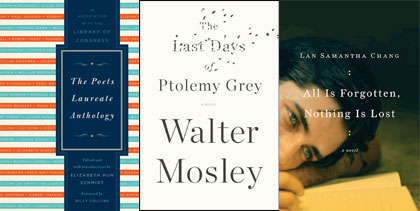
The Poet Laureates Anthologyedited by Susan Schmidt,All is Forgotten, Nothing is Lostby Lan Samantha Chang andThe Last Days of Ptolemy Greyby Walter Mosley
I trust that listeners can detect the fun; and that's part of the point of having a free-form discussion of three books with Alan Cheuse every month. We don't always have to like them, though we are pretty good at this point at picking books we like. But in talking through the three books, Alan and I both get a chance to seriously discuss not just the individual books, but the experience of reading itself. Books are often seen as a solitary form of entertainment, and that's correct only so long as we don't talk about what we read with others. And not just the plots, or the gist of books, but the reading experience itself.
As often happens, we sort of backed into a slight theme with two of our choices. We started out talking about 'The Poet Laureates Anthology,' which, as edited by Susan Schmidt is something quite amazing. Of course, 'The Poet Laureates Anthology' (W. W. Norton & Company ; October 4, 2010 ; $39.95) offers great poetry, and lots of it. But the real shock is how great the poets themselves are. If you look back at any other list of prizes or awards, you'll find a lot of forgettable and forgotten work. Not so with the poet laureates who are consistently memorable writers who have stood the test of time. Their poetry is great and the pocket history lesson that you get as a result of the works is equally great.
'All is Forgotten, Nothing is Lost' (W. W. Norton & Company ; September 27, 2010 ; $23.95) by Lan Samantha Chang is set in the world of professional poetry, starting in an MFA workshop and moving through lives and career. Chan's writing is sparse but powerful and her novel makes the most of the setting with which she is intimately familiar. It's great to read while you're leafing through 'The Poet Laureates Anthology,' offering as it does a glimpse of those who become part of this pantheon come into being.
And finally, we both had the luck to tuck into Walter Mosley's latest, 'The Last Days of Ptolemy Grey' (Riverhead ; November 11, 2010 ; $25.95), in which the chameleonic writer conjures up a powerful story of memory, family and love as Ptolemy Grey gets the 'Flowers for Algernon' treatment for Alzheimer's; he gets his memories back, but his death is hastened as a result. Mosley is smart enough to soft-pedal the science fiction and use the tropes to enhance the emotional aspects of the story.
11-30-10:A 2010 Interview with Guillermo Del Toro in Bleak House, The Haunted Mansion
"I was always worried about where Godzilla left his droppings..."
—Guillermo Del Toro
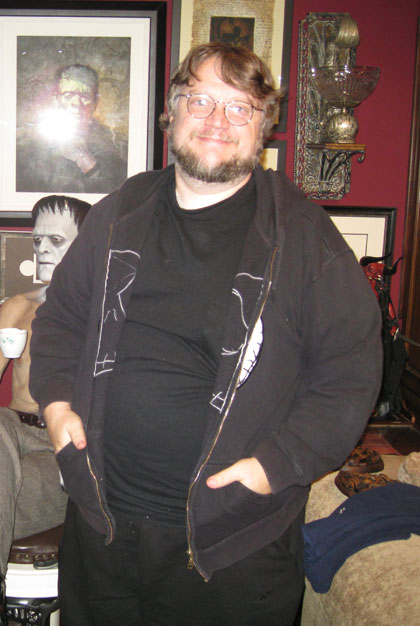
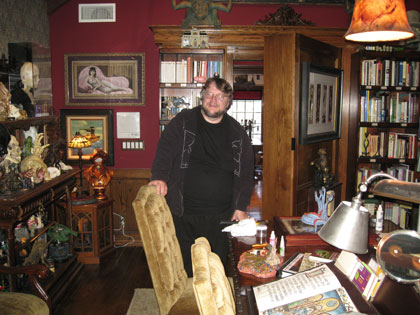
Guillermo Del Toro is a busy man, in every sense of the word. I caught up with him in Bleak House, his Haunted Mansion in the depths of Southern California. (There are two plaques on the front of the house, one dedicated to each name.) For anyone who reads, or anyone who loves monsters or the movies, it is a fat slice of Inverse Heaven carefully wrought out of the SoCal slab-scape.
I'm sorry. I'm just the writer and interviewer, not the photographer. So photos of my time there will be sparse. I was a more than a bit blown away by the life-size Hellboy monster in the hallway, and equally so by the glimpse of a book on shelves. It was, if I recall correctly "...something something Japanese Grotesqueries .... something something." Oh my.
Guillermo and I sat down in the drawing room of his lair, and surrounded by 17th century manuals for determining possession and demonhood, we talked about 'The Fall,' and then went well beyond. Del Toro is an incredible scholar of literature and weird literature, so when I brought up Borges, we almost ended up in labyrinth of our own making. Borges is the kind of writer who demands discussion. We also talked about some upcoming movies, and Del Toro's personal connections to the horror in his work. There are some spoilers in our conversation for both 'The Strain' and 'The Fall,' but the upshot will be that having read them you will be inspired to go back and re-read them.
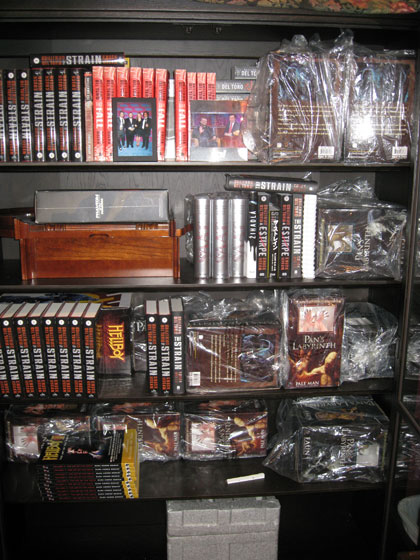
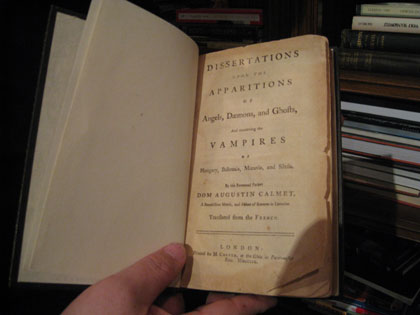
After our conversation, I got a tour of the "man cave," portions of which were not unfamiliar to me; at least in terms of rooms that were stuffed full of books. His collection is really quite remarkable. It's better than a museum. He has a couple of volumes from the first edition of the Encyclopedia Britannica, and right next to them, the very first book of fairy tales published in English. The books are all in immaculate condition. I saw two different manuals for detecting demons, ghosts and vampires; one from 1759 (I think), and another one from the 1800's. He has lots of non-fiction about vampires. He has a first edition from Cotton Mather. Of course he has the complete works of Charles Fort, currently double-shelved in front of the actual legal proceedings of the Lizzie Borden trial. We're talking about just one room. There were several, there was hallways of books. Del Toro's movies — and his novels — reflect a level of Fortean research that is quite remarkable. Of course, my very un-guest-like reaction (barely-suppressed) was a wish to excuse myself so I could sit down and read some of these works.
And, in case you were wondering, Guillermo has, which is why from the get-go movies like Cronos and Pan's Labyrinth seem so much more real, and, for want of a better word, solid, than other movies in the same genre. Del Toro invests his surreal visions with as much reality as they can handle.
08-21-15: Agony Column Podcast News Report : Senator Claire McCaskill is 'Plenty Ladylike' : Internalizing Determination to Overcome Sexism [Incudes Time to Read EP 211: Claire McCaskill, Plenty Ladylike, plus A 2015 Interview with Senator Claire McCaskill]
Agony Column Podcast News Report : Emily Schultz Unleashes 'The Blondes' : A Cure by Color [Incudes Time to Read EP 210: Emily Schultz, The Blondes, plus A 2015 Interview with Emily Schultz]
07-05-15: Commentary : Dr. Michael Gazzaniga Tells Tales from Both Sides of the Brain : A Life in Neuroscience Reveals the Life of Science
Agony Column Podcast News Report : A 2015 Interview with Michael Gazzaniga : "We made the first observation and BAM there was the disconnection effect..."
04-21-15: Commentary : Kazuo Ishiguro Unearths 'The Buried Giant' : The Mist of Myth and Memory
Agony Column Podcast News Report : A 2015 Interview with Kazuo Ishiguro : ".... by the time I was writing this novel, the lines between what was fantasy and what was real had blurred for me..."
Agony Column Podcast News Report : A 2015 Interview with Marc Goodman : "...every physical object around us is being transformed, one way or another, into an information technology..."
Agony Column Podcast News Report UPDATE: Time to Read Episode 199: Marc Goodman : Future Crimes: Everything Is Connected, Everyone Is Vulnerable and What We Can Do About It