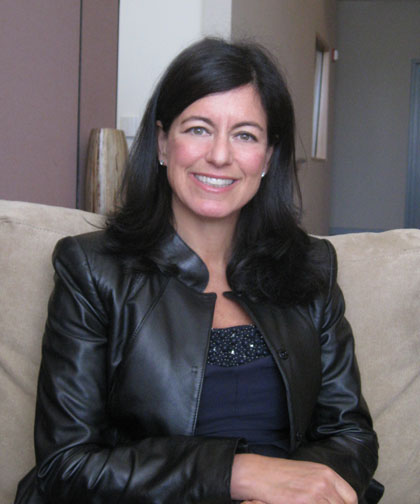
"People think the most important thing I do on the radio is talk ... but actually, the most important thing I do is listen..." —Michele Norris
You never read alone.
Any book you pick up to read has already been read by hundreds, if not thousands, of other readers. As you immerse yourself in the book, it's easy to think of reading as a solitary activity, and of course, you're wrong. All you have to do to find that out is to attend an event a local bookstore.
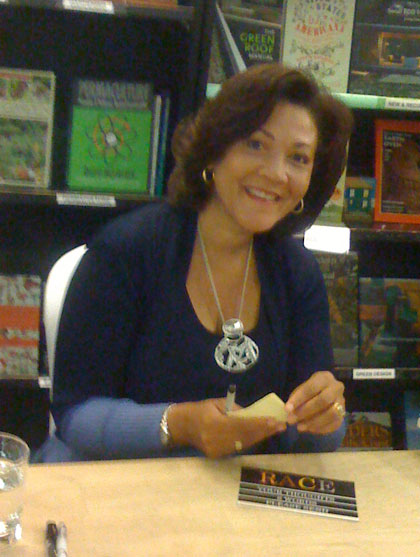
I was fortunate enough to be asked (and sort of finagle) my way into participating in Michele Norris' appearance at Bookshop Santa Cruz — was it just last Sunday? I arrived quite early and set up the sound gear, and then hovered for about an hour. Norris arrived precisely on time and it was immediately clear why she was able to get the sort of interviews that made her book so fine. She is so easy-going and intelligent that she puts those in her vicinity effortlessly at ease.
Santa Cruz is the perfect venue for a writer like Norris. We had a large, involved crowd who arrived early, and were ready to ... listen. That worked out to be a big theme of this show, as Michele Norris noted that it was her job to listen.
But of course, everyone was there to hear Michele Norris, and she obliged us with a wonderful reading from her book and a delightful conversation about the book. Since she was there not just to talk, but to listen, we ran short on our interview, and let the audience talk, and listen as well. Embedded in the audience Q&A portion are some great thoughts from this engaging performer. You can hear her talk — and the audience talk, as well — by following this link to the MP3 audio file of our conversation.
11-16-10:A 2010 Interview with Matt Taibbi
"I had a friend who worked for a Sovereign Wealth Fund in the Middle East..."
—Matt Taibbi
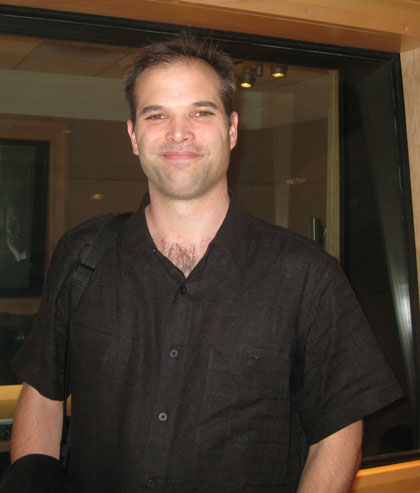
Matt Taibbi is an amazing guy — and not just because of his reportorial skills. To be sure, the accomplishments of 'Griftopia' are amazing. In a relatively short book, he manages to explain some very complex machinations with a laugh-out-loud sense of humor. (This assumes that you were not one of the many direct victims of the scams in the book; those readers may be moved to a lethal combination of fury and depression.) He also offers an amazingly politics-free vision of politics, obviously not an easy feat. But my take on the amazing factor comes from the fact that Matt Taibbi was able to be eloquent and intelligent and fresh.
From what I could decipher, Matt Taibbi had been, and this seems appropriate, popping out of the frying pan and into the fire. I spoke to him at KQED at 1:45 in the afternoon. He'd not at that point even managed to make it to his hotel. He'd gone directly from the airport to another radio station, where he's no doubt found himself in a conversation about the minutia of his book.
For this reader, even reading the book was to a certain extent emotionally trying. A clear-headed portrait of how the world is going straight to hell, 'Griftopia' must have been incredibly difficult to write — and more so to re-live, again and again. Yet once I sat down with Taibbi, he immediately found whatever spark it was that took him through the writing process and brought it life.
I was joined at this gig by Evan Karp of Litseen (http://litseen.com), who unobtrusively filmed the interview. I'll let readers know when the video goes up. But Taibbi was tireless and inspired when we spoke, as we unraveled the tentacles of the vampire squids and talked about the very peculiar life of Alan Greenspan. If only he could have been a rock star, perhaps our world might have been startlingly different.
Taibbi and I talked not just about the content of his book, but also how he crafted it on a prose level and on the larger reportorial level. It was just as gripping to hear him talk about de-complexifying the shenanigans that brought about pericalypse — the apocalypse that has already come to pass, unnoticed, in the general haste — as it was to hear him talk about the grotesque, almost Lovecraftian financial maneuvers that made the impossible possible and the illegal legal. You can take your own tour of 'Griftopia' by following this link to the MP3 audio file of our conversation.
11-15-10:A 2010 Interview with Laurie David
"It's important to take a moment, take a beat, and express gratitude."
—Laurie David
It was hard not to talk to Laurie David. She and I both arrived quite early for the interview at KQED. We traipsed upstairs, only to find the studio still in use. In a waiting area ensconced at the back of the studios, we found ourselves starting to talk about something which we might have thought was not in her book, 'The Family Dinner,' only to somehow wind back to stuff that was in the book. Then we'd both say, "OK. We'll talk about that later." It would only take a moment for us to start talking again, and quickly find ourselves going back to the table.
Laurie David is not surprisingly, a lot like her book. She's full of energy, enthusiasm, and honest, refreshing good cheer. She's also super-smart, and one heck of a lot of fun to talk to. She loves her book, and told me that she's tempted to sleep with it. Who can blame her? She's essentially taken her own family scrapbook and cookbook and had it gussied up into a gorgeous and outrageously useful book for raising kids, cooking dinner and generally keeping your family life on the right side of sanity.
Once we got in the studio, our conversation ranged the full gamut of the book, and happily beyond. I'm glad we did try to restrain our conversation beforehand, because once we got on-mic, it was almost impossible to keep from bubbling over. I suppose, in retrospect that one of the things that makes a book interesting to me is the passion that the author brings to the work. By that measure, 'The Family Dinner' is practically the center of the universe, and in fact both the book and subject sort of should be the center of our very human universes. David is almost like a kid with her grinning excitement and verve.
08-21-15: Agony Column Podcast News Report : Senator Claire McCaskill is 'Plenty Ladylike' : Internalizing Determination to Overcome Sexism [Incudes Time to Read EP 211: Claire McCaskill, Plenty Ladylike, plus A 2015 Interview with Senator Claire McCaskill]
Agony Column Podcast News Report : Emily Schultz Unleashes 'The Blondes' : A Cure by Color [Incudes Time to Read EP 210: Emily Schultz, The Blondes, plus A 2015 Interview with Emily Schultz]
07-05-15: Commentary : Dr. Michael Gazzaniga Tells Tales from Both Sides of the Brain : A Life in Neuroscience Reveals the Life of Science
Agony Column Podcast News Report : A 2015 Interview with Michael Gazzaniga : "We made the first observation and BAM there was the disconnection effect..."
04-21-15: Commentary : Kazuo Ishiguro Unearths 'The Buried Giant' : The Mist of Myth and Memory
Agony Column Podcast News Report : A 2015 Interview with Kazuo Ishiguro : ".... by the time I was writing this novel, the lines between what was fantasy and what was real had blurred for me..."
Agony Column Podcast News Report : A 2015 Interview with Marc Goodman : "...every physical object around us is being transformed, one way or another, into an information technology..."
Agony Column Podcast News Report UPDATE: Time to Read Episode 199: Marc Goodman : Future Crimes: Everything Is Connected, Everyone Is Vulnerable and What We Can Do About It