09-08-10: Bentley Little Finds 'The Disappearance'
Savagery, Satire, and Sweet Surrender
Somewhere in the edits, I lost my line yesterday about how Chuck Hogan's novel, 'Prince of Thieves' — a fine title — was changed in the movie to the deadly anonymous horror-move sounding title, 'The Town.' In fact, 'The Town' is a horror novel, by the ever-prolific Bentley Little, who deserves his own series of movies.
It's been more than 20 years since Little's first novel, 'The Revelation' was released, and nothing seems to stop him. Pretty much every year, sometime more often, Little has blessed this world with a new novel — while curing his readers to sleeplessness. There's certainly a formula to the titles, and to a certain extent the novels themselves. And it's a good one.
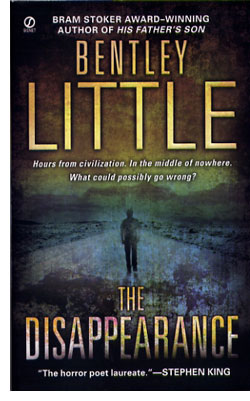
Little's latest novel is 'The Disappearance' (Signet / New American Library / Penguin Putnam ; September 7, 2010 ; $7.99), and it follows a happily predictable arc. Gary and Joan head out from UCLA with Brian, Reyn and Stacy for Burning Man. Sounds like fun. The man burns, and afterwards, while Gary is sitting with Joan, maybe he passes out. Or hallucinates, and it's not a good trip. When he comes to, Joan is gone.
Missing.
You're 12 pages in and hooked. Prepare to stay awake.
Little does not re-invent the horror wheel, but he sure as hell give it a good shove down long, torturous hill, and takes the reader for one of those addictive, can't-turn-the-pages-fast-enough reading experiences. There are some very unusual men about, who have apparently never made it to join the rest of us in the 21st century. They're bad enough, this cultish thing called The Outsiders, the Homesteaders. Of course there is someone or something at the center who is worse. Worse in the case, being worse than a horrific torturous death.
Little knows all the simple tricks of making the trains of good horror novels run on time. He writes great characters, who are flawed in a manner we can recognize within ourselves, but also in a manner than can be explicitly exploited by evil. He takes these people and runs them through the mill of pursuit, ignorance and eventually, unfortunately for them, understanding. The price of understanding generally seems to be life itself, but it is the lesser fates that are more distressing. Little does have a talent for cooking up characters who summon, even court their awful demise. The real catch is that by the time the bad things start to happen, we as readers do not want to them to come to pass.
There's more, however, than just good plotting and characters to recommend 'The Disappearance.' Little has a savage sense of satire and swaggering disregard for your tiny, puny morals. While characters you care about are sometimes literally being torn asunder, Little is taking not-so-subtle swipes at post-21st century America's morals and mores, revealing the building blocks of our civil society to be rotted at the core. He's pretty funny, if you have a sort of sick sense of humor.
Bentley Little does not pull his punches. His work is based in deep discomfort, often with family, or employers. He's not shy about picking off the pillars of society, about toppling our morals. Bentley Little is the sort of writer who might cause his readers to demand their money back. You will not go gently into Bentley's Little night. Do not expect the sort of horror novel that ultimately shies away from the darkness, the sort of horror novel that is comforting or cozy. Things look normal out he outside, at the outset. But they get weird, unpleasantly so, quite fast. His novels are slivers of ice that can pierce your heart and leave no trace of themselves behind. There is very little good out there in a Bentley Little novel. Most of it you bring with you as reader, and as the novel progresses, you just hope there will some left when you're done.
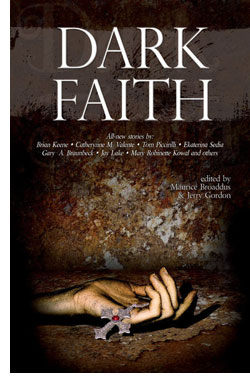
09-07-10: Mario Guslandi Reviews 'Dark Faith'
".. beneath the gore, the violence of horror, there is often a spiritual undercurrent that remains unexplored."
Spirituality and dark fiction are concepts which seldom go together. Yet beneath the gore, the violence of horror, there is often a spiritual undercurrent that remains unexplored. On the other hand spirituality in its various expressions (religion, cults, belief in a supernatural side of life) may have a dark shade that we usually prefer to ignore.
'Dark Faith' is a hefty short story anthology which addresses this unusual subject, assembling twenty-six brand new tales plus four poems committed to investigate the darker aspects of faith in its broadest meaning, from established religions to offbeat cults, from a private devotion in something transcendent to the wonders of the magic that goes unnoticed through our prosaic daily existence. This is a brilliant, original theme that most of the contributing authors develop with a serious, honest attitude, revealing their own deepest feelings and beliefs, or, in other words, their own faith either in something or in nothingness.
To comment in detail upon such wide material would be either impossible or simply tedious, so I'll simply mention the stories that have especially impressed me . To me the best story is Brian Keene's "I Sing a New Psalm", an outstanding, insightful piece showing how the roots of our frail faith in God can be easily shaken by the cruelty of life. In "He Who Would Not Bow" Wrath James White depicts a powerful, apocalyptic tableaux where a vengeful God rules the world bringing about death and destruction.
Matt Cardin is becoming a kind of expert on the subject of the relationship between religion and horror (I'm looking forward to getting his collection Dark Awakenings, but my review copy seems to be lost in the mail). Here he provides "Chimeras & Grotesqueries" , a visionary, albeit a bit obscure report of supernatural (or just weird?) events hinting at supernatural powers existing beyond our daily experience of reality.
Ekaterina Sedia's "You Dream" is a superb tale ( although, in my opinion, only marginally pertinent to the anthology's theme) where dreams and bitter childhood memories merge in a nostalgic mix of emotions.
JC Hay is, to me, a comparatively unknown author, whose "A Loss for Words" is an original, elegant tale full of lyricism about a peculiar physical and spiritual relationship between a woman and a writer exchanging gifts in the shape of words.
Kyle S Johnson contributes "Go and Tell It on the Mountain" , a quite unconventional portrait of Jesus Christ who finally reveals what's really taking place in the afterlife.
The vivid and tense "The Choir" by Lucien Soulban blends elements of Lovecraftian horror, pulp fiction and social issues (a group of American homosexual soldiers are sent back home as criminals aboard a ship during WW2). "The Choir" is a strong piece that cannot be easily forgotten.
Once again Gary A Braunbeck ("For My Next Trick I'll Need a Volunteer") probes the secrets of human life and seeks the meaning of an inexplicable universe by telling a kind of Twilight Zone story where the tragic fate of a dying baby abused by her drug addicted parents is unexpectedly reversed. Even though slightly burdened by too much philosophical explanation, the tale is fascinating and bookends the anthology with a final message of hope.
'
Apt to satisfy the taste of both horror fans and mainstream fiction lovers, 'Dark Faith' includes stories and poems by J Pelland, DF Warrick, E Kaiser, N Mamatas, L Tidhar, J Laje, R dansky, DT Friedman, T Piccirilli, K Dunlap, G Girard, A Kontis, MR Kowal, C Burke, L Prater, CM Valente, LA Snyder, K Barnhill, R Wright plus poems by LD Addison, J Baumbartner, L Prater, K Dinan; definitely a noteworthy volume.
09-06-10:Brendan Connell Tells 'Unpleasant Tales'
Close-up and Too Close-up
The first book I stumbled upon by Brendan Connell, 'Metrophilias,' was a no-genres-land work that defined humans by describing the shadows they cast in cities. With minimal strokes, in short prose poems and terse flash fictions, Connell evoked our presence in our absence.
Now, with 'Unpleasant Tales' (Eibonvale Press ; July 19, 2010 ; $13.50), he offers a collection of stories that lives up to the title. Once again, Brendan Connell is taking a look at humans, and not surprisingly, it is not flattering. Humans are perverse, grotesque and distressingly organic. Yet there is something about us that makes us, though you might not want to actually be human, compelling to read about. Welcome to your own species.
Connell is nothing if not inventive, diverse and sublimely witty. The stories you'll find in 'Unpleasant Tales' are, to the extent that they will make you feel uncomfortable in every way that you can made to be feel uncomfortable, horror stories. But in terms of content, you'll find an alarmingly unfettered exploration of what we are by virtue of revealing who we are. The word "Yikes!" comes to mind.
Just to give you an idea of what we're talking about, without going into details that will spoil a particularly effective story, here's a line from "The Nasty Truth About Dentists":
"I found myself in a restroom, standing on top of a sink."
As with 'Metrophilias,' the stories in 'Unpleasant Tales' speak of dislocation. In this instance, Ron, whose paramour Norma, seems to be drifting away from him since her induction in a dental school, decides to visit the place that is taking her away. What he finds is funny, disturbing, off-putting and intense. Connell has a flair for starting out in everyday reality and inching, one terrifying step at a time, into something that feels real. You have to hope, to pray, your rational mind tells you to believe that it could not be so. But emotions are not swayed by reason.
Within 'Unpleasant Tales' you'll find a bracing variety of subject and story tone. Connell is great in a prose level, and there are lots of passages you'll want to read aloud just to mess with the heads of the people you love. Of course, this inclination will tell you more about yourself than you might want to know, but by then you'll likely be hooked.
Connell's work is truly transgressive, not just gory or gross, though some readers may find that the latter aspects overwhelm the sense of the story. This is not Three Stooges With Chainsaws, and this is not really really really gross-out comedy, though it's often both funny and gross. Connell is up to something much darker here. The stories explore the yucky corners of our minds, which are far less palatable than the yucky parts of our bodies.
That said, this is not a read-it-cover-to-cover collection of short stories, not unless you want to end as research material for Connell's next collection. When you take that approach, you'll see some of the underlying architectural prose structures that unite the stories, and they'll become less effective as a result. You don't drink a six-pack of Absinthe.
Eibonvale's production values are in many ways top-notch. The cover is superb and mysterious in all the right ways. The font and typography and interior design of the book are excellent and go a long way towards making even the most unpleasant of these tales a pleasant reading experience for the readers who likes a nice combination of insight and distress. But the actually typesetting and copy-editing leave something to be desired, as the problems here tend to distract from the core of the reading experience. Still, there's a possibility that too is deliberate. How close do you want to be to this sort of revelation? Maybe a little distance is good.
But not too far. Connell is up to something quite unique as a writer. No matter how squeamish you think you may or may not be, these 'Unpleasant Tales' have something to recommend them. If you're reading this, the chances are that you're a human being trapped in a human body and a human life. You might yearn to go farther, do more. And, you might regret what comes to pass when that yearning is achieved. But by then it will be too late. You are, we are, after all, only human.
New to the Agony Column
09-18-15: Commentary : William T. Vollman Amidst 'The Dying Grass' : An Epic Exploration of Simultaneity
Agony Column Podcast News Report : A 2015 Interview with William T. Vollman : "...a lot of long words that in our language are sentences..."
09-05-15: Commentary : Susan Casey Listens to 'Voices in the Ocean' : Science, Empathy and Self
Agony Column Podcast News Report : A 2015 Interview with Susan Casey : "...the reporting for this book was emotionally difficult at times..."
08-21-15: Agony Column Podcast News Report : Senator Claire McCaskill is 'Plenty Ladylike' : Internalizing Determination to Overcome Sexism [Incudes Time to Read EP 211: Claire McCaskill, Plenty Ladylike, plus A 2015 Interview with Senator Claire McCaskill]
Agony Column Podcast News Report : Emily Schultz Unleashes 'The Blondes' : A Cure by Color [Incudes Time to Read EP 210: Emily Schultz, The Blondes, plus A 2015 Interview with Emily Schultz]
07-05-15: Commentary : Dr. Michael Gazzaniga Tells Tales from Both Sides of the Brain : A Life in Neuroscience Reveals the Life of Science
Agony Column Podcast News Report : A 2015 Interview with Michael Gazzaniga : "We made the first observation and BAM there was the disconnection effect..."
04-21-15: Commentary : Kazuo Ishiguro Unearths 'The Buried Giant' : The Mist of Myth and Memory
Agony Column Podcast News Report : A 2015 Interview with Kazuo Ishiguro : ".... by the time I was writing this novel, the lines between what was fantasy and what was real had blurred for me..."
Agony Column Podcast News Report : A 2015 Interview with Marc Goodman : "...every physical object around us is being transformed, one way or another, into an information technology..."
Agony Column Podcast News Report UPDATE: Time to Read Episode 199: Marc Goodman : Future Crimes: Everything Is Connected, Everyone Is Vulnerable and What We Can Do About It