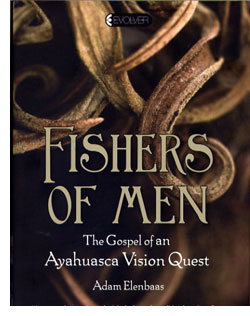
07-20-10: Adam Elenbaas is Caught by 'Fishers of Men'
The Gospel of an Ayahuasca Vision Quest
Our religions do not serve us as well as we might wish. We're told that it's hard-wired into out brains, this sort of belief in a supernatural otherworld peopled by beings who care about our destiny. But when the otherworldliness finds itself placed in the turbulence of a life in this world, it struggles to hold its power over our vision. We question both our beliefs and the worthiness of our daily lives. Neither seems to hold a real answer.
The effect is exponential when religion is a part of our daily lives. It is after all, a paying job for some. And a burden for their children, who find themselves rebelling agains not just the daily drudge, but the otherworld as well. As Flannery O'Connor's Hazel Motes asks — and answers — in her novel 'Wise Blood,' "'Where is there a place for you to be?'"
Nowhere.
Adam Elenbaas starts pretty much at Nowhere in his memoir 'Fishers of Men: The Gospel of an Ayahuasca Vision Quest' (Tarcher / Penguin ; July 22, 2010 ; $24.95). It's a complicated, twisty little memoir that manages to pack a wallop as Elenbaas explores his own life, which itself is an exploration. This sort of fractal vision is important to 'Fishers of Men.' You start your life, after all, inside. Then as you grow up, you go further inward.
From the get-go, there's a raw feeling to this story of fathers, sons and belief. Not just in the scenario (Adam hovering outside the bathroom door as his father pukes his way through withdrawal from regular drugs in preparation for an ayahuasca ceremony), but in the language as well. Elenbaas writes prose that is snipped, clipped and compressed. But there's an ache behind all of this convoluted revelation, one that we can all readily identify with.
The story is complicated and so is the exposition. Adam is the son of a Methodist minister. It may be a "like father, like son" scenario, but that only means that everyone is troubled. Adam certainly does not begin by following in his father's path. Instead, he ends up in a search for sensation; sex, drugs, it does not matter because you cannot fill a void with a void. The first stage of his youth ends badly, but there's a glimmer of hope that leads him to the world of the ayahuasca vision quest.
Elenbaas knows how to pull apart his timeline and put it back together in an order than makes for compelling reading. He's a passionate write and even his religious beliefs come through as raw and authentic. He's an unsparing chronicler of his own and others' faults. But this only serves to make his revelations more powerful to the reader. As a writer, he knows that he has to create characters, plot, to do more than reveal. He has to find a story in his life and a way to tell that story. He manages to do so and the balancing act of avoiding pathos and self-pity.
'Fishers of Men' is also a fascinating journey into the heart of belief, that hard-wired attraction to the otherworldly. Raised as a Christian and inclined to believe thus, Elenbaas finds himself thrust into a very different vision of the otherworld. Readers explore and experience the ayahuasca vision quest with the writer. The synthesis that Elenbaas achieves is gritty and powerful, since he rounds us back and grounds us in characters.
Elenbaas is one of the folks behind Reality Sandwich, along with Daniel Pinchbeck. Reality Sandwich bills itself as "a web magazine for this time of intense transformation," and this book keeps with those themes, but plays them out in a somewhat grittier fashion. Yes, there is a touch of evangelism about this work, but it's subsumed in the more immediate story of personal transformation. 'Fishers of Men' is about the revelation of character, not a revelation of belief.
What's interesting here is not just the ayahuasca vision, or the synthesis that Elenbaas achieves. What's really gripping here, is that with a character-driven story, the author manages to offer an informed vision of vision. It's that fractal effect. And one needs must remember Flannery O'Connor's follow-through.
"If you've got a good car, then you do not need to be redeemed."
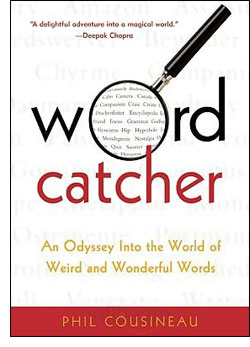
07-19-10:Phil Cousineau is the 'Wordcatcher'
A Selectionary for Curious Mind
There's a grand history of what I'd call Selectionaries; that is, selective dictionaries that pluck out a subset of words, with which the writer in question has great fun. Ambrose Bierce has arguably the best-known and most often referred to example — The Devil's Dictionary. Bierce's wry definitions are still in use. But there is more than one use for a selectionary.
Phil Cousineau, for example, wants us to be enchanted with language, and his selectionary, 'Wordcatcher' is apt to do the trick. He's pulled about 350 words from the English Language, which recently hit the million-word mark, and found the stories behind and within the words that bring them alive. It' an easy read that will make you want to read. In some senses, it might be the perfect example of book.
Cousineau is a smart writer who offers us a brief but intriguing introduction, and then gets straight to the meat of the matter. From A to Z, he careens through the familiar and unfamiliar alleys of the English language looking for words that sound fun, are mysterious and weird, or even very common words. There's a great variety of words under the microscope here, but what they all have in common is that they give Cousineau a chance to exercise his wit, entertain the reader and explore the wisdom behind words.
Cousineau is interested in the part that myth plays in our lives, and threads of myth and legend run through the stories in the book. 'Wordcatcher' is a book that you can read from cover-to-cover, but I'd advise otherwise. This is a book to read between books, between tasks, a way to step out of this world and into the world behind this world — of words.
The argument here is that language is more a part of humanity than we are generally aware of. As we read the definitions and histories of words here, we realize that words are not just to be defined — they are indeed how we define and describe ourselves. They're the building blocks of identity, and the only real means we have of connecting with others. Cousineau's writing and his explorations are great fun. But they're also gentle reminders of the ultimate power of language.
Still fun is of the essence here. The journeys in this book fall into a variety of categories. Some of these words just sound fun — canoodle, catawampus, youthy (from 1611!), kerfuffle. Just to be reminded of their existence is a joy. Where the OED says "o.o.o" (of obscure origin), Cousineau takes off on a flight of verbal improvisation, and the results are enlightening in the way of the very best educated and entertaining "best-guesses."
Some of the words seem common, but their stories reveal the rich history of the English language. Words like crazy, rebate, salary and budget are mini-epics, that have journeyed through our culture to arrive here in the 21st century — with the clear path towards a future we cannot predict. Cousineau knows what to put in and what to leave out in these histories. His prose is lively and has the effect of enticing the reader to imbibe the next selection.
Of course, that's the trick of the selectionary, to keep you going from one word to the next. In that sense, they are like all books, which only hope you'll read one word, then another. But in the selectionary, each word is comprised of more words, and those words of course, might have their own entry in their own selectionary. As the fractal spirals unwind in our mind, the words rise and bring us a clear definition of who we are, by virtue of what we have to say.
New to the Agony Column
09-18-15: Commentary : William T. Vollman Amidst 'The Dying Grass' : An Epic Exploration of Simultaneity
Agony Column Podcast News Report : A 2015 Interview with William T. Vollman : "...a lot of long words that in our language are sentences..."
09-05-15: Commentary : Susan Casey Listens to 'Voices in the Ocean' : Science, Empathy and Self
Agony Column Podcast News Report : A 2015 Interview with Susan Casey : "...the reporting for this book was emotionally difficult at times..."
08-21-15: Agony Column Podcast News Report : Senator Claire McCaskill is 'Plenty Ladylike' : Internalizing Determination to Overcome Sexism [Incudes Time to Read EP 211: Claire McCaskill, Plenty Ladylike, plus A 2015 Interview with Senator Claire McCaskill]
Agony Column Podcast News Report : Emily Schultz Unleashes 'The Blondes' : A Cure by Color [Incudes Time to Read EP 210: Emily Schultz, The Blondes, plus A 2015 Interview with Emily Schultz]
07-05-15: Commentary : Dr. Michael Gazzaniga Tells Tales from Both Sides of the Brain : A Life in Neuroscience Reveals the Life of Science
Agony Column Podcast News Report : A 2015 Interview with Michael Gazzaniga : "We made the first observation and BAM there was the disconnection effect..."
04-21-15: Commentary : Kazuo Ishiguro Unearths 'The Buried Giant' : The Mist of Myth and Memory
Agony Column Podcast News Report : A 2015 Interview with Kazuo Ishiguro : ".... by the time I was writing this novel, the lines between what was fantasy and what was real had blurred for me..."
Agony Column Podcast News Report : A 2015 Interview with Marc Goodman : "...every physical object around us is being transformed, one way or another, into an information technology..."
Agony Column Podcast News Report UPDATE: Time to Read Episode 199: Marc Goodman : Future Crimes: Everything Is Connected, Everyone Is Vulnerable and What We Can Do About It