06-23-10:Adam Langer Corrals 'The Thieves of Manhattan'
Lies, Balderdash and the Absolute, Unvarnished Truth
Sometimes, the only way to tell the truth is to lie.
I'm not talking about a fib. I'm talking about a big-ass whopper, the sort of thing that when truth comes out, and it always comes out if there's money to be made, the sort of affair that when the deadlines pass and the headlines arrive, that lives will be ruined — briefly! — and then, of course, huge checks will be cashed.
There's also nothing that happens that can't be cashed in on. The trick is to do so artfully, or, at the very least to make everyone laugh at one another without realizing they are also not just in on the joke, but the object of the joke as well.
Let me put take on my movie trailer intro voice and suggest that, in a world where talk show hosts can make and break a first time author who published a memoir that was later determined to include more imagination than the average memoir, and in a world where the same writer can mumble years later cut a deal with a Hollowood producer for more money than God by selling a YA "Sci fi" high-concept thriller, well in that world, which closely resembles our world, a book like Adam Langer's 'The Thieves of Manhattan' (Spiegel & Grau ; July 13, 2010 ; $15) is simply inevitable.
Langer's book is a novel, a farce, and a satire (of sorts), but only in the specifics. Everything is made up. There is no "Blade Markham," author of a memoir about heroin addiction, desertion in the Gulf War and other tawdry exploits. Ian Minot, Our Hero in 'The Thieves of Manhattan' is a complete fabrication, as is literary agent and failed author Jed Roth. Thusly, Roth never asked Minot to revise an old thriller by Roth as a new memoir by Minot in a ruse to blow the lid off, as they like to say, "the Blade Markham phenomenon." It's all lies, damn lies and politics.
All lies and the only way to tell the truth.
And telling lies is, as it happens, Langer's forte. 'The Thieves of Manhattan' is one of those almost relentless novels that in a sense, blows up the world on every page, and often a few times per paragraph. At least, the literary world, for which Langer has devised his own patois. Minot lives in a world of "franzens," where you can woolf from one topic to another and where, in the world of fantasy literature, at least, door-stopping tolstoys are de rigeur.
But Langer does more than manufacture words; he does a great job of breaking down the hoaxing process, giving the novel a sort of Fortean edge. The blow-by-blow details are literary equivalent of those scenes in the old A Team episodes where they have to build some complicated Rube Goldberg device. It's fascinating and funny.
If 'The Thieves of Manhattan' sounds like a movie, it started out as a screenplay. And one presumes that in its own world, it would become a movie, a very bad one. Let's hope that in this world, we are not graced with something quite horrible like: "Book Movie." Perhaps, with luck, just by saying those words, we can prevent one more happy lie from becoming an unfortunate truth.
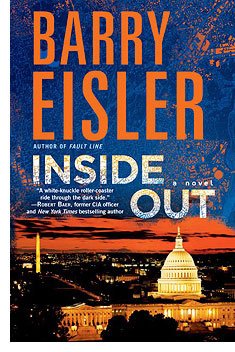
06-22-10:Barry Eisler Steps 'Inside Out'
Black Hearts and Black Ops
In the "write what you know" sweepstakes, Barry Eisler is uniquely qualified to write spy novels. Early in his career, he did time with the CIA. He was as in as in can be. Now that he's out, he can tell a story. He's the creator of the John Rain series. Now he follows up last year's 'Fault Line' with an ultra-topical tale that speculates just how far to the right we have turned, just how far down the torture rabbit-hole we find ourselves. What we've read in the newspapers sounds bad. What if it is just the tip of the iceberg?
With 'Inside Out,' (Random House ; June 29, 2010 ; $25), Barry Eisler takes his fiction where his opinion has already gone. Funny how time in a covert world can create a man who now speaks so freely. He's beyond outspoken when it comes to the dirty tricks and bad apples that came out of the so-called War on Terror. If you name a liberal blog, the chances are that Eisler has written passionately there about both the innate wrongness of torture and its ineffectual nature.
As a writer of thrilling spy fiction, Eisler can go places even the blogs cannot go. He's not just free to say the truth; he's free to speak from his imagination, which, alas, may be less vurulent, less upsetting that whatever truth eventually emerges — if it ever does. The setup for 'Inside Out' is pretty damn brilliant. Ben Treven, last seen in 'Fault Line,' starts the novel in a Manila jail. His instincts kicked in during a barfight, and somebody wound up dead. Not him. Not yet, at least. He might wish it to be so soon enough. He's sprung by his buddies in the CIA, who have a tiny problem Remember the missing torture tapes the CIA accidentally destroyed sometime during the previous administration? The real torture porn? And how two tapes turned into 92 tapes? Eisler posits that those tapes weren't destroyed. As 'Inside Out' begins, Ben Treven learns that they were stolen, and those who have them are poised to plaster them all over the Internet. He's spring from jail with the idea that he'll stop this from happening.
Not surprisingly, this proves to be a dangerous assignment. Those out to kill him from inside the US government are more numerous than those out. Moreover, it's even money that the ones holding the tapes used to work for the CIA. Look what we accomplished when we trained some Afghan rebels to fight the Soviets. Do we really think that we are immune to the same problem from the inside? Of course, hubris is ever the downfall of the powerful.
'Inside Out' builds from the psychological complexities and care character creation of 'Fault Line.' Treven is conflicted from the start, but those around him are not. It's pretty creepy to see those we'd like to think of as "the good guys" turn out to be bad apples. Eisler paints in all shades of dark gray and pitch black. This is not a pretty picture; the characters in 'Inside Out' are frighteningly believable.
The action is also believable, but everything, the action the characters, and the prose is driven by a combination of practical and moral outrage. Torture does not work, no matter what Kiefer Sutherland says or does on the Tee Vee. Not only is it morally wrong, it is ineffective, in fact, it is actively counterproductive of any goal other than the satisfaction of sadistic desires. Eisler can say things with power in his fiction that he cannot in his blog entries and opinion pieces. He can put us in the minds of those being tortured. This is not a happy place to be, but it makes for a great ripping yarn with a powerful and to some unpalatable, political aftertaste.
No matter what your political persuasion, the chances are that you'll find Eisler's novel a gripping piece of prose. It's pure fiction of course, but that means that it can speak the truth more forcefully than government approved press conferences. Sure, this is just a thriller, and it lives up to that description. Derring-do, fire fights, skullduggery and double-crosses abound. Life is probably a little more sordid and settled down, no? So far as we know, they got away with it, got off scot-free.
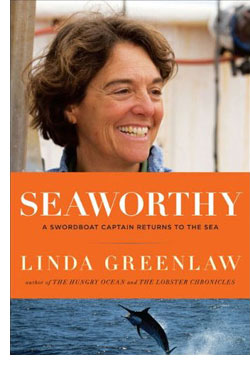
06-21-10:Linda Greenlaw is 'Seaworthy'
Back to the Grand Banks in Not-So-Grand Style
It's all down the voice. If your humble narrator has a compelling, entertaining voice, you will follow her anywhere. And in fact, following the leader is very much part and parcel of the story that Linda Greenlaw tells in 'Seaworthy: A Swordboat Captain Returns to the Sea' (Viking / Penguin Putnam ; June 1, 2010 ; $25.95).
Having had her moments of fame in the wake of the part she played in both the book and movie of 'The Perfect Storm,' Greenlaw decided to settle down to the extent that she became a lobsterman. For a one-time celebrity, she was living a surprisingly paycheck-to-paycheck life, and had not managed to settle down much either. Before the call came, that is.
At the beginning of 'Seaworthy,' we find Linda Greenlaw in circumstances not necessarily befitting one of her authority and celebrity. She's running low on money. She's not immensely happy; her plan to ditch the high seas and get hitched didn't pan out. And lobster trapping, while it does involve going out on the ocean just was not the same as those heady trips to the Grand Banks. When she gets a call from an old friend to see if she wants a shot at captaining her own boat, she decides to accept. How hard can it be?
It proves to be much harder than she can imagine. Greenlaw has a fluid, confident and mordant voice on the page, and reading about her travails as she sets out on the ocean again is really enjoyable. She's very straightforward, and cuts to the chase every time, telling the readers, as she selects her crew, just how bad the selection is. It's quite amazing that even gets the people she needs, and that they prove to be as good as she needs them to be. And she does need them to be good, because pretty much everything conspires against her.
Greenlaw's writing and pacing make this book really quite enjoyable. She knows how to spin a yarn, how to create characters on the page and how to keep the reader zipping along. Even if you have little or no interest in the subject, Greenlaw is good enough to keep you on the page. The pacing here is great. It's matched by descriptions that bring her milieu to life. Not surprisingly, she has the ability to immerse us in the tension of Grand Banks sword fishing, and the ability to convey the sense of drudgery without boring the reader. It actually helps quite a bit that pretty much everything goes wrong on this trip. And while her expedition is something of a disaster, the book is anything but. It's really entertaining.
But what really makes this a book that pretty much anyone can read and enjoy is Greenlaw's voice. As a connoisseur of writers who use words I can't broadcast on the radio well, I can attest that Greenlaw is superb. This language is just salty enough to seem authentic and sparse enough to be very entertaining. Lainda Greenlaw may or may not be seaworthy — that's what she discovers in the book — but 'Seaworthy' itself is definitely worthy of your valuable time.
New to the Agony Column
09-18-15: Commentary : William T. Vollman Amidst 'The Dying Grass' : An Epic Exploration of Simultaneity
Agony Column Podcast News Report : A 2015 Interview with William T. Vollman : "...a lot of long words that in our language are sentences..."
09-05-15: Commentary : Susan Casey Listens to 'Voices in the Ocean' : Science, Empathy and Self
Agony Column Podcast News Report : A 2015 Interview with Susan Casey : "...the reporting for this book was emotionally difficult at times..."
08-21-15: Agony Column Podcast News Report : Senator Claire McCaskill is 'Plenty Ladylike' : Internalizing Determination to Overcome Sexism [Incudes Time to Read EP 211: Claire McCaskill, Plenty Ladylike, plus A 2015 Interview with Senator Claire McCaskill]
Agony Column Podcast News Report : Emily Schultz Unleashes 'The Blondes' : A Cure by Color [Incudes Time to Read EP 210: Emily Schultz, The Blondes, plus A 2015 Interview with Emily Schultz]
07-05-15: Commentary : Dr. Michael Gazzaniga Tells Tales from Both Sides of the Brain : A Life in Neuroscience Reveals the Life of Science
Agony Column Podcast News Report : A 2015 Interview with Michael Gazzaniga : "We made the first observation and BAM there was the disconnection effect..."
04-21-15: Commentary : Kazuo Ishiguro Unearths 'The Buried Giant' : The Mist of Myth and Memory
Agony Column Podcast News Report : A 2015 Interview with Kazuo Ishiguro : ".... by the time I was writing this novel, the lines between what was fantasy and what was real had blurred for me..."
Agony Column Podcast News Report : A 2015 Interview with Marc Goodman : "...every physical object around us is being transformed, one way or another, into an information technology..."
Agony Column Podcast News Report UPDATE: Time to Read Episode 199: Marc Goodman : Future Crimes: Everything Is Connected, Everyone Is Vulnerable and What We Can Do About It