Kids will do all sorts of things to your life. They inspire you to take them places. (Yes, you really do want to work, but it is always a good day to go to the zoo.) They will inspire you to cook them meals you might never have attempted. (Yes, I love fish and chips, let's boil some oil.)
And if you're Justin Cronin, your young girl might ask you to write about "a girl who saves the world." 765 door-stopping pages later, the world has been turned upside down, you have the sort of novel that makes booksellers pant with anticipation, and you're only one-third of the way done.
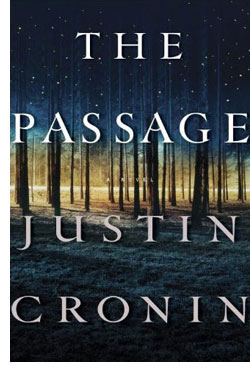
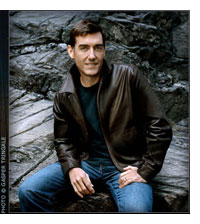
Justin Cronin had no business writing 'The Passage' (Ballantine / Random House ; June 8, 2010 ; $26). Cronin, a Pen/Hemingway winner, the author of 'Mary and O'Neil' and 'The Summer Guest,' is not the sort of writer you might guess would compose an epic science-fiction horror story. He's the sort of writer who writes real stories about what is really happening in this world — which is what makes 'The Passage' so effective. At his daughter's behest, Cronin was able to tap into the notion that we live in a science fiction horror world. Once he made that leap, 'The Passage,' and its forthcoming sequels, were a foregone conclusion.
Not surprisingly, 'The Passage' starts with our eternal efforts to develop ever-more effective means of killing humans. Humans have been making weapons to kill one another since before we were actually human. The next logical step would be to turn humans into weapons, and as 'The Passage' begins, we have managed to be more successful than we wished.
Bad things happen. They always do. In this novel, the worst thing that happens is essentially that Cronin's daughter gets her wish. Or at least, we hope, the beginning of her wish. There is a girl, who may save the world, but there's a lot less world to save, and a lot more bitchin' monsters out there than at present.
Cronin proves amazingly adept at creating a big-screen, world-ending literary scenario. He conjures up a big cast of characters, some of whom you will love, some you'll hate and some who will simply terrify you, because they once were human. He knows how to tug at mystery and pace Apocalypse, no easy tasks. He has a great visual sense and creates scenes of action that come alive in your mind as you read with more clarity than any screen adaptation can hope to manage.
More importantly, Cronin knows how to make you care that the world is ending. To my mind for all the gore, for all the eviscerated guts and steaming piles of entrails that George Romero ever served up, the most terrifying scene in any of his movies, and as well, the most heart-rending, is the scene in Night of the Living Dead where the young girl wakes up from death and kills her mother with a garden trowel. Cronin taps into this same combination of wrenching horror and emotional devastation often in 'The Passage,' and he uses the same literary skills that won him that Pen/Hemingway award to involve and terrorize his readers.
Cronin's first stab at the apocalyptic horror genre is that rare work of science-fiction horror that actually suffers from over-characterization, at least as a stand-alone novel. On one hand that makes for some fine scenes in 'The Passage,' but there are also portions that offer depths to characters who in this part of the narrative at least, do not make use of the details we are given. And he is working in territory that has been deeply and effectively mined by a host of other writers, even though his work is outstanding. Chances are, if you pick up 'The Passage,' it's going to keep you awake at night; you'll be slavering for the next segment. There is no doubt that you will meet a girl who can save the world; Cronin's daughter can sleep at night. When you finish 'The Passage,' you'll be more connected than you might wish to the science fiction horror nature of the world we live in. And perhaps inspired to take your child to the zoo.
06-02-10:'Animythical Tales' by Sarah Totton and 'Metrophilias' by Brendan Connell
Better Seeds
There are more publishers out there than might meet the eye. It's easy enough to find the big titles in just about any bookstore. There are piles of them up at the front. But there are books well worth buying that you'll actually have to hunt for. You'll need to poke around your specialty bookstore to find them. The good news is that they are well worth searching for, and when you find them, they're can be pretty weird, in the best possible sense.
'Animythical Tales' (Fantastic Books ; April 11, 2010 ; $12.99) by Sarah Totton is an unexpectedly sunny selection of dark, fantastic fiction; 'Metrophilias' (Better Non Sequitur ; May 1, 2010 ; $12) by Brendan Connell collects thirty-six city visions, powerful prose portraits of humans and their habitations. Neither collection is something you'd ever expect from a major publisher. Generally by the time they catch on, authors like Totton and Connell are writing novels.
'Animythical Tales' collects ten stories, some of which hail from Black Static, Polyphony and Fantasy, which should give you an indication of just how diverse Totton's work is. Nearly every published story has been honored in some manner. Three are actual award winners: "The Man with the Seahorse Head" won the Commonwealth Short Story Competition; it's a surreal vignette of, well, a man with a seahorse head and a brood of young under his suit. "The Bone Fisher's Apprentice," which won a Writers of the Future Award, is a chilling yet beautiful story of a foundling who grows to regret desire. "Flatrock Sunners" won a Black Quill Award; it's a story about things best left to the imagination of the narrator. But they'll surely insinuate themselves into your imagination.
Totton's prose is generally terse but evocative. She says less than you might expect, but tells you more than you realize. She knows how to sketch around the edges of an image and let the reader fill in the details with an imagination stimulated by crafty writing. Moreover, she knows how to tell a short story, getting the reader in fast without seeming rushed. Animals of one sort or another figure in these stories, and there's an almost festive feel to this collection even though many of the stories are chilling or disturbing. Totton knows that some readers at least, like to be disturbed. Her unusual take on the world is bracing and entertaining.
Brendan Connell is up to something quite different in 'Metrophilias.' For a book that literally goes all over the map — both in time and place — it's a fairly straightforward collection. Thirty-six stories, thirty-six cities, one, tight-focus subject: humans in the places they live. For all the commonality, the pieces vary wildly. Some, like "Sybaris," are prose-poem portraits, close, tight and generally rather dark. Others, for example "Edinburgh," tell dark tales in the slash of knife. None are more than three pages, many are shorter. Read the whole book in one sitting on a dark rainy day, and you'll travel the world to realize that darkness falls everywhere. Connell, like Totton, knows well what not to say. But he says enough to leave you feeling as if you've managed a long tour of the places in the world where humans cast shadows. This is our purpose, to cast a shadow; to block the light and define the darkness.
'Animythical Tales' and 'Metrophilias' are both sturdy, slim books that you'll read quickly but not forget soon. There's a feeling that these books were thoroughly vetted, that the publishers made a deliberate decision to publish them with the idea that they would find an appreciative audience. It's nice to see that the same technology that enables Advance Reading Copies of trashy popular literature can be made to work on the side of angels, even if, by and large, these are very dark angels.
06-01-10:The Return of The Agony Column
Logic, License and Habit
Though I'm dating this for the first, it may be a day late. I'm still trying to catch up with myself. Time is much on my mind of late. It's not the length of time that ages one — it's the level of experience. So much has happened since I last updated the site that it is hard to know where to begin.
I started out this posting with the idea that I was going to write about the travails of my friggin' computer. Let me put it this way: I'm on my second hard drive and third logic board in three weeks. In between, I had a dodgy logic board that ran fine until I connected my audio archive disks. I found myself beset with an intermittent problem that meant I spent most of an entire week rebooting my system and running disk drive integrity checks. There were more problems with hardware, and when those were solved, problems with software licensing. I couldn't use the software I owned! The stress level was off the charts. My life of steady routine and intense habit was thrown off the rails. Fortunately, I had two things to keep me going; great reading and great conversations with writers.
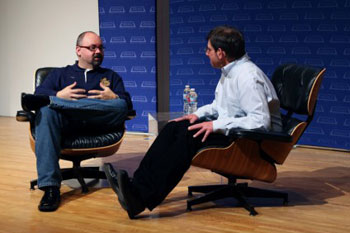
From Zachary Mason and Guy Gavriel Kay, to Guy Gavriel Kay at KQED, then on to Cory Doctorow and his fine novel, 'For the Win,' the last bit of fiction to make it up on this site, to Chuck Palahniuk's delightfully dense 'Tell All' to an interview overlooking the San Francisco Bay while the tides clashed beneath the Golden Gate Bridge, to a death-and-light fixture defying stint hosting Mr. Palahniuk's appearance in San Francisco — all while waiting on pins and needles to see if I can get my computer fixed. Again. And again! Dash down to LA, to talk to Carlos Ruiz Zafón on stage, then back up to SF for Juliet Schor and Paul Provenza with Dan Dion — on the same day!
Coming up in the podcast, you'll hear Cory Doctorow on 'For the Win,' Chuck Palahniuk in a one-on-one interview and live, I'll podcast the audio of the Carlos Ruiz Zafón gig ... and that's just the first wave. After that, look for Juliet Schor on economy and ecology, and Paul Provenza with Dan Dion talking about the art of comedy. And that brings us up to last Thursday. The books in the queue include Sherri S. Tepper, David Mitchell's history novel, Gary Shteyngart's science-fiction comedy, China Miéville's 'Kraken' (a gift to his readers and the world!) and Sloane Crosley's utterly entertaining essays.
I want to thank readers and listeners who make this possible. Thanks folks, I'm back on the job, please be patient while I once again engage the ship of the state of reading.
New to the Agony Column
09-18-15: Commentary : William T. Vollman Amidst 'The Dying Grass' : An Epic Exploration of Simultaneity
Agony Column Podcast News Report : A 2015 Interview with William T. Vollman : "...a lot of long words that in our language are sentences..."
09-05-15: Commentary : Susan Casey Listens to 'Voices in the Ocean' : Science, Empathy and Self
Agony Column Podcast News Report : A 2015 Interview with Susan Casey : "...the reporting for this book was emotionally difficult at times..."
08-21-15: Agony Column Podcast News Report : Senator Claire McCaskill is 'Plenty Ladylike' : Internalizing Determination to Overcome Sexism [Incudes Time to Read EP 211: Claire McCaskill, Plenty Ladylike, plus A 2015 Interview with Senator Claire McCaskill]
Agony Column Podcast News Report : Emily Schultz Unleashes 'The Blondes' : A Cure by Color [Incudes Time to Read EP 210: Emily Schultz, The Blondes, plus A 2015 Interview with Emily Schultz]
07-05-15: Commentary : Dr. Michael Gazzaniga Tells Tales from Both Sides of the Brain : A Life in Neuroscience Reveals the Life of Science
Agony Column Podcast News Report : A 2015 Interview with Michael Gazzaniga : "We made the first observation and BAM there was the disconnection effect..."
04-21-15: Commentary : Kazuo Ishiguro Unearths 'The Buried Giant' : The Mist of Myth and Memory
Agony Column Podcast News Report : A 2015 Interview with Kazuo Ishiguro : ".... by the time I was writing this novel, the lines between what was fantasy and what was real had blurred for me..."
Agony Column Podcast News Report : A 2015 Interview with Marc Goodman : "...every physical object around us is being transformed, one way or another, into an information technology..."
Agony Column Podcast News Report UPDATE: Time to Read Episode 199: Marc Goodman : Future Crimes: Everything Is Connected, Everyone Is Vulnerable and What We Can Do About It