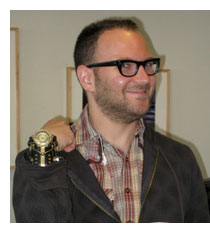
I've spoken often with Cory Doctorow, and we have more than once talked about the work of Robert A. Heinlein. Like many readers of science fiction, I started out with the great juveniles; 'Have Spacesuit Will Travel' and 'Red Planet.' And of course, I quickly graduated to the more adult offerings, like 'Stranger in a Strange Land' and 'Time Enough for Love.'
These days, the juveniles get more respect than his adult books, but that's probably just a temporary perspective. The kids who are currently reading books like Doctorow's own YA novel, including 'Little Brother' and his latest, 'For the Win' (Tor / Tom Doherty Associatges / Pan Macmillan ; May 11, 2010 ; $17.99) may decide that both Cory's and Heinlein's so-called "adult" works have more substance. And their kids will probably turn that opinion upside-down.
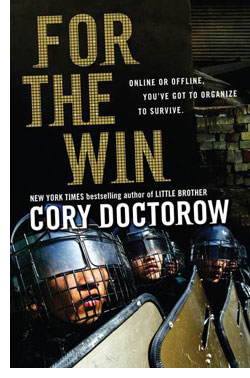
You'd have to be hiding under a cybernetic rock to have missed Doctorow's latest novel, which follows three young gamers spread out around the globe who meet in virtual worlds with a mysterious Big Sister Nor, intent on bringing a new generation of dirt-poor gold farmers together. Expect Doctorow's usual skill with plotting, prose and pace to ensure that you'll finish this book with the same fever any much-desired title will instill. There are a lot of great Big Ideas rattling around in here, told in a manner that even adults can grok. 'For the Win' is already a winner.
When you read this novel, there are a lot of interesting effects, if you're a seasoned (read: old, as in, "Fuck off, old man!") reader of science fiction. This is a novel I, at least found to be diverting on a number of levels. As a ripping yarn, that's a done deal, see above. But there's a question of where your empathy lies, and a more theoretical question as regards literature about games. This is where things get oddly interesting.
'For the Win' introduces a trio of young characters, and their parents as well. Doctorow puts us in the minds of the young protagonists, and front-loads us with all sorts of great, logical reasons why we, the readers, should understand their plights and their decision. He's eminently successful. But his real skill is revealed in what he does with the parents, so far as this parent is concerned. With regards to Leonard, an Orange County kid who calls himself Wei-Dong, I found myself totally identifying with his motivations for his response when his parents flip out over his video game shenanigans. When I was a kid, my parents regularly mentioned military schools in the same tone-of-voice, because in part, at least, I was "living in a fantasy world" reading those Heinlein juveniles and later, the adult science fiction.
And on a rather different take, the very notion of writing about gaming is of ontological interest to me as a reader. There's a bit of commonality with the better examples of historical fiction going on here, in that both immerse the reader in the perspective of characters who have rather different ideas about the nature and import of reality itself. And for me at least, I find it interesting that Doctorow chose to create a novel instead of, for example, a game. Oh, the game may come later, but the choice remains important, to my mind. Doctorow understands that there are inroads you can make with the written word that no other technology can duplicate. Reading is on the downslide for a reason, I suppose, even if it is to my mind both bad and temporary. That's because it requires effort of the mind to bring about the reading experience. Games, movies, entertainment — are all much more passive than reading. When I read 'For the Win,' I'm collaborating with Doctorow, to create an experience for one — me. That makes anything I read ultimately more important to me than any movie or game I view or play because I manufacture all the visuals myself. Doctorow scripts, I direct.
The slick thing about Doctorow's decision to write about games is that it puts me in the perspective of those who feel that the video game experience is analogous to the reading experience. It's not, they're not, but there's more there than I would have suspected. But as well, a video gamer reading about video games might find there is more to reading than they suspected. I might not be the only Doctorow reader to identify with the email-sending Jewish mother. And books may not prove to be as outmoded as the video-game playing youth of today may feel. Read about gaming in 'For the Win.' It may be your last, best chance to be a Jewish mother. Probably not, but it's a great place to start.
New to the Agony Column
09-18-15: Commentary : William T. Vollman Amidst 'The Dying Grass' : An Epic Exploration of Simultaneity
Agony Column Podcast News Report : A 2015 Interview with William T. Vollman : "...a lot of long words that in our language are sentences..."
09-05-15: Commentary : Susan Casey Listens to 'Voices in the Ocean' : Science, Empathy and Self
Agony Column Podcast News Report : A 2015 Interview with Susan Casey : "...the reporting for this book was emotionally difficult at times..."
08-21-15: Agony Column Podcast News Report : Senator Claire McCaskill is 'Plenty Ladylike' : Internalizing Determination to Overcome Sexism [Incudes Time to Read EP 211: Claire McCaskill, Plenty Ladylike, plus A 2015 Interview with Senator Claire McCaskill]
Agony Column Podcast News Report : Emily Schultz Unleashes 'The Blondes' : A Cure by Color [Incudes Time to Read EP 210: Emily Schultz, The Blondes, plus A 2015 Interview with Emily Schultz]
07-05-15: Commentary : Dr. Michael Gazzaniga Tells Tales from Both Sides of the Brain : A Life in Neuroscience Reveals the Life of Science
Agony Column Podcast News Report : A 2015 Interview with Michael Gazzaniga : "We made the first observation and BAM there was the disconnection effect..."
04-21-15: Commentary : Kazuo Ishiguro Unearths 'The Buried Giant' : The Mist of Myth and Memory
Agony Column Podcast News Report : A 2015 Interview with Kazuo Ishiguro : ".... by the time I was writing this novel, the lines between what was fantasy and what was real had blurred for me..."
Agony Column Podcast News Report : A 2015 Interview with Marc Goodman : "...every physical object around us is being transformed, one way or another, into an information technology..."
Agony Column Podcast News Report UPDATE: Time to Read Episode 199: Marc Goodman : Future Crimes: Everything Is Connected, Everyone Is Vulnerable and What We Can Do About It