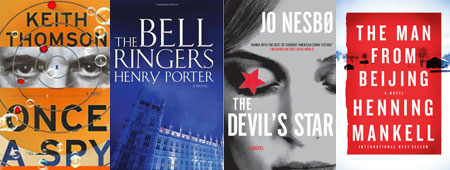
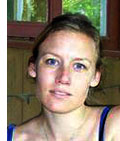
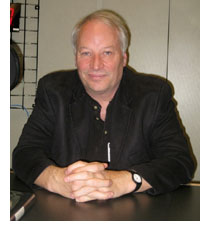
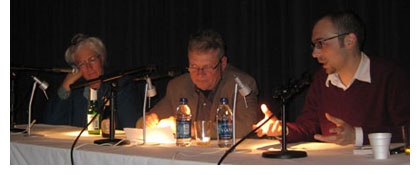
Keith Thomson,Once a Spy Henry Porter,The Bell Ringers Jo Nesbo,The Devil's Star Hennig Mankel,The Man From Beijing
One of the most fun aspects of working with NPR's Alan Cheuse is that he loves a good thriller. It's kind of unexpected, because his own work is quite wonderfully literary, and he is a keen and intelligent critic of literary fiction, which he clearly loves as well.
But he's a man who travels fairly often, and finds himself at airports looking for something to read on the plane, and reading in planes — probably more often than many Americans read something other than the newspaper. So when he suggested that we talk about thrillers, I jumped at the chance. He recommended 'The Bell Ringers' to me a while back, which he described as a "really boffo spy novel." How could I resist?
And so readers have seen today's four books creep through the Agony Column in the past weeks. You have some idea of my take on them, and now you can get that of Alan Cheuse, and you'll find it as observant and spot-on as ever. For while Cheuse no doubt likes his thrillers, he's quite as astute critic of the small bits. Not surprising, I suppose, but it is refreshing to have a literary critic turn his eye to the thriller genre.
And for the most part, these books do fall into the thriller genre, as opposed to the mystery genre. Jo Nesbo writes a pretty solid mystery, but when you ratchet things up to the point of a serial killer, then you do veer pretty close to the exclusive world of thrillers. Keith Thomson's 'Once a Spy' is solidly in the high-concept, high body count world of thrillers, and 'The Bell Ringers' is as well. The latter does aspire to do more than simply thrill, however, as Cheuse observes. He also comments on the elephant not in the room with the other two books, 'The Devil's Star' and 'The Man From Beijing.' That would be Stieg Larsson, author of 'The Girl Who.." novels. You can find out who ranks where in the well-considered opinion of Alan Cheuse by following this link to the MP3 audio file.
Victoria Blake
03-04-10: A 2009 Interview with Victoria Blake
The View from the Underland
"You're going to edit this, right?" — Victoria Blake
Victoria Blake is not lucky — she's smart. Luck won't get you very far in a publishing world that is coming apart at the seams. Smart is what is needed, and Victoria Blake has made a lot of smart choices. Underland Press is an interesting experiment and one that is proving remarkably successful.
Part of this has to be her strategy of release formats, and that was one of the first thing I asked her about. Trade paperback and super-fancy limited edition hardcovers are not all that common. But uncommon is apparently what is needed.
There are a lot of prize-winning and award-nominated titles in the Underland list these days. Brian Evenson's 'Last Days' got put on the Time Out Best of 2009 list and won the American Library Association's Best Horror Novel of the Year award, while Jeff VanderMeer's 'Finch' received a Nebula Nomination. That's a lot of mainstream affirmation for an "underland," as it were, press. Good taste will always triumph.
One of the things I talked to Victoria Blake about was just the mechanics of making books. You know, back when I was reading all those mass-market paperbacks, I just presumed that the publishers had their own presses. I imagined a sort of "I Love Lucy"-style production line, stamping out yellow-edged books. Back then we'd call it sheer fantasy, but today we call it three-d printing. But that's not what's happening with Underland, obviously. I wanted to find out what was happening.
And of course, the announcement of the iPad, and all the Secret Treaties signed with the New York Publishing World, have made the subject of electronic editions ever more pertinent. It seems rather unclear how this will affect the smaller publishers. I sought to have Victoria give us her take on all this — and maybe talk about her plans.
But in the end, to my mind, it always comes down to content. All the bells and whistles and all the placement and marketing tools won't matter a whit if what you've got on display is ... second rate. That's clearly not the case with Victoria and Underland. She has a great eye for a very unusual style of quality, one that balances edgy weirdness with actual accessibility. So what titles might we look forward to in the future from Underland? To find out what Victoria Blake has to say on the matter, just folloow this link to the MP3 audio file.
Joe R. Lansdale at NPR West
03-03-10: A 2009 Interview with Joe R. Lansdale
"What really is important is this social connection with people." Joe R. Lansdale
It's no surprise that the third part of 'The Drive In' is a bus trip through a landscape that only Joe R. Lansdale could devise. This is, after all, an omnibus. But when you have access to excess, sometimes you can check these things out and get the low-down on how one of your most cherished series gets finished up while you were off pan-frying filet mignon and serving it with Spaetzle and a nice demi-glace.
As much as I like 'The Drive In' and 'The Drive In 2,' I'm no big fan of popcorn, steamed hot dogs and slightly flat soft drinks. And given the provinces of the demeanor of The Popcorn King, I feel entirely justified in that regard. And yes I do pan sear filet mignon. It's the best way to cook it. Lansdale, on the other hand, knows all about Drive In food, which, in his universe, like Soylent Green, tends to be made from people.
I gave Joe Lansdale a ring, or rather my telephone number and had my recorder all ready to go. He's a busy guy these days, and I think he's probably always been, so no surprise there. But readers might find part three of his opus more than a little surprising, because he gets his people in that there bus and promptly takes a big ol' left turn — I don't mean politically, either.
Lansdale seems to be sneaking up on American Lit from behind, with a baseball bat in his hand, and the intention of smacking readers and in particular, academics upside the head, proving his point that weird is not just good, or good enough. Weird is, for Joe R. Lansdale essential, it is a key compentnt of the toolkit for writing that aspires to be good, dirty fun but proves in the long run to be able to beat the tar out of a bunch of stuff that seemed to imply the light of truth shone forth from its pages. That may or may not have been true, but what is certainly true is that Lansdale has a gift. You can hear him exercise said gift by following this link to the MP3 audio file of our conversation.
03-02-10: Laurie R. King, Terry Bisson and Jedediah Berry at SF in SF
Beyond BoucherCon
You go to SF in SF religiously, like I have for some three years-plus, and you're going to get a bit cocky, think you've seen it all.
Then you toss Laurie R. King, Jedediah Berry and Terry Bisson at genre fiction, put 'em behind a table in front of a few people, and all hell breaks loose.
In the best possible manner.
When you hear the phrase "panel discussion," you might be tempted to think, well that kinda shit is for librarians, or Talking Heads.' Pundits and idjits, if you have a discerning-enough eye to tell the difference. But put some writers in the mix, and damn if sparks don't fly, then land in someone's hair and set it afire.
I start out this recording with Laurie R. King as she follows on from Rina Weisman and talks about BoucherCon. But it doesn't take long for Bisson, Berry and King to really get into the good-old, good-time discussion of genre fiction and, more importantly — why The Cultural Elite and the Mainstream Media don't take much of anything particularly seriously unless it has the imprimatur of the Critical Consensus. The latter, along with the Cultural Elite, have long conspired to keep genre fiction and science fiction and horror in particular, under their collective thumbs. It's time for genre fiction readers to rise and proclaim the kind of cheesy stuff we like is every-gods-damned bit as good for the shattered remains of our tiny brains as any piece of hoity-toity kitchen-window epiphany fiction.
Well, that's the theory, at least.
The actuality may be a bit more demure, but rest assured that these three manage to really stir the pot. Language I cannot broadcast on my radio show is used by parties you would not be likely to associate such language with. Things are said and cannot be unsaid. Defenses of genre fiction are made and then blown to pieces by those making them. In general, a good time is had by all. You can hear just how good a time we had by following this link the MP3 audio file.
(Language warning!)
Adam Haslett at KQED
03-01-10: A 2009 Interview with Adam Haslett
"With her, and with each character, how does the rhythm create a kind of musical argument?" Adam Haslett
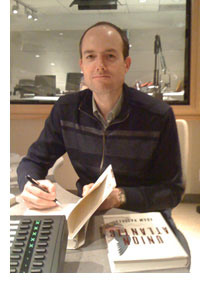
Well, I had the pronunciation right. There's a plus. I'd been saying Adam Haslett's last name as has-lett, not hays-lett, but somewhere — perhaps in a phone conversation with his publicist? — I somehow heard the correct way (hayslett) and it stayed in my all-too-tiny brain all the way to the interview. And listening to the raw tape, I notice that I didn't, as usual, screw up the introduction.
Of course Haslett had read for me from his novel before I did the introduction. I suspect that the effect of being exposed to perfectly composed sentences read by the man who wrote them helped straighten out my language centers. Think of a linguistic version of Kurt Vonnegut's Ice-Nine. A few sentences from Haslett, and all of sudden you're speaking the language as she is supposed to be spoken.
It's a lot of fun to hear Haslett read his work, and talk about it, even if the crystal ball effect is somewhat disorienting. Here's a man who appears to have decided to investigate the souls of those who hold the levers of the financial Rube-Goldberg machine that controls our economy just as these men were setting said machine into a shuddering disaster from which we're all still recovering — if we're lucky. Lots of us (and yours truly may be counted among these) are not particularly recovering economically. We're clinging to the edge of the ledge.
The virtue of Haslett's novel is that he offers us the perspectives of those who brought us there, as well as those of us whose last fingers are slowly slipping in the crumbly dirt. I talked with him about how he crafts these characters, and not surprisingly, it's not easy. It's sentence by sentence. But Haslett does have a lot on his mind in 'Union Atlantic.' You can find out just what that is by following this link to the MP3 audio file of our interview.
New to the Agony Column
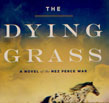
09-18-15: Commentary : William T. Vollman Amidst 'The Dying Grass' : An Epic Exploration of Simultaneity
Agony Column Podcast News Report : A 2015 Interview with William T. Vollman : "...a lot of long words that in our language are sentences..."
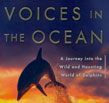
09-05-15: Commentary : Susan Casey Listens to 'Voices in the Ocean' : Science, Empathy and Self
Agony Column Podcast News Report : A 2015 Interview with Susan Casey : "...the reporting for this book was emotionally difficult at times..."
08-21-15: Agony Column Podcast News Report : Senator Claire McCaskill is 'Plenty Ladylike' : Internalizing Determination to Overcome Sexism [Incudes Time to Read EP 211: Claire McCaskill, Plenty Ladylike, plus A 2015 Interview with Senator Claire McCaskill]
Agony Column Podcast News Report : Emily Schultz Unleashes 'The Blondes' : A Cure by Color [Incudes Time to Read EP 210: Emily Schultz, The Blondes, plus A 2015 Interview with Emily Schultz]
07-05-15: Commentary : Dr. Michael Gazzaniga Tells Tales from Both Sides of the Brain : A Life in Neuroscience Reveals the Life of Science
Agony Column Podcast News Report : A 2015 Interview with Michael Gazzaniga : "We made the first observation and BAM there was the disconnection effect..."
04-21-15: Commentary : Kazuo Ishiguro Unearths 'The Buried Giant' : The Mist of Myth and Memory
Agony Column Podcast News Report : A 2015 Interview with Kazuo Ishiguro : ".... by the time I was writing this novel, the lines between what was fantasy and what was real had blurred for me..."
Agony Column Podcast News Report : A 2015 Interview with Marc Goodman : "...every physical object around us is being transformed, one way or another, into an information technology..."
Agony Column Podcast News Report UPDATE: Time to Read Episode 199: Marc Goodman : Future Crimes: Everything Is Connected, Everyone Is Vulnerable and What We Can Do About It