|
 |
12-30-09: Belinda Bauer Unearths 'Blacklands' : Apt Pupils
When we hear a book described as crime fiction, we tend to think of a pretty limited range of plots and ideas. Cops, criminals and justice about cover it. But just like any genre or sub-genre, crime fiction proves to be more malleable than one might at first presume. After all, Dostoyevsky wrote crime fiction.
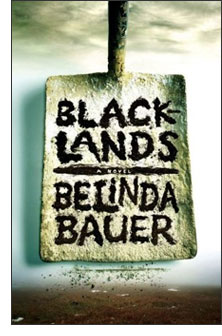
Belinda Bauer's 'Blacklands' (Simon & Schuster ; January 5, 2010 ; $23 / Bantam Press ; January 2, 2010 ; £14.99 ) is a bleak portrait of life after crime. Steven Lamb was not even alive when his Uncle Billy was kidnapped eighteen years ago. But with even with Billy's killer supposedly in jail, the body was never found, and Steven's mum, his nan, his family is still dissolving. Steven's a smart 12 year-old outcast who spends his time out in the moors, digging, looking for the body where the killer's other victims were found. But he is smart, and soon enough thinks up a better plan.
I'd suggest readers ignore the jacket flap and the online plot summaries and simply immerse themselves in this tense portrait of the despair and desperation that grow from a crime, even one committed one generation before. Bauer wrote the novel without an agent and submitted it to the Crime Writers Debut Dagger before it was published. It was shortlisted and not surprisingly, sold quickly. There's a good reason for this. Bauer has the so-British sense of detail and intensity in her prose. She turns her vision of life in a small town into a searing portrait of loneliness and ultimately, terror. Every crime has consequences, and the taking of Billy Peters simply require more time play out. Steven is determined to learn what happened, to understand the crime. The consequences of that understanding are beyond his expectations. Every crime does indeed have its punishment, but this is not necessarily meted out in any just manner. Knowledge can bring both rewards and retribution.
'Badlands' is an excellent debut, and, if there are turns that are not unexpected, then Bauer's prose and sense of place give then power and heft. 'Badlands' is a short book, but it has a grand vision of how a single crime can reach across three generations and how much influence a single, evil human being may have. We're always hearing that every single person can make a big difference. It's just not usually applied to the art of murder.
|
|
12-29-09: Alta Ifland's 'Elegy for a Fabulous World' : Melting the 'Voice of Ice'
There's a certain fictional voice that instantly identifies itself; simple words in a skewed landscape. And while the words and even the speaker have that sort of direct approach, we know that the vision of the world is diffracted. The light shining from the world through the narrator is bent in a fundamental manner. We know that this is neither the world we know, nor a world we can, in fact, ever know. This is a fabulous world.
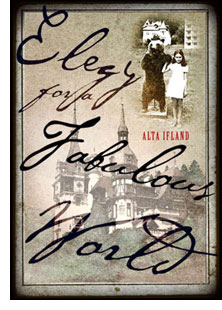
When last I spoke with Alta Ifland, she'd just published 'Voice of Ice,' a collection of prose poems that would have fit along nicely with the sort of flash fictions one will find coming from the odd corners of the genre fiction world. Her new collection, 'Elegy for a Fabulous World' (Ninebark Press ; October 7, 2009 ; $16) is a collection of short stories set in a peculiarly hermetic world where apparently simple language is wrapped around surreal perceptions to create a sort of dislocating effect on the reader. Every word is familiar; every sentence is strange.
Ifland has an excellent website altaifland.com, and a good presence online; you can find the title story online at Boston University's AGNI. But the whole here is definitely greater than the sum of the parts. 'Elegy for a Fabulous World' is divided into two sections — "There" and "Here and There," which reflect, in some sense, a sort of progression from childhood to adulthood and from being in some foreign place to being foreign in some place. But really, these are stories for readers who simply feel out of place, stories of those for whom words are a place, a world, not surprisingly — a fabulous world.
Fabulous, in Ifland's hands, is not "wonderful, wow," but rather a place where fables and stories and misperceptions define the world as much as the hardscrabble struggle for daily existence. There's a dark and rather ghoulish sense of humor at work here, whether it's describing "Fedea the Gravedigger" ("his baggy gray pants, all rags, held in place with a piece of string") or in "Milk, or How I Became an American Citizen," Miruku, a beefy Japanese-Armenian son-of-immigrants, who avoids credit card payments by, "days when he spent all afternoon talking to these people, his explanations extending into a maze filled with intricate detours, his voice soft and sweet as a woman's, a voice one didn't expect coming from such a body."
Ifland doesn't just focus on the grit of a childhood in the Ukraine and an adulthood in the US, though there is a strong autobiographical streak in these stories. Everything is transmuted by her words, her splintered vision, sometimes into the realm of pure fairy tale, such as "The Nonexistence of Adelaide Bauer," a fine piece of absurdist storytelling the works utterly in the negative; "Such creature could only have surfaced out of nowhere." Even those stories which hew closer to reality seem to be sewn out of shadows. In "The Wedding," the narrator's "Cousin H" is now divorced; there are no names here, only "Aunt M," or "The American," or "The Mother." Oh we know all the details, "the blue pleated dress" her mother wears to another wedding and the "meatballs, cabbage" served. But there's a formal, abstract ring to all the personal particulars, a nod and a wink to the language that creates this fabulous world, that creates our fabulous world every day of our lives. We are, of course, the heroes of our own stories, and whether we wish to acknowledge it or not, they are populated by images just as conveniently sketchy, just as surreal as a minotaur or a Siren. Our personal mythos is every bit as pervasive, every bit as evasive as the surreal worlds experienced by Ifland in 'Elegy for a Fabulous World.' Entering hers, you'll come back to your own with a degree of apprehension and wonder.
|
|
12-28-09: A Review of Indigo Springs by Alyx Dellamonica : Start With the Magic
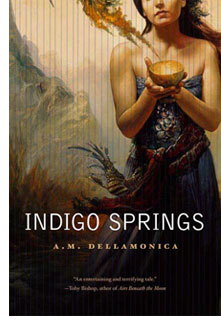
The name was certainly familiar. I'd seen the tagline "A. M. Dellamonica" on a host of articles written for the "Sci Fi Wire." To be honest, I didn't consider that a good sign. But a great cover image can go a long way towards getting me to crack a novel, and, again being honest, I have to admit that after reading the opening of 'Indigo Springs,' I was totally hooked.
I'll also admit that I was reminded in the best way of the writing of the giant tome that was officially ahead of 'Indigo Springs' in my queue. Dellamonica's sense of mystery and magic and her vision of a government response to both was totally gripping. But what rescues 'Indigo Springs' from being a mere thriller also slows the torrential pace. It's probably a good choice, after all is read and done. But that opening — to die for.
That said, the entire novel is an opening of sorts, though again, it works out well for a standalone. I also think that readers will find here a novel that can be, perhaps should be, marketed as "General Fiction," even though the publisher, Tor, is pretty much a speculative fiction-only house. To my mind, this might have been a good choice for the Forge imprint, where Tor sends its thrillers to compete with the stuff of big-budget action movies. You can really see that opening in your mind, and it would scare the bejeebers out of you on screen.
That said, you could also make an argument to market this with the paranormal romances, if it didn't seem so much more ... I guess, non-target audience-oriented than the parade of paperbacks featuring halter-topped babes with cropped hair and pouty lips. Actually, come to think of it, it's also a good candidate for a new-century relationship novel, what with all the fascinatingly well-drawn characters of ambiguous sexuality. Where your bookseller might place 'Indigo Springs,' it's certainly worth a look-see. You can read my review of the book (as opposed to the marketing strategy) here.
|
|
|
|
|
|
|