|
 |
10-02-09: Two True : 'Tokyo Vice' by Jake Adelstein and 'The Snakehead' by Patrick Radden Keefe
True crime has been on a roll of late, with 'Tokyo Vice' by Jake Adelstein and 'The Snakehead' by Patrick Radden Keefe. If you’re looking for non-fiction with all the color of crime fiction, some great writing and compelling stories, look no further. And even if you prefer crime fiction, there's a good chance that you'll find these books as gripping as any novel you could pick up.
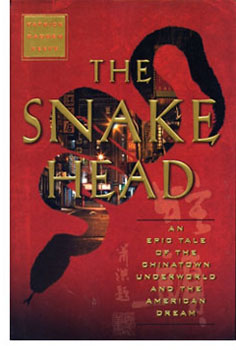
'The Snakehead' by Patrick Radden Keefe (Doubleday / Random House ; July 21, 2009 ; $27.50) is the more novelistic of the two books. In it, Keefe introduces a character you'll not forget — Sister Ping, a middle-aged grandmother who ran an international human smuggling operation with the efficiency of a ruthless corporate boss. 'The Snakehead' started as an article for the New Yorker, written after 300 shivering, starving immigrants were found when a ship ran aground off a New York Beach. The trail led to Cheng Chui Ping, Sister Ping, who on the face of it, ran a restaurant and grocery store in New York's Chinatown. But she also ran an underground bank for illegal immigrants and a human smuggling operation as a multi-national conglomerate, partnering with the Fuk Ching gang. Keefe's book is gripping, thorough and entertainingly suspenseful, focusing on a world that most of us would not even suspect existed. As he tells a great story, he explores the costs of illegal immigration to both the immigrants and those tasked to prevent it. He gets at the issues by letting his gripping story unfold. You'll read it like a novel. 'The Snakehead' reminds us that crime history is indeed history — and the source of powerful storytelling in the hands of a writer like Keefe.
In 'Tokyo Vice' (Pantheon Books / Random House ; October 13, 2009 ; $26), Jake Adelstein takes the "fly on the wall" approach to the Tokyo police that David Simon once applied so memorably with 'Homicide: 'A Year on the Killing Streets'. In 1992, Adelstein, having relocated to Japan, was struggling to learn the language as took a test in order to apply for a job reporting on crime for Yomiuri Shinbun, the largest newspaper in Japan. Both in spite of and because he was a gaijin, an outsider, a foreigner, he made the grade, but then found himself immersed in an alien culture upon which he was supped to write in a foreign language. Needless to say, it a was a high-stress occupation, but over the course of twelve years, Adelstein worked his way through extortion, murder, human trafficking to the point where he went up against the yakuza ("a lot of them like to call themselves gokudo, meaning literally 'the ultimate path.'") Adelstein tells his story in a compelling first-person narrative, with a nice frame to put things in perspective from the get-go. It ups the suspense as readers immerse themselves alongside Adelstein in a detailed and exotic world; both Japan itself and the criminal underworld of Japan that Adelstein covers. Pick up this book in the bookstore and you likely won’t want to put it down; Adelstein sets himself up with a sizzling scenario. Both 'Tokyo Vice' and 'The Snakehead' demonstrate that true crime non-fiction can be every bit as compelling as fiction and offer the same fascinating visions of our society — from the beneath the bottom of the barrel upward. Crime, like cream rises to the top.
|
|
10-01-09: Pyr Books Takes 'Desolation Road' : Ian McDonald's First Novel Re-Issued
Science fiction readers, not surprisingly, tend to live in and look forward to the future — at least so far as reading goes. But the literature has a rich past, much of which is pretty difficult to get a hold of. Thanks then, to Pyr, which reaches into science fiction's past to pull out a title that pointed the way to the future.
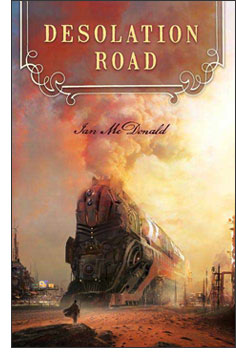
Yes, everybody's been to Mars. From H. G. Wells to Edgar Rice Burroughs, from Ray Bradbury to Philip K. Dick. (Dick's 'Martian Time-Slip' is one of his best.) Not surprising then, the Ian McDonald, now famous for works like 'Brasyl' and 'River of Gods' set his first novel on Mars. What is more surprising, however, is how hard this book has been to get in the United States. Now Pyr rights that wrong with their excellently presented trade paperback version of 'Desolation Road' (Pyr Books / Prometheus ; July 28, 2009 ; $15.98). Once again, we can visit Mars as seen through the unique vision of Ian McDonald.
'Desolation Road' was really a glimpse of the future of science fiction when it first came out, some twenty years ago, even as it also nodded to the past. Like 'The Martian Chronicles,' 'Desolation Road' is an episodic novel in which the town of Desolation Road, accidentally founded where no town should be, is the main character. The series of interlocking stories that wind around McDonald's setting have some of the feel of fairy tales and yarns and tall tales. He uses the same sort of ethic flavorings that run through his other works, snippets of today that seem like tomorrow. McDonald excels at making our world seem as alien as the alien world upon which he sets his stories. And even though this is a science fiction novel, set on Mars, it has much of the feel of fantasy. There's a lovely sense of whimsy at work here, evident in the language and the names of the characters. 'Desolation Road' is a book you want to read, and probably re-read.
The problem has been that in the US, it’s not been easy to come by. I remember friends of mine back in the 90's searching for this title and having to import it. The Bantam Spectra edition left the station back in '88. Twenty-one years later, the train has arrived again. Hoist your glasses and drink to 'Desolation Road.'
|
|
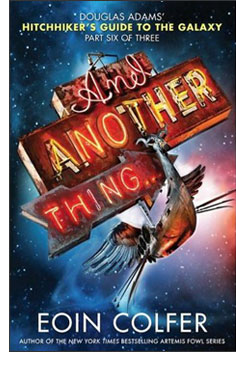
09-30-09: Eoin Colfer Coughs Up Eric-the-Half-A-Book : 'And Another Thing...'
Astute readers will no doubt have noticed that last week, when I wrote about the Pan Macmillan re-issues of the Douglas Adams' Hitchhiker's Guide to the Galaxy novels, I managed to miss just a little bit of newsy stuff. Like the fact that there's another book in the trilogy by Eoin Colfer! Oops. It was just another thing, after all.
At that point, it was not a thing at all, but an announcement, and not, to my mind, necessarily a welcome one, for fans of the originals, fans of Eoin Colfer and probably for Colfer himself. After all, it seems sort of like an idea out of Hollowood — sequel to a series by much-beloved author who departed this realm at a tragically youthful age. It's not really an enviable assignment. Fans of books have a natural tendency to be suspicious at best, and outraged by the very mention at worst — by these sorts of shenanigans, and well they should be. Being asked to write a sequel to a trilogy that was already clocking in at five books is one of those offers you can't refuse — but might have good reason to wish you could.
In one of those weird stunts that publishers have dreamed up to show they can be just as odd as Hollowood, Hyperion Books has sent 'And Another Thing ...' (Hyperion Books / HarperCollins ; October 12, 2009 ; $25.99), the new sequel to Douglas Adams' Hitchhiker's Guide to the Galaxy novels ... well, almost. In point of fact, they didn't send the whole book. Nope. They sent Eric-the-Half-A-Book, 140 pages (presumably of 280) of half-a-sequel. I have to admit, I was afeared, because, well, you know, I didn't want anyone to, not to put too fine a point upon it, crap up Adams' fine work. Like many readers, I hold the first five books in high regard. I've read them and bits of them more times than I can count, and I've watched the TV series as well. (I thought the Hollowood movie, well, pretty much what you’d expect — a big budget waste of time, money and talent.)
So the good news is, strangely enough, that 'And Another Thing...' is pretty darn good. Or at least the first half is! Now the second half might very at this moment be 140 pages of, "All work and no play make Jack a dull boy." And if that's the case, well, it's got to negatively affect one's overall judgment of the work at hand. I like it that Colfer has yarbles enough to include Cthulhu as a character, and that he puts him in a job interview. I like his prose, which captures the essence and spirit of Adams' work with just enough nowish-verve to seem original and fresh. I grinned as I read Eric-the-Half-A-Book, very much against my will. Yes, Colfer has managed to do the very difficult with deceptive ease. And you know that when a wrier makes it look easy, that means it was probably quite hard. Hats off to Colfer. 'And Another Thing...' is both it's own thing and enough a piece of the puzzle that it hangs in perfectly with the rest of the books.
I suppose that's the deal here. I think that unsuspecting readers who picked up this one first would enjoy it enough to go back and seek out the others, and enjoy the whole shebang. These are all fun books; they’re not, to paraphrase Joe R. Lansdale, books of big thinks. These are books where the meaning of life is reduced to 42. And you know, I think I agree, the meaning of life is 42. And if Colfer keeps writing sequels until he is 42, or reaches book number 42 of 3, (whichever comes last) well, I'd look forward to 'em and read 'em up. The bottom line is that Colfer has managed to distinguish himself with fine silly work, fine silly enough that I'll have to look at his other stuff.
Hopefully, you're reading through to this paragraph. If you're in the UK, send me your land mailing address; the first three to do so will get a set up HHGTTG re-issues with stickers in place, mailed directly to them by the publisher, and hopefully let the publisher know via their website that they read The Agony Column. From me to you folks, when I can I will. I'm working on a US version, so wish me luck!
|
|
09-29-09: Nick Gevers Edits 'The Book of Dreams' : Silverberg, Shepard, Lake, Baker and Ford
In theory, I must dream, but I rarely remember. I suppose that my dreams are in general too nebulous to remember, that the events therein are so finely minced before mixing that the experience is a puree, in which no specific element is large enough to stand out and make up some sort of surreal plot, as is generally supposed to be the case. If I do have a normal sort of dream, it’s often so intense and specific that I feel as though I went to sleep in my bed, woke up somewhere else and deal with it for some hours, only to wake up again with a full day of dealing with stuff ahead. Like many readers, I'm particularly interested in fiction about dreams. Or fictional dreams. Or fiction as dreams.
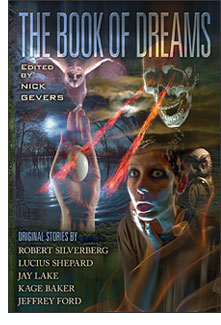
It's not billed as a series, yet, but I hope it becomes one. 'The Book of Dreams' (Subterranean Press ; January 2010 ; $20) edited by Nick Gevers is a slim, 117-page collection of short stories by Robert Silverberg, Lucius Shepard, Jay Lake, Kage Baker and Jeffrey Ford, with a knockout cover and interior illustrations by J. K. Potter. And this is one of those collections that is a great book you can hand someone and say, "This is why I read science fiction."
Now, strictly speaking, these stories aren't exactly science fiction, but most folks who don’t haunt that section of the bookstore wouldn’t notice. What they would notice is great writing, lots of variety and a lot more imagination packed into a small space than you'd think possible, even given that the theme of the book is dreams. And for this reader, at least, you get three generations of science fiction writing, demonstrating that the genre always has been, and likely will be, very strong.
Robert Silverberg was among the first of the science fictions writers I ever read, and I have vivid memories of his work and my paperback copy of 'Nightwing.' His entry here, "The Prisoner," offers ample evidence why this is so, as he takes one aspect of dreaming and tweaks it until we are thoroughly engulfed in the flames of slumber. He's the first generation of three that I mentioned, and his work here seems as fresh as ever.
I'd put Lucius Shepard and Kage Baker in at least, my second generation of science fiction writers. Shepard dreams of Hollywood, and Baker, Vietnam. They both bring their strong mix of great prose and vivid, detailed imaginations to the work here. It's specific, pointed American Magic realism at its finest.
Third generation writers Jeffrey Ford and Jay Lake explore a more mythic dream landscape with words as symbols, dreams as prophecy and narrative as a means to burrow into our collective unconscious. Dreams as stories and stories as dreams. It's much like the reading experience itself, a dream from which we need not wake; especially when we're reading such fine fiction in such a finely produced book.
|
|
09-28-09: Mario Guslandi Reviews 'The Witnesses Are Gone' by Joel Lane : Film and Nothing
We're starting off the week with Mario Guslandi's review of the latest from the talented Joel Lane, 'The Witnesses Are Gone'. Just seeing the name brought back memories. Joel Lane is one of the authors I first picked up when I was discovering horror fiction in the 1980's. If I'm not mistaken, he was editing Chills: The Magazine of the British Fantasy Society. And later on, as I toiled away in the IT world in 1994, his collection of stories, 'The Earth Wire' was one of those books that grabbed me and convinced me, like Clive Barker's 'The Books of Blood,' that horror was a genre where the limitations could be turned into strengths.
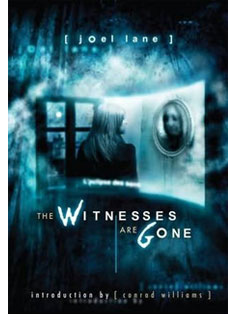
Lane's work is superbly creepy, with an urban vibe that reminds me of Ramsey Campbell. He captures the terror of those public spaces when, in any given moment, the crowds are gone and the wind blows bits of trash through the streets. 'The Earth Wire' was nominated for a World Fantasy Award back when it came out, and this fine new volume from PS Publishing lives up to that standard of quality. It's a novella with a superb cover image. Here's a link to Mario's book review of 'The Witnesses Are Gone.' I think it sounds like it's definitely worth buying; and let me suggest that, if you don’t have one, you as well take the time to scare up a copy of 'The Earth Wire.'
|
|
|
|
|
|
|