|
 |
05-01-09: Follow-Up on Donburi Mania : Test-Driving a Good Cookbook
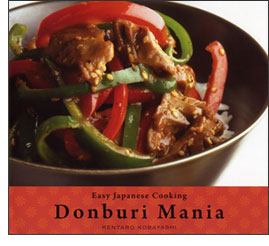
So the deal with the Donburi cookbook is this: a buncha stuff on rice. It looks and calls itself "Easy Japanese Cooking," and I'll take author Kentaro Kobayashi that it is Japanese cooking, and indeed often easy. But don't think you've got a one-taste cookbook here, because lots of the recipes seem like simple classics, re-simplified and served on rice. I say that like it's a good thing because it is a good thing.
But it isn’t all a bed of roses. You've got to be on your toes, and unless you have a very well-stocked oriental grocery store nearby, you're going to be doing some substitutions, particularly for the greens. Let's deal with the veggies first, then. Kobayashi wants you to use what he calls "bunching onions" in just about every recipe, but no fancy grocery store or even the produce stands carry them about here. He says in the recipe that you can use leeks or green onions, and I split the difference and use both with almost straight-across-the-board success. He also has lots of calls for komatsuma, which I remember seeing in the one giant oriental market I did go to over the hill. I suppose I'm a bit frustrated, 'cos I know that market would have everything I need, but still, spinach seems to fit well, and in one recipe, Kobayashi suggests baby bok choy as well. And there's the mushrooms; he wants "king oyster", I can get "tree oyster." Maybe it's just semantics. He also wants maitake, which I cannot find, and for which I subbed very expensive shitake mushrooms. Just be aware that with regards to the vegetables, you're going to need to be flexible and inventive unless you have a good oriental market close by.
One of the main ingredients you need is miso paste. I had to venture out to Shopper's Corner to find some, but it is really tasty and a key ingredient that you can't substitute around. I bought a sack of Yamabuki Tezukuri Miso. It cost about six bucks, looks like it will make a lot of meals and keeps well in the fridge. So plan on finding something like it, which is probably doable in a gourmet-ish grocery store.
Next on your checklist is rice. Since the cookbook is pretty much "buncha stuff on rice," well you want some dependable rice. The photos, very helpful, show white rice, and I've had great luck with Trader Joe's White Basmati rice, which cooks up in about 20 minutes, and is not too fussy about being opened up while cooking. Moreover, it keeps well, so if you have leftovers, you can nuke 'em in the morning to make Sunny-side Donburi for brekkie.
One of the quirks of 'Donburi Mania' is Kobayashi's penchant for non-standard measuring terms, to wit, the "nub." I put a nub at somewhere between a teaspoon and a tablespoon, depending on how you feel about the ingredient in question. Generally, it's a nub of ginger, so I slice off something around the size of a fingertip, then peel it and crush it with a garlic crusher to get the juices and a bit of pulp, but not the fiber. If you're sharing with crushed garlic, crush the garlic first. And as for garlic, I almost always put a lot more in than suggested, translating one clove to six. And let me here mention that I use Christopher Ranch peeled garlic cloves. Once you go there, you won’t come back.
You'll also be using eggs more than you expect, and Kobayashi has a particular way he likes you to cook them. On one hand, he shows you a specific kind of pan to cook them in, then says that he just uses a generic 6" saucepan. He calls the style of eggs he cooks "simmered egg sauce" or "creamy eggs" ; I call them basted eggs, not quite poached.
One of the nice things about 'Donburi Mania' is that the recipes are generally for two servings. Alas, Kobayashi must not be very hungry by the time he eats, or use a lot more rice in the mix, because I generally find them to be about 1 1/2 servings. If you’re serving for two, you may find you can comfortably double the recipes and have a bit left over. A bit — this food is great.
Another nice thing about 'Donburi Mania' is that he doesn't give you cooking times. I find that I start laying out the ingredients about two hours before I want to eat and firing up the actual cooking about 40 minutes before I want to eat. For the most part, you can prepare the main dish in one pan and the rice in a little covered pot. Cleanup's easy.
Now back to the Japanese issue. There are some recipes, a significant number, that seem "Japanese" only by virtue of the fact that they’re in this book. Take for example "Pork Stroganoff Donburi," which is out-friggin'-standing. It's pretty much like any other stroganoff that you've made, but somehow seems easier and tastier. "Melty Cheesy Meat Sauce Donburi" reminds me of a marinara sauce, and indeed includes mozzarella cheese. There's a clean recipe for scallops and even a potato salad that could easily be airlifted into a comfort food cookbook.
'Donburi Mania' cookbook then, is a lot more than you might think it is. It might be all Japanese, and everything might be served on rice. (You could easily serve many if not all of these dishes on potatoes or noodles if you preferred.) And the recipes that have ingredients in common (mostly miso paste) have a samey taste, but that's a really, really good taste. You could easily and very cheaply, cook three meals a week out of this and probably not receive any complaints. Prepare for compliments instead. In hard use, over a couple of weeks, 'Donburi Mania" has proved to be a sturdy, excellent cookbook. It's well worth your money and time, and I look forward to the remaining volumes in the series.
Step-by-step photo gallery of making of the Loco Moco Donburi
The accompanying gallery shows a step-by-step making of the Loco Moco Donburi. This is a spicy chicken-burger with a nice red sauce, topped with an egg. My market doesn't have ground chicken on hand, but they were more than willing to grind two boneless, skinless thighs and one boneless, skinless breast. I got two dinners for two, really, out of that package. This Donburi stuff is appealingly cheap to make, but tastes ands looks outstanding.
|
|
04-30-09: Jhumpa Lahiri and Kevin Canty : Stories Past and Future
Form matters. Form matters in fiction, though it is tempting to think that's not the case. It's easy to think well, "Fiction is fiction and books or stories have this or that impact ... the impact of fiction." And so novels and novellas and short stories might seem to be some sort of continuum. But form matters and a short story can be as different from a novel as a novel may be from a poem or a work of non-fiction.
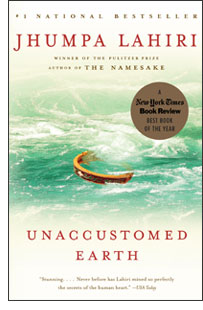
One need look no further than two single-author short story collections to grasp just how different short stories can be. You can pop right down to your local independent bookseller and pick up a nice trade paperback copy of Jhumpa Lahiri's 'Unaccustomed Earth' (Vintage Contemporary / Vintage Books / Random House ; April 7, 2009 ; $15), and, if you can get through all the accolades that slather the cover and first few pages, you'll find a collection of stories that live up to that praise. Lahiri is an accomplished short story writer and uses the form to create reading experiences that are powerful yet compact. Her visions of expatriate Bengali and American children are subtle and sparse but wrought with honestly-earned emotions. The power of feelings in our lives is often best realized in the short story format, and Lahiri knows how to craft exquisite reading in a compact — but not too compact manner. Stories like "Hell-Heaven" and "Year's End" will enter your mind, but pierce your heart. Lahiri writes on the long side of the short story form and her prose is rich and detailed.
Take your time reading the Lahiri; the stories are longish and dense enough to require a bit of assimilation; not surprising as assimilation is often the context of the story in one way or another. By the time you finish, you'll be lucky if Kevin Canty's 'Where the Money Went' (Nan A. Talese / Doubleday / Random House ; July 14, 2009 ; $24.95). Canty's stories are very much Americana, pointed and spiky like a basket of freshly-sharpened pencils. His characters are the people you might otherwise ignore, the people you don’t remark upon at the soccer match, the married couple you might think you know, but do not, the valiant losers and ungraceful winners. If you read the Lahiri and the Canty you'll find that they're remarkably dissimilar both from one another and from the experience of reading novels. Canty cuts to the chase, attacking his stories and characters as if they were a particularly hearty meal that needs eating. There's a pleasingly blunt quality to his language, lending his stories a raw quality. Lahiri and Canty, each of them teaches the reader with every story that short stories are indeed powerful and the feel and heft of that power is something different, not just from story to story, but essentially different from the stories told in novels.
|
|
04-29-09: 'Kill Her Again' With Robert Gregory Browne : Conservation of Suspects
There's an unwritten rule when it comes to reading mysteries, that I call the Conservation of Suspects. It's pretty obvious, really; when you’re reading a mystery, the chances are that the doer is someone you've met. And if there are two crimes in a book, you can be pretty sure that they’re connected. And everything in a book will have consequences.
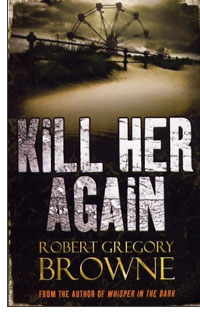
Consequences are just the beginning of 'Kill Her Again', (Pan / MacMillan UK ; May 1, 2009 ; £6.99 ; St. Martin's Press ; June 30, 2009 ; $7.99) by Robert Gregory Browne. FBI Agent Anna McBride has just been demoted after blowing it in a ruinous operation in San Francisco. She's still got the scars to show for it, and only Daddy Dear's connections in Justice have given her the not-so-good fortune to end up in Victorville California. It's an armpit desert town where a violent murder requires her concentration. But there's a problem. Since the blow-up, Anna has been having visions of a little girl who knows that she's about to be murdered. The visions are not just dreams; they are raw experience, memory inserted in Anna's mind. They're highly distracting and not helpful when she needs to focus on the grisly crime scene. Of course, Anna's visions are more than visions. Hypnotherapist Daniel Pope helps her realize that they're the key to an old murder that has direct bearing on her present life.
Browne's got a pretty neat high-concept behind this tidy paperback thriller, and I'm not going to spoil it for you. I will warn you that the back cover does, so don’t read it. But do read the book if you’re looking for a fine slice of American Cheese in a Brit wrapper. Browne's novel is out now from Pan MacMillan in the UK, and it's very nicely designed package that manages to convey some of the some of the eerie feel that Browne gets out of his American armpits. It'll be out in June in the US in a much worse looking package, which might, to my mind, actually detract from the reading experience. But it does look like Cheese, through and through.
The pleasantly exciting discovery here is that Browne is a capable writer who crafts an entertaining police procedural with a dollop of the supernatural. Well, maybe more than a dollop, with a nicely worked-out storyline that takes itself seriously enough to be credible and more fun than you expect. Browne's characters, dialogue and pacing are all spot-on and thriller ready. Since I've been to many of the locations he talks about, I can say that he has a pretty good sense of place and good feel for menacing but human antagonists. You’re not just getting some cackling madman caricature here, which is something of a relief. The Bad Guy is a nasty piece of work however. In fact, nobody is particularly cuddly in this novel. Everybody is kind of screwed up, which is a nice touch. And as you know, one of those Everybody is really screwed up, and catching him will have unforeseen but interestingly logical repercussions. If you look at the paperback rack and yearn for the days of yore, when Mickey Spillane had cornered the market on American Cheese, here's a good reason to make some e-site ship you a You-Kay mass market paperback. Though it may have come via the ever-alert Pan MacMillan folks, 'Kill Her Again' is a prime slice of American Cheese. Hot, fun and a bit greasy, perfect served on the beach on your back porch.
|
|
04-28-09: Declarations of Independents : Three Books from Independent Publishers
The rest of the world is hurtling towards hell in a hospital handbasket piloted by Laurie Garret, who clearly knew that 'The Coming Plague' was in fact coming, and Stephen King, who happily decimated the world with the superflu in 'The Stand.' Better hurry up and start reading these enormous tomes before you see someone wearing a mask in your local grocery store. (I saw one yesterday.) Let the world go. The independent publishers of the world are doing just fine, thank you very much, and here are three examples of books that speak to that fine state.
Does reverse alphabetical, by author sound OK? Then we start with 'Experiments at 3 Billion AM' (Eibonvale Press ; March 20, 2009 ; £18.75 / £27.50) by Alexander Zelenyj, a massive 658-page collection illustrated by David Rix. Zelenyj is an incredibly talented if totally-unknown-to-me writer who works the full spectrum of speculative fiction with ease and the ability to blur out any genre lines you may care to draw. Science fiction, fantasy, horror, slipstream and relentless re-combination, Zelenyj does it all with a narrative clarity that makes for fast, enjoyable reading. The B&W interiors by Rix are classy and reminiscent of a seventies style of science fiction illustration. The collection is available with two versions of cover art via direct purchase from the publisher's website. Zelenyj has won a Pushcart Prize in spite of the fact that much of what he writes is clearly genre fiction. But don’t expect overly-literary lah-dee-dah. Expect great writing, a lot of it, at a bargain price. And thanks UK independent Eibonvale Press for the favor.
Sometimes you have to wait. In this case, ten years, for the next installment of Adam Niswander's "Shaman Cycle" now out from Hippocampus Press. If you blinked back in 1999, you might have missed 'The Hound Hunters' in the "Integra Southwest Supernatural Thriller" series. But thanks to Hippocampus Press and Adam Niswander, you can score a pretty damn incredible deal. You buy 'The Hound Hunters' (Hippocampus Press ; December 31, 2008 ; $20) from the Hippocampus Website, and they'll ship you unread, hardcover first editions of 'The Charm' and 'The Serpent Slayers' at no additional cost. These books are great, kind of pulpy, well-written stories of supernatural mayhem with extremely well-drawn monsters and zippy plots that recast Lovecraftian themes in a southwestern setting. If you're looking for great monsterific fun, go directly to this website and get ready to get hooked. They may keep you up all night, but you'll sleep well in the morning. Here's to hoping that Niswander has more Shaman Cycle novels in the hopper. And here's to New York's Hippocampus Press for filling the Lovecraftian void.
Speaking of waiting, you won't waiting long for a high-quality reprint of Charles de Lint's classic novel, 'The Onion Girl' (Subterranean Press ; August 31, 2009 ; $75). By this summer, the seminal Newford novel will be available in an extremely fine signed, limited edition with a new introduction by the author. De Lint manages to create literate, character-driven novels with slightly surreal supernatural themes and yet is still not well-known to a reading public that laps up pabulum vampire sagas. This edition of 'The Onion Girl' may not change that, but it will give readers a book worth buying, reading, re-reading and keeping on your valuable shelf space from Subterranean Press in Michigan.
While the world calls doom and responds with gloom, while the mega-publishers do their part to contribute to the rising ranks of the unemployed (alas, sigh), these three books from independent publishers state that it is indeed quite possible to publish high-quality books and make a profit. In the direst times, we'll be able to read.
|
|
04-27-09: H. P. Lovecraft's Collected Essays CD ROM: 78.5 MB Into the Future
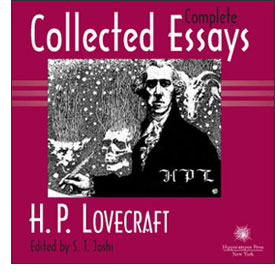
Even though H. P. Lovecraft was something of a futurist, I don’t think he could have foreseen the 'Collected Essays of H. P. Lovecraft: Complete' (Hippocampus Press ; August 20, 2008 ; $65) by H. P. Lovecraft and S. T. Joshi on CD ROM. But if he did, rest assured you could find out exactly where in this excellent electronic rendering. In theory, I should despise this sort of thing. I love books, the physical presence, and the smell of the pages. And to be sure, you can get each of the books collected here in hardcover format from Hippocampus, at $40 a pop, or in trade paperback at $20 a pop. And you probably should do just that. But trust me, if you need to do research, or just want to browse the collected essays of H. P. Lovecraft as if they were a well-designed website, then this CD is essential and irreplaceable.
Thank you, Hippocampus, for making this CD a pretty damn easy piece of high-tech literature to deal with. The instructions are simple and not quite complete, at least on a latest-generation Mac laptop, so let me help prospective buyers. First and foremost, you need Adobe Reader to use the CD. Even though I'm not a big fan of Adobe, the software is (currently) free from this download link, and pretty much ubiquitous. Step, one, get it if you don’t have it.
Step two, (they say) is to put the CD in the drive and press start. But the CD does not automagically open up and show you a shiny start menu as you might expect. Once it mounts on your desktop, you have to open up the CD and click on the "Start.PDF" icon. Sure this is all obvious to me, but it's worth mentioning nonetheless.
I'd suggest most buyers first burn the CD as a "Disk Image." This means you don’t have to put the CD in your drive, nor wait for the slower CD access times. Thanks and congratulations to Hippocampus for making this possible and not trying to slip in some weird DRM software that would require you use only the CD.
OK, 'nuff said about the administrivia. Let's get to the good stuff. Take a gander at the CD home page here and know you can now go anywhere and do anything with all the essays Lovecraft ever wrote, carefully and thoughtfully categorized by the eminent Lovecraft scholar S. T. Joshi. The "how to use this CD ROM" contains exactly one screen full of excellent instructions by CD designer David E. Schultz. And then, you're off and running searches for say, mentions of the word "moon" to see if you find the article that Lovecraft wrote about the possibility of traveling to the moon, a future event he did in fact foresee. Or you can find all the mentions of Robert Bloch. Anyone who has an interest in or a need to research the non-fiction of Lovecraft should run, not walk to their browser and pick up this CD from the Hippocampus website.
Even the casual reader will find a lot to love here at a decent price. You get the entire run of Lovecraft's amateur magazine, The Conservative, in both searchable PDF and scanned facsimiles. You get all five volumes of his collected essays; Amateur Journalism, Literary Criticism, Science, Travel, Philosophy; Autobiography and Miscellany, plus a 22-page Chronology of Works (fiction and non-fiction) and 9-page index of titles. It's all very straightforward and sort-of stripped down. It' also a deadly time-sink, because once you open it up, it's hard to put away. Can there be a better recommendation?
|
|
|
|
|
|