|
 |
04-24-09: Alex Bledsoe Gets Into a 'Blood Groove' : Re-Animating Vampires (Again, Damn It!)
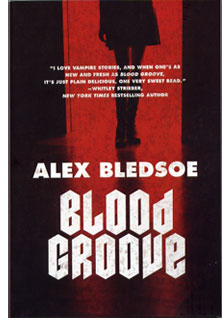
Alex Bledsoe first popped onto the scene with his enormously entertaining fantasy noir 'The Sword-Edged Blonde' from Night Shade Books. And just to prove he's the kind of guy who can shine the light of darkness even on the most-over-worked genre, he's back with 'Blood Groove' (Tor Books / Tom Doherty Associates ; April 2009 ; $13.95), an inventive and witty update/backdate of the vampire genre. 'Blood Groove' presents old with new, new with old and offers all the fun of a blood-drenched acid trip back to the scraggly seventies.
Yes, it's true, I used to hope that some sort of literary virus would come along and manage to wipe out the vampire fiction genre. But if that were to happen, it would literally pull the rug out from under publishing in general, and more importantly, deprive readers of some truly entertaining and intelligent writing. So here we are, with a new Alex Bledsoe novel that will curl your toes with tension and terror, but also make you laugh.
Bledsoe sets up the novel in the first two chapters with the kind of economy that grabs a reader and keeps you reading. Baron Rudolfo Zginski was staked in Wales in 1915 ... but alas, the end is only the beginning. Sixty years later, he ends up on a morgue table in Memphis, Tennessee and a morgue attendant, hoping for a real killer of a thesis, removes the silver cross from his twisted corpse. Memphis is the home to a nest of teenage vampires, who, alas, reflect the callow values of the 1970's. What they know about being a vampire comes from the movie Blacula. In short order, Zginski steps, "out of the morgue and into the polyester era." Turns out that someone's got a new drug out there, one that's addictive and deadly to vampires. Zginski has to mentor his teenage thralls and try to avoid becoming a footnote in the Age of Aquarius. It's that simple and that fun.
Bledsoe's a great stylist with a wicked imagination and an ability of hew to the story. Between Zginski and his followers, he's got a gaggle of great characters and an impeccable sense of the times. But 'Blood Groove' is not just an exercise in blood-drinking nostalgia. It's a toe-tapping noir that is quite humorous and yet takes its blood, death and violence with the kind of seriousness that makes the commentary inherent in a novel about the seventies — when, as ever, the racial divide in America somehow got in our faces — quite pertinent and even a bit poignant. But hell, commentary, shmommentary, 'Blood Groove' is just that — a tight, smart novel that gets in a groove and keeps the reader riveted. It's KTEL time. Get out your compilations, and remember that smiling faces probably don’t hide the fangs.
|
|
04-23-09: 'Cheek by Jowl' With Ursula K. Le Guin : Meta-Reading for Readers, Writers, Young Adults and Fantasy
The ability to simply read can be deceptive. Because we can look at the print, put the words together and follow the logic, create the world, engage, as it were in the reading experience, we think we can read.
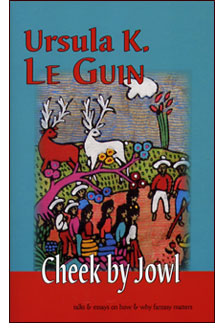
But reading is more than putting together the strings of words. The reading experience itself consists of not just assimilating the language, but putting it in context with our world and the literary world. Now, much of the time, we can do that without additional help. But sometimes, it helps to read about reading and read about writing. Ursula K. Leguin's 'Cheek by Jowl' (Aqueduct Press ; April 2009 ; $16) is an essential book of writing about writing and reading, particularly in the genres of fantasy and young adult fiction. If you either plan on reading or writing either, this book will be the magnifying glass and prescription eyeglasses that will make it all clear, bring it all into focus, heighten your vision. This is meta-reading.
'Cheek by Jowl'is an important book by any measure. Essays and non-fiction by one of today's most important literary figures are always welcome, but 'Cheek by Jowl' offers transcribed and expanded speeches from Ursula K. Le Guin, targeted at those who are interested in reading — and writing fantasy. And here's one the best aspects of this book; it's the product not of some castoff imprint of a mega-publisher, but the work of Aqueduct Press, a dedicated small press with an emphasis on genre fiction and women. At the moment, through May 1, they're offering a pre-release special of $12, making this book even more of a must-buy.
'Cheek by Jowl' includes 8 essays that you simply could not find collected anywhere else, and most of which you’d have been pretty hard-pressed to find in the first place. These include speeches and magazine articles, many of which have been altered and expanded for this publication. It's beautifully illustrated with a three-page list of the sources of the illustrations. It also includes an extensive bibliography for those who would read more.
The emphasis in 'Cheek by Jowl' is on fantasy and young adult fiction. Le Guin is an acknowledged master of both, and what she has to say on the subject is fascinating, informative and entertaining. Whether she's covering "Assumptions About Fantasy" or "Animals in Children's Literature" her writing will inform all of your reading both inside and outside the genre. If you've ever been to a optometrist to have your eyes checked, you'll recall putting your chin on a rest and staring out while the doctor flipped different strength lenses in front of your eyes. Sooner or later, one of them makes things startlingly clear. 'Cheek by Jowl' is the literary equivalent, meta-reading that will make everything else you read much clearer.
'Cheek by Jowl' is also the sort of book any writer, even a certain schoolteacher, might benefit from reading before plunging into the task of writing "Young Adult Fantasy." I'm using the quotes because Le Guin goes to a good deal of trouble to define all the words in that much-abused label. While not sold as a writer's guide, it is indeed the quintessential guide for any writer in any genre. 'Cheek by Jowl' will induce you to think deeply about everything you read and write. It will multiply your depth perception as a reader, and your skill set as writer. Unlike targeted how-to's, 'Cheek by Jowl' is rather timeless. It doesn't address anything particularly current. One might well presume that reading about how to read could be boring or pedantic; but this is clearly not the case. 'Cheek by Jowl' reveals the worlds behind the words. Some might consider it a revelation.
|
|
04-22-09: Sarah Waters Unveils 'The Little Stranger' : Ghosts of Our Own Decisions
The whims of literary prejudice are fascinating to chart. Horror fiction has always been considered déclassé, a cut below mainstream literature. Put some supernatural element in your story and you've taken it down a peg — unless you're talking about a ghost. Ghosts have a get-out-of-the-ghetto-free card. There are indeed some fine, fine literary predecessors who help matters; Henry James' 'The Turn of the Screw' is an authentic masterpiece and model for those who would take an unreliable narrator and let him (or her) spin a story of the goings-on in some remote British mansion.
Shirley Jackon's 'The Haunting of Hill House' offers an American analogue, in which readers get a so-called scientific investigation of the supernatural. Of course science can only go so far when it comes to examining our souls. These novels to me exemplify the great (potential) strength of all supernatural literature; that is, a writer can introduce an element of the fantastic into an emotionally-charged situation as a means of externalizing the interior lives of characters while telling a story that involves and grips readers.
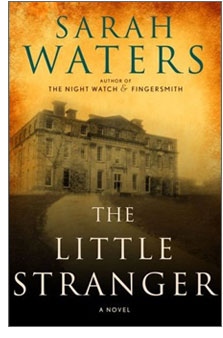
Sarah Waters latest novel, 'The Little Stranger' (Riverhead / Penguin Putnam ; April 30, 2009 ; $26.95) opens in Hundreds Hall, a rambling, impressive structure that the narrator of the novel, Doctor Faraday describes from his first visit as a ten-year old boy as, "...blurred and slightly uncertain–like an ice, I thought, just beginning to melt in the sun."
The details tell the tale in a great ghost story, moving the plot at a sub-conscious level in parallel with the greater story arc. The two intertwine and allow the writer to explore characters in an intimate yet luxurious manner. Doctor Faraday's childhood memory has been triggered by events in the here-and-now, which in 'The Little Stranger' is postwar Britain, still shell-shocked and in need of loving repair. The physical wounds of those who survived the war may have been bandaged, but the psychic wounds of a nation have not. They are fresh and powerful enough to induce visions, to affect the minds and bodies of the inhabitants of Hundreds Hall. The Ayers family, once grand, who indeed once employed Faraday's mother as a maid, are now having problems with their maids. It's not surprising that Faraday would have some issues with his present assignment.
Waters is a justly acclaimed writer whose last novel, 'The Night Watch' drew a lot of attention. She started out writing new Victoriana, including 'Affinity,' reviewed by proto-Agony Column reviewer extraordinaire Serena Trowbridge. With her latest offering, Waters finds herself in the rather interesting position of having a potential bestseller with a heavy genre fiction element. Of course, nobody would label 'The Little Stranger' horror fiction, even though it does include some genuinely frightening material. And labels, after all, are irrelevant. What matters is that 'The Little Stranger' is a gripping, ripping yarn that happens to have finely-prose and a literary emotional heft. I do think that readers who enjoy this novel should look up Phil Rickman's work, particularly his Merrily Watkins novels, starting with 'The Wine of Angels' and continuing through his latest, 'To Dream of the Dead,' which offer a similar ambience. And likewise, Rickman (and James and Nathaniel Hawthorne and Shirley Jackson) fans should seek out 'The Little Stranger.' Of course, this recommendation only goes as far as your trust in the narrator of this particular tale of reading. It's well known I'm haunted by books.
|
|
04-21-09: Warren Fahy Discovers the 'Fragment' : All Monsters, All the Time
Here be monsters.
That's what they used to put on the portions of the map if they actually had no idea what was really there.
We have a need, a desire, to fill the unknown with that which we fear. Presumably on the hope that it will remain unknown, and our fears will go unrealized. But as time has gone by, our fears have not been realized, the unknown bits of the world have been relentlessly mapped, and thus far we've found fragile and often unique island habitats, but no monsters.
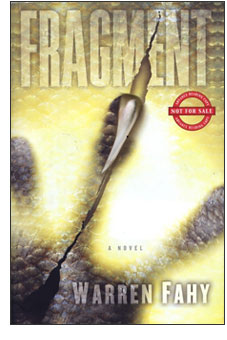
Warren Fahy's 'Fragment' (Delacorte / Bantam Dell /Random House : June 16, 2009 ; $25) suggests we've mapped but not explored that portion of the map marked "Here be monsters." It's easy enough, after all, to mark the location of a small and difficult-to-access island in the South Pacific. Such a speck may go unexplored for more than two hundred years, bearing only the name of the man who happened upon it, in this case Henders Island. But we 21st century humans are desperate for entertainment, so desperate that we'll pack a boat full of scientists — so long as they're young and attractive — and send them on a cruise with a cameraman to film a reality TV show called "Sealife." When the crew of the Trident gets a distress call in the vicinity of Henders Island, it's got to be great television; a daring rescue, perhaps, and a chance to examine a new island ecology that botanist Ellen Duckworth finds irresistible. Unfortunately, this ecology is like nothing else on earth.
'Fragment' is a cunningly conceived and entertainingly executed piece of present-day speculative fiction. When the mostly obnoxious crew of the Trident goes ashore on Henders Island, they find a world quite unlike ours. Here, it seems, enforced by centuries of isolation, a completely alternate ecosystem has evolved. Wave your hands in any direction you wish — Fahy chooses several, all thought-provoking and credible — and the result is an island covered stem to stern in utterly deadly, voracious and highly imaginative monsters.
From the get-go, humans barely stand a chance on Henders Island. Fahy bravely and rather shockingly sets up characters just long enough to have them slaughtered by critters ranging in size from dust-speck to SUV. He's smart enough to extrapolate the consequences of such a discovery, and ups the ante accordingly. He even creates a few likeable characters who are not immediately devoured by the voracious wildlife of Henders Island.
Fahy's greatest strength here, however, is the skill with which he has conceived the ecosystem and designed the monsters. Taking a cue from Stephen Gould's 'Wonderful Life: The Burgess Shale and the Nature of History,' Fahy has created a wonderfully baroque and colorful collection of critters, each and every one inimical to human life, or indeed to the rest of life on this planet. These are not aliens or lab experiments, they're the result of an alternate evolutionary path. The wildlife of Henders Island is not simply a collection of deadly creatures, it is an isolated ecology which, if introduced into the rest of the world, would surely lead to extinction of life as we know it.
Fahy effectively describes killing-machine monsters you can imagine after reading his prose, but never could have before. They're really quite unique, both in their physical attributes and in terms of Fahy's speculative science. But he's smart enough to know that the best monsters are not simply killing machines — they're characters. That's what distinguishes 'Fragment' from other monster-fests. Fahy has an interesting take on how to dispose of his characters. On one hand, he'll kill his humans without batting an eye, but his monsters get the kind of attention they might get were there really such a place as Henders Island. Let's just hope that is all remains a fragment of his imagination.
|
|
04-20-09: Anneli Rufus and Kristan Lawson Declare 'The Scavenger's Manifesto' : Save the Earth and Money in Style
I'm a discount kid. I was brought with a healthy respect for thrift, for watching my money and scouting for savings. WalMart — they're newcomers in my book. I come from the old, old school. I used to work at the Zody's in Covina, and my parents and I used to frequent White Front in Azusa, where we regularly spent weekends at the swap meet. I used to buy Roxy Music bootleg albums and cassette caddies on the cheap. And I'm proud to know that according to Anneli Rufus and Kristan Lawson, that makes me a scavenger.
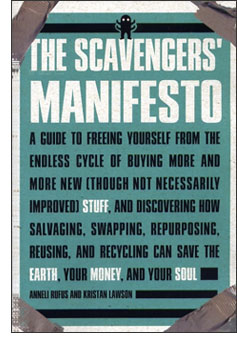
Rufus and Lawson have just released their declaration of independence, 'The Scavenger's Manifesto', (Jeremy P. Tarcher / Penguin ; March 19, 2009 ; $14.95), an entertaining and informative look at the ethos and implications of the act of "scavenging." If you think that you’re going to get an over-the-top guide to dumpster diving (and I have one of these somewhere in the stacks, but was unable to locate it), think again. 'The Scavenger's Manifesto' is a smart, funny and very thorough examination of all things pertaining to the history, morals and practice of scavenging. Just as in the average dumpster or "Free" box, there's a lot more here than you'd expect.
Rufus and Lawson are both lighthearted and methodical as they examine the act of scavenging and its implications. The philosophy, the history, the prejudices, every aspect of scavenging is explored in detail with witty prose and an acerbic, slightly skeptical eye. We learn that the bias against scavenging is both biologically and Biblically based and baseless. But Rufus and Lawson aren't hard-core extremists who are out to push an agenda. Rather, they intend to demonstrate that the lives we lead already involve the art and act of scavenging no matter what our economic status. By offering a clear-headed vision of who and what we are, they achieve an aim worthy of the word "manifesto." Informed and thus empowered, readers will learn to make the most of their scavenger-hood.
In a chapter titled "Scavenomics," they look at the act of scavenging as an aspect of the economy, and note that balance is essential. For centuries, the act of scavenging has been an unacknowledged part of the economic cycle. By understanding how re-use and recycling, thrift shopping and bargain-hunting fit into the real-world flow of cash and goods, we can get a better bead on living sustainably without having to sacrifice. In an incredibly informative chapter titled "Finding Yourself" they address the grand range of scavenging, from the CEO with a metal detector to the dumpster-diving anti-commercial starving student. They widen what we usually think of as scavenging to include shopping at yard sales and swap meets, even to the point of seeking the super-sale bins at otherwise hoity-toity department stores. It's eye-opening and fun to read.
Rufus and Lawson examine the ethics of scavenging and even issue a pre-emptive twelve commandments, aimed at improving the practice and image of scavenging. They're as simple and enjoyable as the rest of the book; "Don't scan. Don't mooch. Don't eat gross stuff." How can you not agree with such assertions? Jam-packed with useful advice and helpful perceptual shifts, 'The Scavenger's Manifesto' is perhaps the perfect book — to check out of your local library! But I'm sure they won't mind if you buy it new. After all, the easiest advice to ignore is your own.
|
|
|
|
|
|